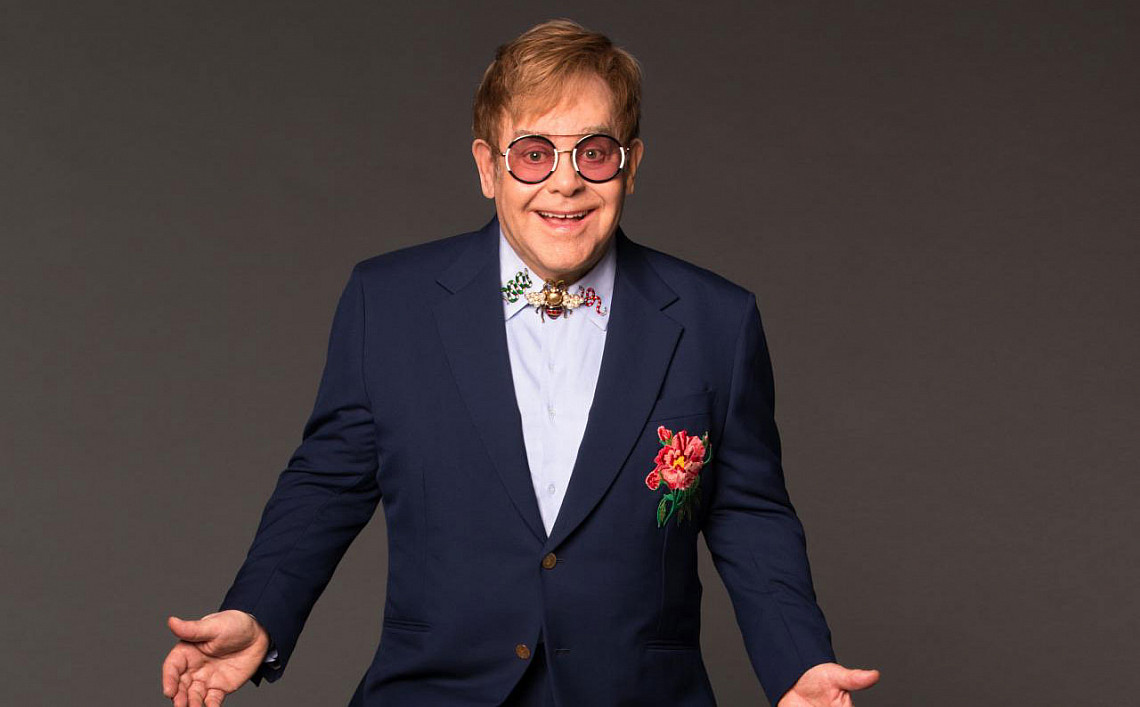
 Photo: Greg Gorman
Elton John first cracked the Hot 100 in 1970 when "Border Song" placed at #92 (it dropped off the chart the following week). For the next 30 years, he had at least one song on the chart every year, an absurd streak that survived throat surgery, rehab and disco. He was 23 when it started; 53 when it came to an end. The closest anyone has come to this record is 23, a mark set by Elvis Presley with a run from 1956 to 1978 (the year after he died), and equalled by Madonna from 1983 to 2006.
Here, we break down the songs of this streak. Most years, he had more than one song on the chart, in which case we highlight the biggest hit. Elton wrote the music for all but one of these, collaborating with three different lyricists, but mostly Bernie Taupin. Also amazing: On his farewell tour (which runs through 2021), only about half the songs in his setlist are on this list; favorites like "Tiny Dancer" and "Levon" were never big hits.
How did he do it? For one thing, he kept putting out new music, never going more than two years without an album during the run. Billy Joel, on the other hand, hasn't released any new music since 1993, except for one classical album. Also, he had some help, especially from George Michael, who sings on three of the songs on this list.
Here then, are the songs of Elton John's 31-year winning streak.
1970 "Border Song," written with his new lyricist Bernie Taupin, gives him his first chart hit when it comes in at #92 in August. In a sign of the John/Taupin songwriting prowess that makes this streak possible, Aretha Franklin covers the song, taking it to #37 in December.Here, we break down the songs of this streak. Most years, he had more than one song on the chart, in which case we highlight the biggest hit. Elton wrote the music for all but one of these, collaborating with three different lyricists, but mostly Bernie Taupin. Also amazing: On his farewell tour (which runs through 2021), only about half the songs in his setlist are on this list; favorites like "Tiny Dancer" and "Levon" were never big hits.
How did he do it? For one thing, he kept putting out new music, never going more than two years without an album during the run. Billy Joel, on the other hand, hasn't released any new music since 1993, except for one classical album. Also, he had some help, especially from George Michael, who sings on three of the songs on this list.
Here then, are the songs of Elton John's 31-year winning streak.
1971 "Your Song" is his first big hit, climbing to #8. It appeared on Elton's second album, released in April 1970 around the same time it was included on Three Dog Night's album It Ain't Easy. That summer, Elton was buzzed about as a budding superstar, earning high praise for his run of shows at The Troubadour in Los Angeles. "Your Song" was released as a single in October and made a steady run, reaching its peak in January 1971 and launching him to stardom.
1972 "Rocket Man" shoots to #6. We were still sending men to the moon at this time (Apollo 16 was the latest mission), but the lyric was inspired by a 1951 Ray Bradbury short story called The Rocket Man, about a child whose father is an astronaut. "Rocket Man" became Elton's sobriquet and the title (condensed to Rocketman) of his 2019 "fantasy musical."
1973 "Crocodile Rock" is Elton's first #1 hit. A '50s throwback with a falsetto la la la la la chorus, it's a classic case of lyrical dissonance, with an uplifting melody but a lyric that tells the story of a guy who is now lonely and irrelevant, dreaming of the days when he and his girl Suzie (who left him for some foreign guy) danced to the Crocodile Rock.
1974 "Bennie And The Jets" is his second #1. This one is a salute to glam rock, a look that suited Elton even if the sound didn't. In the song, Bennie And The Jets are a futuristic all-female band.
1975 Elton lands three #1 hits this year: "Philadelphia Freedom," "Island Girl" and a cover of The Beatles' "Lucy in the Sky With Diamonds." "Island Girl" was the biggest hit of the bunch with three weeks at the top, but songs about Jamaican prostitutes don't always age well, and this one has withered (Elton hasn't played it live since 1990). "Philadelphia Freedom" has a better origin story: The title is a nod to Elton's friend Billie Jean King, who at the time was coaching a professional tennis team called the Philadelphia Freedoms, making her one of the first women to coach men at the professional level.
1976 "Don't Go Breaking My Heart," his chirpy duet with Kiki Dee, gives Elton his sixth #1. He has done the song with other duet partners over the years, including RuPaul and Miss Piggy.
1977 The beginning of a fallow period for Elton John, his biggest hit is "Bite Your Lip (Get Up And Dance!)" at #28. Burned out and drifting away from Taupin, he doesn't release an album this year.
1978 "Part-Time Love" (#22) is his first hit without Bernie Taupin, whose services are now being used by Alice Cooper. It's from his album A Single Man, where he teamed with lyricist Gary Osborne. In their partnership, Osbourne wrote the words to Elton's melodies, in contrast to Elton writing the melodies to Taupin's lyrics. Elton also dropped his longtime producer Gus Dudgeon for this album and used a new set of musicians.
1979 At #9, "Mama Can't Buy You Love" is the first freshly written hit song Elton didn't co-write. Written by the team of Leroy Bell and Casey James, it was recorded in 1977 when Elton teamed with producer Thom Bell to record an album flavored with Bell's Philadelphia soul sound. Only three songs were recorded, and they didn't emerge until 1979 when Elton's record company put them out on an EP called The Thom Bell Sessions '77. Released as a single, "Mama Can't Buy You Love" got Elton back to the Top 10 and also rose to #1 on the Adult Contemporary chart.
1980 "Little Jeannie," again with Osborne on lyrics, goes to #3.
1981 One of his more obscure hits, "Nobody Wins," makes #21. Using the melody from a French song called "J'veux d'la tendresse" ("I Want Tenderness"), Osborne wrote lyrics based on conversations they had about Elton's father, who never once saw him perform. Elton played the song live only a handful of times - it's not easy to pull off on stage because it used a drum machine.
1982 Reunited with Taupin, "Empty Garden (Hey Hey Johnny)" (#13) is their tribute to John Lennon, who was murdered in 1980. Lennon's last concert appearance came at an Elton John concert in 1974 when Elton brought him on stage as a special guest.
1983 "I'm Still Standing" goes to #12. It's a symbol of the unbreakable Elton, but Bernie Taupin had something different in mind: a kiss-off to an ex-girlfriend. Also notable as Elton's first MTV hit.
1984 "I Guess That's Why They Call It The Blues" hits #4. Taupin regrets the lyric, "I simply love you more than I love life itself," as the whole "I'd die for you" thing is kind of cliché and not true to life.
1985 "Wrap Her Up," with guest vocals by George Michael, makes #20. In the song, they sound like horndogs, going through a list of women they want to wrap up and take home. At the time, Elton was married to a woman and Michael was 13 years away from coming out as gay.
1986 "Nikita," also with guest vocals by George Michael, hits #7. It's a Cold War tale of a Westerner separated from his love, who is on the other side of the Berlin Wall in East Germany.
Bernie Taupin wrote the lyrics for two #1 hits that had nothing to do with Elton John: "We Built This City" by Starship and "These Dreams" by Heart, both collaborations with Martin Page.
The live "Candle" was recorded on December 14, 1986 at Elton's last concert before having throat surgery that sidelined him for much of 1987.
1988 The kiss-off classic "I Don't Wanna Go On With You Like That" goes to #2. Part of his Reg Strikes Back album, it's a comeback of sorts after a rough year where he recovered from surgery, battled drug addiction and separated from his wife. To mark a new beginning, he gives up his outlandish stage costumes, along with some of the more garish items in his wardrobe, in an auction that rakes in $8 million.
1989 "Healing Hands," from the Sleeping With The Past album, hits #13. The John-Taupin team can be ruthlessly efficient: they wrote every song for the album over a four-day stretch in Denmark.
1990 "Sacrifice," also from Sleeping With The Past, goes to #18. Lyrically, it takes on a tough topic: being trapped in a marriage that isn't working.
1991 "You Gotta Love Someone" peaks at #43 the first week of 1991, his only chart appearance of the year. In the summer of 1990, he checked into a hospital to deal with a raft of issues that had built up and calcified over the years: bulimia, cocaine addiction, alcoholism, megalomania (he recalls looking out a window one day and saying, "It's too windy. Can someone do something about it?"). Over the next year, he takes it easy, making few public appearances (mostly charity events) and focusing on his health and sobriety.
"You Gotta Love Someone" was one of four songs he recorded for the compilation To Be Continued... before going in for treatment.
1992 George Michael again. His duet with Elton on "Don't Let The Sun Go Down On Me" goes to #1, one better than when it was first released in 1974. Elton was a special guest at two George Michael concerts in March 1991 where they did the song as a duet that was later compiled into the single. The first time they performed it was in 1985 at Live Aid when Michael came on stage during Elton's set.
1993 "Simple Life," from his 1992 album The One, makes #30. His life was anything but simple, but under control after getting his addictions and eating disorder in check.
1994 Elton roars to #4 with "Can You Feel The Love Tonight" from The Lion King. Written with lyricist Tim Rice, it won the Oscar for Best Song, beating out two other songs they wrote from the film that were also nominated: "Circle Of Life" and "Hakuna Matata."
1995 Back with Bernie Taupin, "Believe," from the album Made In England, goes to #13. Post-Lion King, Elton is once again king of the jungle (or at least a mighty predator).
In his native UK, Elton's streak is 29 consecutive years on the singles chart, starting in 1971 with "Your Song" and ending in 2000 with "Written In The Stars." In the '70s he was much more popular in America, where he had five #1 hits before "Don't Go Breaking My Heart" went to the top in both the UK and US.
1997 "Candle In The Wind '97," with new lyrics written in tribute to Diana, Princess of Wales, goes to #1, where it stays for 14 weeks. It's far and away the best-selling single in UK history, and in America, it's certified as selling 11 million, the most since the RIAA started keeping track in the '50s ("White Christmas," released in 1942, probably sold more). These staggering numbers were driven by Elton's performance of the song at Diana's funeral, which an estimated 2.5 billion tuned in to watch. The single, produced by Sir George Martin (Elton was knighted the following year), was a charity effort that raised about $62 million for the Diana, Princess of Wales Memorial Fund.
Elton was good friends with Diana and many of the other royals; when she died on August 31, 1997, he asked Taupin to re-write the lyric for her funeral. He did, with the first line going from "Goodbye Norma Jean" to "Goodbye England's rose." The funeral was the only time Elton performed this version of the song.
1998 A few weeks after Diana's funeral, Elton releases a new album, The Big Picture. The single "Recover Your Soul" hits #55 in May 1998.
1999 "Written In The Stars," a duet with LeAnn Rimes, goes to #29. Elton wrote it with Tim Rice for a new version of the musical Aida, which opened on Broadway in 2000. They earned a Tony Award for the score (Elton still needs an Emmy to go EGOT).
2000 Written with Tim Rice and longtime Madonna hitmaker Patrick Leonard, "Someday Out Of The Blue," from the animated film The Road to El Dorado, reaches #49.
2001 "I Want Love" stalls at #110, ending Elton's spectacular streak. He's landed a few more Adult Contemporary hits, but hasn't been back to the Hot 100 since.
May 25, 2019
Elton John Songfacts entries
Interview with Peter Asher
More Song Writing