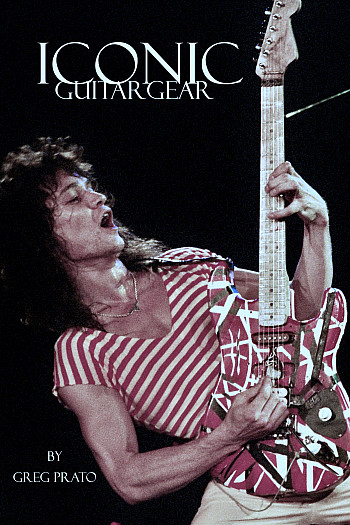
 Renowned rock guitarists and experts discussing their preferred "tools of the trade" serves as the basis for my 36th book overall, Iconic Guitar Gear (which is available in paperback, hardcover, Kindle, and soon, audio). For each guitarist in the book, the set-up is simple – an intro paragraph kicks things off, followed by quotes detailing or discussing instruments, amplification, or effects (and in some cases, all three).
Over 150 guitarists are featured in the 319-page book, including Jimi Hendrix, Eddie Van Halen, Randy Rhoads, Stevie Ray Vaughan, Brian May, Tony Iommi, Jimmy Page, Jeff Beck, John Lennon, Kurt Cobain, Kim Thayil, Johnny Ramone, The Edge, Gary Moore, Alex Lifeson, Yngwie Malmsteen, Steve Vai, Dimebag Darrell, Zakk Wylde, Billy Sheehan, Les Claypool, and Mike Watt... among many others.
Below are five exclusive excerpts from the book, focusing on the equipment of Randy Rhoads, Steve Vai, The Edge, Kurt Cobain, and Bill Gould.
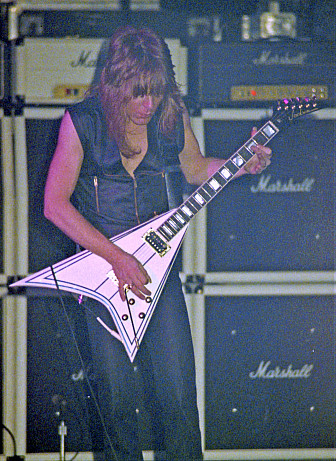 Randy Rhoads with his offset Flying V. Photo by Bill O'Leary. Check out more of his rock photos.
Randy Rhoads (Jackson Concorde)
Brad Tolinski [author of Eruption: Conversations with Eddie Van Halen and Light and Shade: Conversations with Jimmy Page, former Guitar World editor]: I think Randy felt like it [a Karl Sandoval Flying V with a polka dotted design] looked too imitative of a standard Flying V – which it did. It had two humbuckers in it, but except for the whammy bar it was essentially a Flying V. So, Randy decides he is going to refine the design, and he comes up with this other idea – of doing an offset V. Which I didn't know this until recently – the asymmetrical V shape was inspired by the Gibson Explorer. It doesn't really look like it, but he liked the offset design with the wing being bigger on the top. So, I think he decides to call it the "Concorde" because the Concorde plane was new around that time, and he flew from Britain to America on it. It represented the future, it was a sleek futuristic-looking airplane and he wanted his guitar to reflect that. So, he has this thing that looks sort of like a jet taking off – his guitar. And he takes a little bit from the Explorer. But Randy essentially draws the whole thing out.So, he goes back to Wayne Charvel's workplace and Wayne's gone – he sold it to a guy named Grover Jackson. And Sandoval is not there, either – he's gone. So Randy just gets into this conversation with Grover Jackson, and Grover says, "Well... let me do it." And of course, Grover Jackson goes on to create Jackson Guitars and is sort of a legend in his own right. But these guitars look different, but they are essentially modeled on his cream-colored Les Paul, which was his main instrument. They were mahogany bodies, they have two humbuckers like Les Pauls, they have the neck-thru design. They're very much "Gibson instruments." Which even though he's ripping off Eddie a little bit, I find it interesting that he's also trying to set himself apart. He's trying to make his own statement. He's not doing just the one humbucker in the rear – he's got both in there. He's not aping a Fender body shape – he's trying for something new, something original, something different.
Steve Vai (floating tremolo bar)
Steve Vai [Frank Zappa, David Lee Roth, Whitesnake guitarist]: One of the big innovations – and I'm OK using that word, because it was – was the floating trem. I just instinctually wanted to pull way up on the bar, and there were no guitars that did that. And this was just when Floyd Rose was a newbie, y'know? I just took a hammer and a chisel, and banged out where the block is, and all of a sudden, the bar is going up a fifth.So, when I had Kuni [Kunio "Kenny" Sugai, creator of Performance Guitars] make these guitars, they all had these cavities. I had four pre-Jems made, but, they were the Jem. I still have one of them. When I joined Dave Roth's band... and that's one of the reasons why I had these guitars made, because I was going on tour with a big, huge rock band, and I needed to be equipped. So, I thought these guitars were great for me. They were perfect – DiMarzios, and everything I wanted. I was like, "OK! This is my joy. I don't know if anybody else would be interested in something like this."
I didn't even think about stuff like that – endorsements. I always stayed away from endorsements, because I never wanted to be locked in. And I didn't know if I'd ever find companies who would give me the service I really needed. But when I joined Dave Roth, a lot of companies wanted to give me the service I needed. And they all wanted to make the Jem. [Ibanez would eventually make the Jem line of guitars for Vai.]
The Edge (Vox AC30 amps + effects)
Matt Pinfield [radio host]: The Edge's sound is one of unconventional beauty – as his quest for using the right amount of space between non-consecutive accented notes, and the use and stretching of the digital delay through his favorite Korg SDD-2000 up through the masterpiece that was The Joshua Tree. Rarely do bands or artists create two masterpieces back to back, as the Edge and U2 did on their next studio album, Achtung Baby, pushing even further into sound experimentation. At that time, the Edge [who early on, was often spotted playing either a Fender Stratocaster or a Gibson Explorer] upgraded to the Korg SDD-3000 – and has pretty much used it ever since. The AC-30 amps he uses with the two 3000's makes for an even sharper focus on the delay.Kurt Cobain (Univox Hi-Flier Custom; Soundtech, Randall RG-120 Commander amps + effects)
Chad Channing [Nirvana drummer]: Kurt used a DS-1 Boss distortion pedal which he later upgraded to the DS-2, and for a while he played through 2x10 Soundtech cabs with a Randall head [Randall RG-120 Commander Amp]. Kurt of course did play a Univox [during the Bleach era, he played a 1960s Univox Hi-Flier Custom] and Kurt also once bought a blood red Jazzmaster but decided not to convert it to a lefty – so he gave it to me. I later sold it to a friend of mine.Bill Gould (Aria Pro II Integra, Zon Sonus)
Bill Gould [Faith No More bassist]: I met Joe Zon at NAMM in 1992, and he said he had a bass for me. I played it once live when I broke a string on my Aria [Gould played Aria basses from 1983-1992], and never looked back. I believe [Gould's signature Zon bass] was created in 2018. It was based upon the bass that Joe made for me in 1992, however, with the option of an onboard parallel drive that would remove the need for a drive pedal. I think it worked out nicely. First of all, my basses are handmade, so they are really unique to many others just by definition. They have a really nice, stable, ultra-low end to them, and the added parallel drive is something that was very novel at the time (maybe it still is, but I'm not shopping for a new bass so I wouldn't know!).June 28, 2022
Order Iconic Guitar Gear (and check out more excerpts by using the "Look Inside" feature on the page) on Amazon
Further reading:
Interview with Steve Vai
Interview with Joe Satriani
Interview with Bill Gould
Excerpt from Greg's book Shredders
The 100 Greatest Rock Bassists
Fact or Fiction, U2
The Stories Behind 10 Unexpectedly Great Guitar Solos
More Song Writing