Led Zeppelin made their big impact in America opening for Vanilla Fudge, and although Fudge drummer Carmine Appice tells us that stories of Zep "blowing away" their headliners were fabricated, they fared much better than Jimi Hendrix, who suffered the indignity of getting booed by Monkees fans.
Most bands have opened for someone at one point or another, and because there are slivers of time when the Strawberry Alarm Clock is a bigger deal than Lynyrd Skynyrd, we all have a story of seeing some soon-to-be-famous artist when they were warming up the crowd for a headliner they would soon eclipse (Alanis Morissette > Vanilla Ice). Things seem to work best when the opener is a lite version of the headliner, but some bands see it as a way to give a newer act a shot at stardom (The Rolling Stones with Living Colour), and others pick openers they want to hear, which is how you get B.B. King or the Pixies opening for U2 (more on that later) and the Ramones opening for Pearl Jam. Prince even manufactured his own opening acts, putting together The Time and Vanity 6 for his 1999 tour.
These short sets that play while the audience is getting settled are usually uneventful and given only passing attention, but there are times when the contrast between opener and headliner is so distinct, we'll never forget it. Feel free to post your own in the comments below, but these are our selections for the most incongruent opening acts.
Most bands have opened for someone at one point or another, and because there are slivers of time when the Strawberry Alarm Clock is a bigger deal than Lynyrd Skynyrd, we all have a story of seeing some soon-to-be-famous artist when they were warming up the crowd for a headliner they would soon eclipse (Alanis Morissette > Vanilla Ice). Things seem to work best when the opener is a lite version of the headliner, but some bands see it as a way to give a newer act a shot at stardom (The Rolling Stones with Living Colour), and others pick openers they want to hear, which is how you get B.B. King or the Pixies opening for U2 (more on that later) and the Ramones opening for Pearl Jam. Prince even manufactured his own opening acts, putting together The Time and Vanity 6 for his 1999 tour.
These short sets that play while the audience is getting settled are usually uneventful and given only passing attention, but there are times when the contrast between opener and headliner is so distinct, we'll never forget it. Feel free to post your own in the comments below, but these are our selections for the most incongruent opening acts.
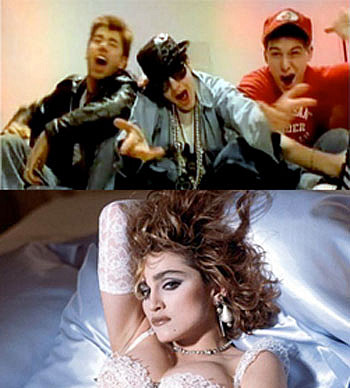
Beastie Boys Opening For Madonna
Say what you will about Madonna, but she's managed to stay relevant through decades in the cutthroat world of pop music. Madonna was still topping charts before and after Britney shaved her head, Christina got fat and Tiffany started working at Golden Corral. She has even survived repeated identity theft c/o Lady Gaga.
But in 1985, Madonna was Gaga, Spears, and everyone else rolled into one. She was nigh on unstoppable, having released her second album, Like a Virgin. "Virgin" would go on to sell over 12 million copies thanks to songs like the title track and "Material Girl." Madonna was just 25 and on top of the world. That same year, while touring, she chose the Beastie Boys to open for her on the Like a Virgin tour. This was before "(You Gotta) Fight for Your Right (to Party)" got them on MTV and Licensed To Ill became the first #1 rap album. They were a vaguely-known rap trio with a cult following - kind of like the Black Eyed Peas before they had Fergie.
Predictably, things didn't go so well. On nearly every date the Boys were booed throughout their half-hour performances and they would respond by swearing at the audiences and making lewd gestures. Madonna knew that she and the Beastie Boys weren't the most compatible groups in the eyes of her adoring throng, but she was a personal fan and enjoyed watching the boys put on a hell of a show, despite receiving no warmth from the audience.
The tour would go on to gross over 5 million bucks thanks to Madonna's clever micromanagement (she sold crucifix earrings and fingerless gloves so middle school girls could rock her "boy toy" look) but many critics lambasted the show, saying that it was overblown and that the Beastie Boys were simply a bad fit. But if you think about it, are Madonna and the Beastie Boys so different? Both have been successful for decades because of brilliant image reinvention. The Beastie Boys were once foulmouthed rappers and ended up being lauded for their political activism. Madonna has been everything from a Material Girl to a movie star to a Kabbalah practitioner with a British accent. Nobody could have known it at the time, but Madonna and the Boys were perhaps not as incongruous as one might think.
Jimi Hendrix Opening For The Monkees
In 1967, the popularity of the Monkees was at full capacity. Their TV series had debuted just a year earlier and they were poised to bring their fame to the next level with an American tour. But what band or performer could they choose to open for them? There weren't any other knockoff Beatles around: Oasis was decades away and Badfinger hadn't yet formed. And so it was that the Monkees had to choose a different kind of act. Enter Jimi Hendrix.
Jimi Hendrix, like the Simian Superstars, was also on his way to international fame and glory. But in 1967 he was still only fairly well-known. He had just recently made waves in Monterey for lighting his guitar on fire but he had yet to release a chart-topping hit. The Monkees, however, knew full well who Hendrix was. They had seen him play guitar with his teeth and had listened to an early cut of "Hey Joe" thanks to mutual friend John Lennon.
But still, the Monkees were a decidedly pop group with a decidedly young, pubescent, white female audience. Hendrix was a hard rocker who attracted an older, usually more male clientele. Nobody had any fantasies about the two acts being a good match, though. Even band members Mike Nesmith and Peter Tork admitted that they simply wanted the chance to see Jimi shred every night, not caring a whit if he was a good fit.
He wasn't a good fit, though, and the young white audience couldn't make sense of "Foxy Lady." In city after city Hendrix tried and failed to connect to people who thought Purple Haze was a mod fashion label. He would be greeted by boos and chants of "We want the Monkees" and at times he would respond with a middle finger or two. But during the tour, Hendrix finally started receiving the radio airplay that he was seeking. This allowed him to leave the Monkees' tour and headline his own show after seven painful dates.
Jewel Opening For Neil Young
It isn't that Jewel and Neil Young are especially disparate in terms of music. They both pen most of their own tunes and they both grew up at roughly the same latitude; Jewel in Alaska and Neil in Manitoba. Also... well, actually that's about all they have in common.
Neil Young was born without laurels to rest on, weaving throughout his illustrious career into different musical styles such as folk, rock, and grunge. In many cases, he jump started entire new forms of music or brought them to new levels (his album Ragged Glory is a good example). Jewel, on the other hand, used her rugged Alaskan upbringing as a publicity tool (the story of her sleeping in a van was an even bigger hook than the chorus to "You Were Meant For Me"), and adapted to the prevailing trends. She emerged at a time when female acoustic singer-songwriters like Joan Osborne and Sarah McLachlan were all the rage and later jumped on the country music bandwagon after Shania Twain opened the floodgates. But in 1996, the two of them were brought together when Jewel was asked to open for Young on his tour.
This was actually Jewel's first time performing in front of a large crowd. Her massively successful Pieces Of You album hadn't yet exploded, though "Who Will Save Your Soul?" was starting to gain a bit of a foothold. To make matters worse, Young was touring on a recent album with sometimes-bandmates Crazy Horse, meaning that this was to be a very electric show. Jewel's acoustic songs, meant for intimate environments, didn't go over too well for an audience waiting raptly for some electrical dissonance.
Still, Jewel did better than expected, garnering some acclaim while performing venues as historic and huge as the Garden. Her album would go on to sell over 12 million copies, too. Jewel never matched the sales of her debut, but she did go on to headline her own tours and many of them received warm reviews. So while she and Young might have been incongruous on the same bill, the young songstress no doubt benefited greatly from the wisdom of the Godfather of Grunge.
Justin Timberlake Opening For AC/DC and The Rolling Stones
In 2003 Canada was abuzz with SARS. The disease had broken out in Toronto and it threatened to put a damper on the rising fortunes of one of the fastest-growing cities in the world. Like killer bees and flesh-eating bacteria, the SARS "epidemic" was blown way out of proportion by a news media that earns its keep by preying on human fears. But SARS was indeed hurting tourism and the city knew it needed an exciting event to lure in wary visitors. Its plan was a good one: A giant, balls to the wall outdoor concert with over half a million in attendance, with headlining acts Rush, AC/DC and The Rolling Stones. Needless to say, this was going to be big. And what did the town decide to call the concert? SARSFest. It's kind of like if Hiroshima renamed itself "Mutationville."
Either way, the show was a rousing success. But at its outset this fact wasn't quite set in stone yet: Opening for the headlining groups, some of the greatest-selling acts of all time, was Justin Timberlake. Now, Justin is no slouch now and he wasn't then, either. By 2002, Timberlake had left 'N SYNC while they were still among the most popular acts around. That same year Justin released Justified, his solo effort, to rave reviews and multiplatinum status. Also, this was before the infamous "wardrobe malfunction" event, AKA Justin grabbing some Jackson boob. So either way, Justin was a huge, very famous performer.
But he wasn't the Stones. Nor was he AC/DC. And Rush? If you've ever met a Rush fan, you know how hard it can be to steer the conversation away from Neil Peart (you know you're dealing with a hardcore fan if he pronounces it the right way: "Peert"). So Justin, poor Justin, was simply outclassed and outmatched. He was too young, too fresh, too R&B by way of slick pop production. And the fans were impatient and testy, which is said to be an early symptom of the onset of SARS. They began pelting Justin almost immediately with water bottles, assorted items and, perhaps most embarrassingly, muffins. The barrage lasted throughout the shortened set. Timberlake, for his part, didn't take the muffin-bombing personally. He admitted that, if he were there to see the Stones and AC/DC, he'd have taken part in the Spunkmeyer Splattering. When the Stones took the stage, Mick made a point to bring Justin out to join him in a duet of "Miss You." While no muffins were thrown, you can hear the unmistakable sounds of discontent when he appears.
Radiohead Opening For Alanis Morissette
Foisting Radiohead on Alanis Morissette's concertgoers was asking a lot, but she thought they could handle it (maybe thinking it ironic). Morissette was a big fan of the eccentric British rock band, known at the time for their morose 1992 debut single, "Creep." Their obtuse, guitar-saturated songs are a far cry from Morissette's ear-pleasing and highly understandable tunes, the ones that made Jagged Little Pill the most popular album of the era.
This pairing took place for 13 shows in August 1996. Jagged Little Pill had been popping in and out of the #1 spot on the Billboard 200 since October 1995; it popped back in midway through this run.
Radiohead is challenging enough when you've heard their music, but they used their sets to try out new songs for their upcoming album, which is like watching an avant-garde foreign film without subtitles. Alanis fans hoping for some snappy numbers instead got unrefined oddities like "Let Down" and "Paranoid Android."
"My main memory of that tour is playing interminable Hammond organ solos to an audience full of quietly despairing teenage girls," Radiohead guitarist Jonny Greenwood told Rolling Stone.
That next Radiohead album was OK Computer. Lavished with praise from critics, it ended up on most "Best albums of 1997" lists and put up huge numbers around the world, including America, where it sold in excess of 2 million. Other legs of the Jagged Little Pill tour used Our Lady Peace and K's Choice as opening acts - certainly more compatible, but a lot less interesting.
Stevie Ray Vaughan Opening For The Moody Blues
1983 was a big year for Stevie. He was busy toiling away at what would become perhaps his finest hour, Texas Flood. Earlier that year, Vaughan was approached by David Bowie as a possible opening act. It fizzled, and that year saw Vaughan opening instead for the Moody Blues.
In many cases, the band or performer that is opening for the established act is expected to get it over with quickly so that the headliner, the act that everyone really came to see, can get on with the show. But Stevie didn't get the memo, nor did the fans of the Moody Blues. In many dates during the concert run, the fans would actually demand that Vaughan keep performing. Remember that a guitar player of this caliber, with his otherworldly Texas blues abilities, hadn't been seen in quite some time. As Stevie would dazzle the audience at each show with his Hendrix-inspired gimmickry and downright phenomenal shredding, more and more buzz began to swarm around the Bolero-hatted prodigy. The Moody Blues, by comparison, started to seem like dinosaurs. They were touring to promote their 11th album, called The Present. In truth, the album is not bad by any means but it didn't sell well at the time. To this day it is one of the band's most overlooked efforts.
At any rate, The Present started to look like The Past when the Moody Blues would enter the stage after Vaughan left it. Stevie's astonishing fretwork was a far cry from the more dour and bland Moody Blues sound. Some audience members would even shout for Stevie to come back to the stage. This was a rare reversal on the traditional way of things; instead of the opener being booed so that the real act could go on, the headliner was losing ground to the upstart.
Nine Inch Nails Opening For Guns N' Roses
Nine Inch Nails brought industrial music out of the warehouse and into the light with their debut album, Pretty Hate Machine. Released in 1989, it earned the group a spot on the first Lollapalooza Tour in 1991 and proved especially popular in Europe, where "Head Like A Hole" made the singles chart.
On their Use Your Illusion tour, which ran from May 1991 to February 1993, Guns N' Roses used at least a dozen opening acts, including Skid Row, Faith No More and Motörhead. They stepped out of the metal comfort zone with Blind Melon and Smashing Pumpkins, but the industrial thumps of NIN were a stretch for fans of GNR. Trent Reznor leaned into it. "Here we are on the biggest ever tour and you've never heard of us," he told the press. "We're some synth fa--ot band opening for a heavy rock band. I have to go out with that attitude."
In 2012, Reznor recalled the shows as some of the worst ever for Nine Inch Nails, telling Q the audiences were "hostile" and "moronic."
"They didn't want was some homo-looking dudes playing noisy synths and they made that very clear to us," he said.
Reznor says he learned something from the experience very few people know: Axl Rose loves the Pet Shop Boys.
Creed Opening For Metallica
Creed plays rock music. Metallica plays rock music. What could be so incongruent about the two? Well, for one, Creed was known for making radio friendly by-the-numbers rock with varying levels of Christian undertones. Metallica is thrash metal with varying levels of AntiChristian undertones.
But in 1998, Creed was arguably bigger than Metallica. Not in the grand scheme of things, of course, seeing as Metallica is Metal Royalty, but in the up-to-the-minute pop world, Creed was trending higher. That year, Metallica released Garage, Inc., a rather good covers album that showed an impressive range for the already aging rockers. The album went on to go platinum twice over. But during that time Creed was in the midst of a rather astonishing streak of four multi-platinum albums in a row - one of which went diamond. The astonishing part is not that it was during a time when Napster was negatively effecting album sales and the CD industry was beginning its decline. It's astonishing because Creed isn't really all that good. But they had their moments. The song "Higher" stayed on top of the charts for 17 weeks, breaking records left and right.
But Creed was opening for Metallica, and not the other way around. A Metallica show is unique in that its audience consists primarily of Metallica fans. Not heavy metal fans, though there is of course an overlap there. No, Metallica fans are another breed altogether. Often, Metallica fans find it futile and useless to discuss music that isn't directly related to Metallica. And for their part, Metallica has often been kind to their fans by choosing opening acts or tourmates that offer at least some level of Metallicaesque sensibility. To pay back the band for its kindness, many Metallica fans have been more than gracious as they sat through the various openers throughout the decades of the band's fame. But Creed was something else altogether. At each date, Scott Stapp would sing his Top 40 hits that were already becoming overplayed on the radio and on movie soundtracks. The audience rarely responded with excitement or glee, but it is to their credit that they never physically harmed him. In truth, booing was about as bad as it got.
The Replacements Opening For Tom Petty
In 1989 Tom Petty was close to entering his third decade of fame. The Replacements, however, were only a few years past their breakthrough album Let it Be and just a couple years before their breakup. 1989 was about the peak of their middling amount of fame, though they would go on to influence the alternative boom that made the 1990s so much more enjoyable musically than both the decades before and after.
But hearing the Mats was nothing like seeing them, especially in their early years. Often performing drunk and doped up, the band had an energy that was way more manic than anything Petty could offer or his fans could take.
Some credit the tour with Petty as the straw that broke the camel's back, and it surely didn't help matters. The previous year, original member Bob Stinson was fired, as well as manager Peter Jesperson. Chris Mars would also leave the following year. Much of this had to do with lead singer and frontman Paul Westerberg. Westerberg, who was also the principal songwriter, was leaning toward a more melodic sound, which is quite evident if you track his solo career after the breakup. Bob was more of a drinker and drug user and, sadly, he died a mere five years after the breakup from complications related to a lifetime of alcoholism and drug addiction.
A couple years later The Replacements would tour Europe opening for Elvis Costello, a much more appropriate pairing. But the performances opening for Petty were the image of a band that had just fallen over the threshold. By the time they opened for Costello, the band was already written off by everyone, including the band itself.
Grandmaster Flash Opening For The Clash
By the time 1981 came around, The Clash was already dubbed "the only band that matters." Their incredibly influential album London Calling had made it stateside the previous year. Their radio hit "Rock the Casbah" was still a year away, and the rudeboys were well known for putting forth cutting-edge music. It wasn't surprising that the album Sandinista featured several songs that were heavily influenced by hip-hop. "The Magnificent Seven" in particular was almost a tribute to the stellar Brooklyn proto-rap scene where they had witnessed acts like Grandmaster Flash and the Treacherous Three.
That same year, the Clash came up with the bright idea to have Grandmaster Flash open for them. By all logic this should have worked - though the Clash are widely considered a punk band, their body of work has always been predominantly influenced by reggae, dub, and ska. The black influence on their music, particularly in Strummer's tracks, should have meshed perfectly with Flash and the Furious Five. The Clash's socialist leanings and revolutionary ideals also fit wonderfully with the social messages expressed in Flash's hits like "Freedom" and, later, "The Message." Also, Sandinista was heavily influenced by turntable work, one of the innovations that Flash brought to the mainstream.
But despite the seeming similarities and the lyrically pleasing Flash-Clash moniker, this pairing was a bust. The Clash invited Flash and the Five to open for them at Bond's in Times Square, later the site of Tower Records. Almost immediately things started going downhill. First the sound system broke down. Then, when Clash fans saw that their beloved band seemed to be a different skin color, they responded by pelting cups and beer cans at Flash and the Five, giving them a reason to be furious. Remember, too, that this was in New York, Flash's hometown. When The Clash finally took the stage, a noticeably angry Mick Jones berated the audience. He said, "What's wrong with you?" and then made a point to sing the Flash-influenced "Magnificent Seven." It was a bit surprising for all involved that Clash fans, a group that often boasts about their open-mindedness and tolerance, were so decidedly intolerant of the progenitors of what is today one of the most popular music genres in the world. And Flash was a lot better than most of today's hip-hop acts. Maybe if Blondie had been rapping to them things would have gone more smoothly.
The Pixies Opening For U2
Much like the Monkees chose Jimi Hendrix to open for them not out of compatibility but out of artistic respect and awe, Irish rockers U2 selected the Pixies as their opening act for their Zoo TV tour in 1992.
The Pixies are hard to really nail down; most people have spent a lot more time reading about them than listening to their music, and that's because every music writer has something to say about the Pixies. Some say that they were the progenitors of emo music with their inventive musical style. They championed the almost bipolar style of music that swerves from peaceful picking to overwhelming walls of electric bliss. But this same music also influenced grunge musicians like Nirvana. There are those who say that the Pixies were the definitive band of the hardcore genre. Still others see the Pixies as the main influence of alternative music, the genre that would come to define the mainstream just a few years later, when grunge would fizzle out because all the people who played it were dead. Either way, one thing everybody could agree on was that the Pixies influenced and were influenced by the idea of rock music being bloated, overproduced, bland, and staid. Sort of the way people looked at U2 during the '90s.
By the time alternative rock was gaining steam in the underground, U2 was already over a decade old and were getting some negative press for their image. Their album The Joshua Tree had made them international superstars five years earlier and a backlash was already looming against their bombast. After all, this was the disenfranchised, cynical, Reality Bites '90s. It was then that U2 started becoming a bit more experimental. They released Achtung Baby, an album that rode the coattails of a newer, more esoteric form of music. When the time came to tour for the album, U2 knew right away that they could increase their credibility by traveling around the country with a band that had its finger on the pulse of the new generation of rock music.
But the Pixies were always known as underground darlings who eschewed the rock star ideology. This is what made them so incongruent with the Zoo TV tour. With its incredibly expensive props and sets, the tour represented every negative aspect of "Old" rock except for the music, which strove to be a bit more alternative. The worst part, though, was that Bono started creating different "characters" and personas while on stage. The most memorable character was a strutting, posturing rock star known as "The Fly." He was modeled after a song on the album but Bono went on to inhabit The Fly during interviews and press conferences. Bono might have been "parodying" the traditional rock star with his new character but he was still acting like a rock star. At what point does it stop becoming satire?
The tour would go on to gross nearly $70 million dollars. Bono and company had a career renaissance while the Pixies thankfully didn't become much more popular (their fans would have never forgiven them if they had become superstars). U2 would go on to become the most successful touring act in history and Bono would keep satirizing pop culture by directly embracing it. Their PopMart tour "parodied" advertising and commercialism in the same way that The Fly parodied a rock star. Huge imitation McDonald's golden arches and faux supermarket images graced the enormous stage. The highly calculated spoof on consumerism was officially kicked off by a press conference at Kmart. Basically, it was like any other bloated, excessive, corporate rock concert except in this case the performers were winking at us.
~Landon McQuilkin and Carl Wiser
February 14, 2012, updated May 18, 2022
More Song Writing