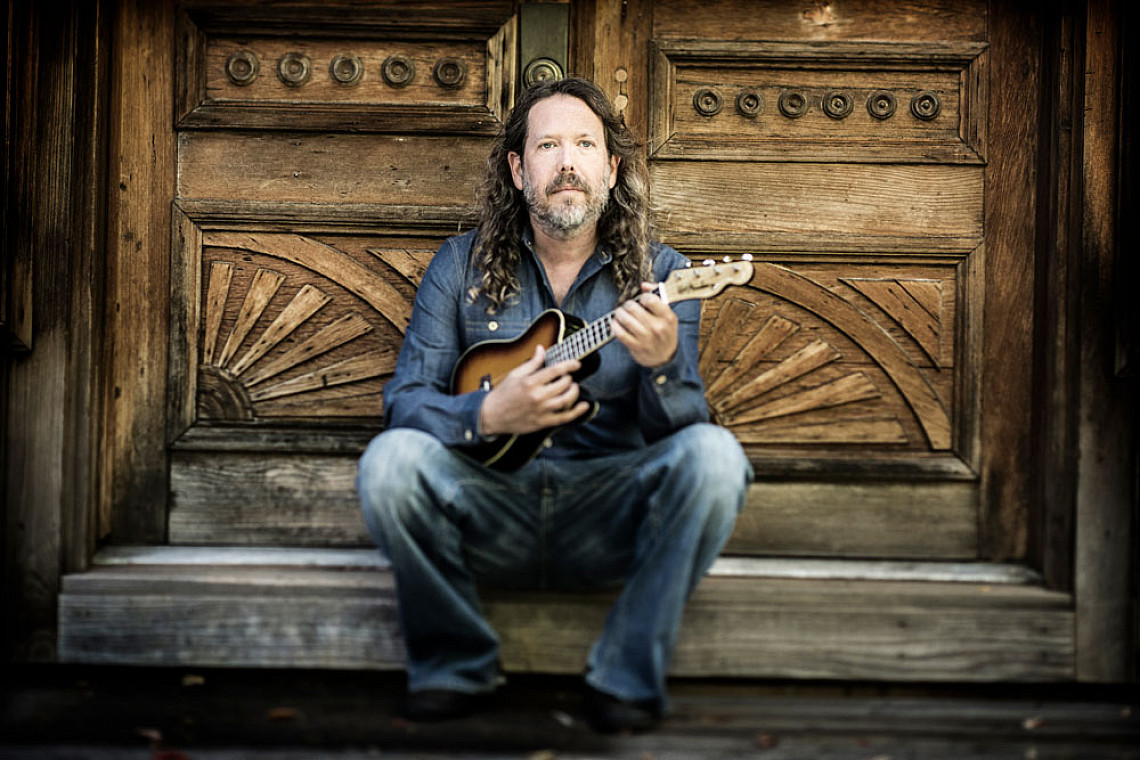
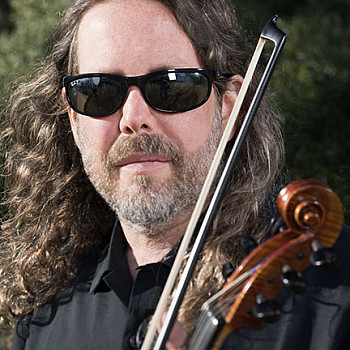
A musical polymath, Jason Crosby has played piano for Eric Clapton, violin for Roger Daltrey and keyboards for Phil Lesh. He's been a member of Robert Randolph's Family Band, and has written songs with Susan Tedeschi, one of his most consistent collaborators.
In 2003, he released a mostly instrumental solo album with contributions from Tedeschi, Derek Trucks, and many of his other cohorts. Fourteen years later, he's back with Cryptologic. This one is more reflective, inspired by a journey that has been filled with euphoric moments on stage and in the studio, but tempered by the disconnect that comes with a life in constant motion. He plays many of the instruments himself, joined on some tracks by The Mother Hips, whose frontman Tim Bluhm helped him write the tracks.
Jason spoke with us about Cryptologic and talked about some of his most memorable moments making and performing music, including the time Prince joined him on stage.
Jason Crosby: It varies depending on where I am. I've actually been off the road for the first time this year for a two-week stretch – my days have kind of been going to the gym and working out, and then practicing violin for two hours, and playing piano and doing a little writing. It's nice and relaxing. But, other times it's showing up at a hotel at four in the morning after a show, getting six hours of sleep and then continuing to drive to the next city, setting up, soundchecking and playing. And other days it's going into the studio for 12 hours.
My life has been very adventurous and jumping from project to project and different things. It's always a new adventure. But, lately, I've been preparing for the release of the record and also for a tour that I'm doing with Jimmy Herring and John McLaughlin, celebrating the Mahavishnu Orchestra final tour of North America.
Songfacts: What are you doing on those 12-hour studio days?
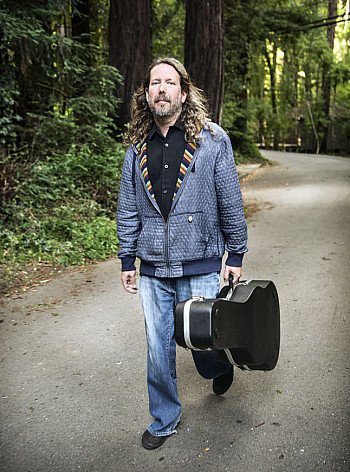 Jason: Well, I was in the studio recently with the The Mother Hips. The 12 hours don't necessarily consist of playing the entire time. You show up and for day one you could be spending the first four hours getting sounds and setting up. And then if you're in day three or four, the producer could be editing something and then saying, "Okay, I need the bassist in here for some fixes and then I want some keyboard overdubs," and then I come in. And then some days we're just full-on tracking and then we're spending 12 hours working on getting the basic tracks for, say, two or three tunes.
 So, even within that, the day varies but it's a lot of camaraderie with the band and shared meals. Blue Rose Music, which is the artist collective and label that's putting out Cryptologic, they're an amazing collective out of Sonoma here in California. I've played on almost all the things that are being done there, so there was The Mother Hips last month and Tim Bluhm before that and Elliott Peck is coming up and the Steve Forbert tribute record that's coming out in a couple of weeks. So, it's awesome to be part of this community and getting to play with all these great people.
Songfacts: When did you write this album?
Jason: I wrote it pretty much over the last two years. There's a couple of songs that are older but I'd say more than half of it was written in 2016.
Songfacts: You have a lot of downtime in your 12-hour studio days. Do you have time to sit there and work on your stuff and get your own projects going?
Jason: I try not to do that just because I like to focus on the project that I'm in, in any given day. It's something that I feel makes me a better sideman and contributor to the project that I'm doing. It's hard for me to work on something that's coming up while I'm doing something currently. Although, in the case of John McLaughlin's music, I've been working on that all year in preparation for the tour in November.
Songfacts: John McLaughlin is on another level. Can you talk about how you approach that and what it's like working in that environment?
Jason: Three days before we set out to tour, we'll get together to rehearse and I'm there. Jimmy Herring and The Invisible Whip band, which I recently joined, we've done 25 shows over the last couple of months, and Jimmy's music is on that level as well. So, I think that was good practice. On the tour in November I'll be doing a set of Jimmy's music and then we'll be doing a set with John.
But, the John music is really so deep and I play a lot of instruments. Originally, it was keyboards and then McLaughlin found out that I played violin. I'll be playing a featured role in his music. It's humbling.
Songfacts: Is this about playing very precise notes or is it more about coming up with your own takes?
That's half of it, and then the other half of it is bringing my own sound and feel to the improvisational aspect of it.
Songfacts: So there's a technical aspect and an artistic aspect.
Jason: Totally. And generally, my practice is divided equally. When I work on the lines, if I've got two hours, I spend an hour just kind of soloing along with old recordings from the '70s because I'll be there in November in featured lineups.
Songfacts: Are there certain acts that tell you to play whatever you want while others want you to play the charts exactly as written?
Jason: Most of the time it's the former.
Songfacts: They want you to do your thing.
Jason: Yeah. Especially the Grateful Dead dudes and the jam band scene that I've been in and even with Susan and Robert and blues and gospel. I don't often audition for these gigs - I've been around a long time and have personal relationships and met all of these people and they want me because I'm me, which is just great. It's awesome. I appreciate it so much.
In the case of Jimmy and John, in particular, they've got these compositions that are almost like classical music. You get that a little bit in "Help On The Way/Slipknot" and stuff like that, but, for the most part, you play whatever comes out. But, I think in the jazz fusion world it's a little more precise. And then there's, obviously, open improvisation within that.
Songfacts: So you can play the parts and bring your own style, but it also seems like there's a degree of professionalism. You have a regimen, you know to show up on time, you clearly have a way of working well with others. I'm sure that's a part of it.
Jason: Well, thanks, yeah. People have definitely told me I'm a nice guy and I try to be humble and nice to everybody. People ask me if I get nervous and usually when I get nervous it's the first time I've ever played with somebody. That doesn't matter if it's John McLaughlin or a buddy of mine - the first time I ever play music with anyone, I'm always nervous, not about the music, but about how our interaction is going to be on playing and off the stage in interacting and planning the show.
Personality means so much, to me at least, as far as what's going to translate to the music. I feel like that is almost part of my role coming into a new situation: to make sure that the vibe is right and spread the smiles around and make sure everybody is psyched to be playing.
Jason: Yeah. I've had a wild ride over the last 25 years. From a career standpoint, it's been unbelievable, but sometimes when you're so busy, you just focus on internal things. I feel like this record represents some things from the past, some demons that I've overcome and some redemption and results from hard work.
I've had my brush with rock and roll lifestyle and there's ways to survive it and there's moderation and all those things to consider. I had some dark years, but I've come out of it nicely.
I think, sometimes, the shadows, the ghost of myself, is thinking back to what I could have become if I'd made better decisions, but I'm happy where I am now.
Songfacts: Was there a specific relationship that forms a thread through some of these songs?
Jason: There's not one in particular, but definitely multiple. It's hard dating a musician, you know what I mean? I've been in relationships that have been great but have been a challenge. Luckily, the past few years I've been with a wonderful girl, and I've taken time to turn inward and improve myself, which has yielded results in my health and my life.
Songfacts: I can see how in order to get to your level you have to just keep going, going, going, and then one day you make an album and all these concerns go into it.
 Jason: Yeah, and Tim Bluhm was instrumental in getting that out of me. From a lyrical standpoint, it was time to open up a little bit and get a little more personal than some of my prior lyrics, which were a little vague. I was telling a story and the stories as I was writing it weren't all so sweet.
Songfacts: You're kind of harsh on yourself, especially in "Suffered A Fool."
Jason: Yeah. Tim and I wrote that together and it was like, "What has bothered you, what has made you feel like this?" And so, we got literal in "Suffered A Fool."
I play ten instruments on the record. It sounded beautiful and that brought out emotion. And the lyrical stuff came later and ended up being what it was. I'm a fan of Beck's record Sea Change [2002]. This was my version of that, I think.
Songfacts: What's the significance of the word "Cryptologic," which shows up in your song "Was I Ever There?"
Jason: I've got to tip my hat to Tim Bluhm on that one because he came up with that line. We were in Hawaii in Moloa'a Beach in Kauai and we did a couple of duo shows. We were hanging at this oceanfront property and we were looking out at the ocean and he said, "I've got this line in my head: cryptologic captain's log." And I was just like, "Wow, that's interesting, let's go with that." And within a day we had that tune.
I don't know if there's a real story to tell other than the imagery we were feeling at that moment in Hawaii. It was the plumeria and being somewhere. Then you're gone and it's like, "Was I ever really there in that beautiful spot for that short period of time?"
Songfacts: You're an interesting cat because you play all these instruments, you have perfect pitch, and you have this ear that gets the attention of guys like John McLaughlin. What goes on in your head when you're making music?
Jason: The avid listener, they're going for emotion and the way the music makes them feel and lyrical content and what they're seeing. So, I try to supply all of that with as much precision as I can. I definitely have an analytical mind, so if there's some passage, I can almost chart it in my head as it's going by because I can hear all the notes.
It's kind of interesting, I guess. I don't know it any other way. People sometimes are fascinated by it but I'm kind of fascinated by what it would sound like if I didn't know. What would a G mean to me if I didn't know it was a G immediately? I have no idea.
Songfacts: I think, to those of us who don't have that kind of musical gift, we hear the whole, so everything comes together, but you can separate all the stems.
Jason: When I was a kid I would go on these tours, and the fourth year the conductor said I could go for free if I organized the scores for all these orchestral works.
That memory's stuck with me and, as I look over these John McLaughlin scores, I'm glad that I had that time to do that because as I was alphabetizing and putting it in score order I would also stay up and read them. I was able to analyze it without playing it.
Songfacts: You've had a chance to play on a lot of Grateful Dead material. Is there a specific song that, when you listen to it, something about it really gets your attention in terms of a musical part?
Jason: Yeah, their studio albums don't get as much attention as their live shows but Blues For Allah and Terrapin Station I think are amazing records. And the song from Blues For Allah that I mentioned earlier, "Help On The Way/Slipknot," I listened to a live recording, it's maybe One From The Vault, and there's a part that Bob was throwing at them and it is just the coolest rhythm thing. It's so unique and Bob Weir is the only person in the world who would have come up with that specific part for that section of that song.
Stuff like that makes them special. All that time working on this music from the ground floor up and with the technical prowess of a virtuoso, they were able to craft something that was so unique to rock.
Songfacts: You did "Hampmotized" with Susan Tedeschi. What does that mean? What is "Hampmotized"?
Jason: It's a nod to Col. Bruce Hampton, who passed away. He is one of two close friends of mine that passed away and I dedicated the record to. Col. Bruce was a mentor to the Southeast scene of musicians. He had the band Aquarium Rescue Unit with Oteil Burbridge, Jimmy Herring, and Jeff Sipe. Jeff was in Susan's band and I was playing with Oteil and Jimmy, so for that record we decided to write a song for Bruce. And I think that Bruce, on his next record, wrote a song called "Susan T" which was kind of "back at us."
Songfacts: What's the most difficult instrument for you to play?
Jason: Violin. Or the singing. Singing and violin are the toughest. Violin, it's a fretless instrument and the instrument that I'm playing is a six-string, so it's the four violin strings plus a viola C; it's almost a cello. So, basically, across the range of cello, viola and violin except for a couple of notes on the lower end, it starts on the C below that, so you miss a couple of notes. Being able to navigate that, and especially now trying to do it in a high register, it's a huge challenge.
And singing has been a huge challenge. That's why at age 43 I'm putting out my first vocal record. I had a couple of solo records back in 2000 and 2002, and then in 2007 I tried a vocal record and the tracks were great but I just wasn't comfortable with the vocal. But, with the help of Blue Rose and a vocal coach and Karl [producer Karl Derfler] and Tim, I feel like I made something good enough to put out in the universe and represent where I'm at.
Songfacts: You once shared a keyboard with Prince.
Jason: I did.
Songfacts: Like, you were both playing the same keyboard at the same time.
So, Prince walks on stage and starts taking over and Joey grabs his microphone and sings along with the other Blind Boys. It was the last song of our set and that song was always the same every night. We called it "The Riff," and it was when Jay Carter who is the founding member of the Blind Boys would go out into the audience and get them all revved up. Prince is playing guitar and the crowd is going frickin' nuts. And Jimmy Carter and the three Blind Boys don't realize Prince is there, Because they're blind.
It's a long tune so Prince was done with the guitar and he gave it back to Joey. I think he's done but then I hear high notes coming from the piano and I look over and Prince is playing the piano. So, I just moved away but he said, "No, come over, play the piano with me." So, we play piano for maybe eight bars and he has a big ole swipe and then he walked off and split. We played another three minutes and by the time we got off stage he was gone. No pancakes, no basketball.
Songfacts: What's the most memorable recording session you were a part of.
Jason: It was during Susan Tedeschi's record Wait For Me, the one that "Hampmotized" is on. Tom Dowd was the producer of that record. I mean, the guy worked on the Manhattan Project and decided to not be a force of evil and then went to make records and that became his legacy.
It was actually the last record he made - he passed away before it was finally mixed. I did the piano solo on the title track "Wait For Me." He told me to play the first eight bars like Ray Charles, the second eight bars like Oscar Peterson, the third eight bars like Jason Crosby, and the last eight bars like all three of them hanging out together. I was 25 years old and it was my first major recording session. That's a memory I'll always take with me.
September 29, 2017.
Get Cryptologic here.
More Song Writing