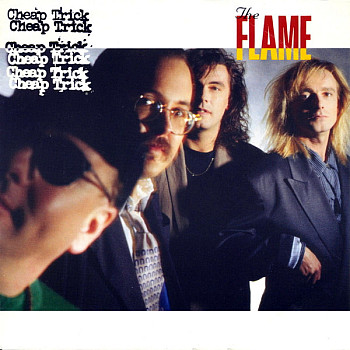
 It's their biggest hit, but Cheap Trick didn't play "The Flame" when they were inducted into the Rock And Roll Hall Of Fame in 2016, opting instead for "I Want You To Want Me," "Dream Police," "Surrender," and their cover of "Ain't That A Shame." (Fun fact: they were inducted by Kid Rock.) The song is a classic power ballad, trading the lust and wild abandon of their previous hits for this:
Another night slowly closes in
And I feel so lonely
Touching heat freezing on my skin
I pretend you still hold me
Cheap Trick didn't write the song (the songwriters Bob Mitchell and Nick Graham did), and they didn't like it, but an executive at their label, Epic Records, convinced them it would be a hit.
Bun E. Carlos, the band's original drummer, told us the story in a 2023 interview. The label exec was Don Grierson, who had placed the song "What About Love" with Heart, sparking their turnaround in the '80s.
"He called us up in early '87 when it was time to start another record," Carlos explained. "Cheap Trick and the label hadn't been getting along great. There had been some bad blood in the last few years. The label would call us up and say, 'There's no single on the record.'"
The band had been hitless since 1979, and Epic was getting impatient. On their 1986 album, The Doctor, the label foisted a song on them called "Kiss Me Red," written by Billy Steinberg and Tom Kelly, the guys who wrote "Like A Virgin" and "True Colors." But Steinberg and Kelly couldn't do for Cheap Trick what they did for Madonna and Cyndi Lauper. The song stiffed and the group's fortunes continued to fade.
Don Grierson entered the picture for their next album, Lap Of Luxury.
"Don goes, 'I've got about 12 songs with me, and I think they're all good singles candidates. I got a couple that I know are going to be #1 - and they're both ballads. Demo some tunes with me.'"
Those two songs were "The Flame" and "Look Away."
"He goes, 'I'll give you first pick. The other one I'm going to give to Chicago.' He played us 'Look Away' first, and we were like, Eh. Then he plays us 'The Flame,' and we're like, 'Well, that ain't as bad as the first one.'"
By this time, bass player Tom Petersson, a founding member, had returned to Cheap Trick after leaving in 1980. The rest of their lineup was Carlos, guitarist Rick Nielsen, and lead singer Robin Zander.
"Rick was like, 'I really hate this,' And me, Tom, and Robin were like, 'We're not crazy about this either... but #1 you say?'"
Working with producer Richie Zito, they went through a lot of songs before settling on the 10 that made the album.
"We sat there and argued with Richie for months and months while we were recording with him out in Burbank. We did about eight or 10 songs for the album, some of them kind of grudgingly. We did 'The Flame,' and Kim Bullard came in and cut a keyboard track – along with a drum machine ticking away – and we were like, 'OK. Let's build on this.' We all got in the room and we did about half a take, and Rick stands up and goes, 'I HATE THIS THING!' And he gets up and leaves. Tom is like, 'Yeah, I don't want to be here, either.' He gets up and walks out. So, there's me and Robin. We put the drums down and the vocals down, and then the next day, Rick goes, 'OK, I'll play some guitar,' so Rick and Tom put their parts on."
With "The Flame" in the can, it was suggested that the band look for a song by another artist to cover as a follow-up single.
"I literally went through piles of tapes with Richie from publishers, went through hundreds of songs. We'd sit there in a room with a ghetto blaster, put a tape in, get about 10 seconds in, and usually just pop the tape out and pitch it in the circular file. We did that for just days in a row – it was like torture. And I was like, 'We should do this song by the Equals.' ["Baby Come Back"] 'Oh, Bonnie Raitt did it – forget that one.' Finally Robin or Richie or someone said, 'How about 'Don't Be Cruel'?' The Judds had just had a country hit with it. We're like, 'Well, how about we try it like this?' And Richie's like, 'Put this thing in there like 'Ain't That A Shame' in the verses.'"
Cheap Trick was back on the charts, and "Don't Be Cruel" kept them there, rising to #4. We hit peak power ballad in 1989. Songs that charted that year include:
"Every Rose Has Its Thorn" by Poison
"When I'm With You" by Sheriff
"Heaven" by Warrant
"When The Children Cry" by White Lion
"Close My Eyes Forever" by Lita Ford and Ozzy Osbourne
Heart's Ann Wilson even teamed up with Zander for the syrupy "Surrender To Me," a confluence of the two biggest bands whose comebacks were powered by ballads.
It wasn't just rockers who got in on the action. Balladeers like Michael Bolton and Richard Marx had moments. One guy who saw it coming was John Kalodner, the dude dressed like a lady in the Aerosmith video. He convinced Cher to sign with Geffen Records and reboot her music career in 1987, and by 1989 she was again a headliner.
A common thread is Diane Warren, "Tenacious D," as Taylor Dayne calls her. She wrote a lot of these songs, not just for pop stars like Belinda Carlisle ("Mad About You") and Cher ("If I Could Turn Back Time"), but also for the likes of Bad English ("When I See You Smile") and Starship ("Nothing's Gonna Stop Us Now"). That song Cheap Trick turned down, "Look Away"? Written by Warren.
"They [power ballads] were all pretty sickening," he said. "But it was a trend – they came and then they went. It was never the end of the world in my book. We did another one for the Busted album ['Wherever Would I Be'], and the label was like, 'Not only is this going to be #1, it's just a question of, how long is it going to be #1?' And when the label guy told us that, we all just kind of looked at each other and broke up laughing. Busted came out and we went to Australia on tour, and when we were over in Australia, power ballads died. I remember we came back home and they put our power ballad out with our $200,000 video that we'd paid for, and it died the death. And we were just like, 'Thank God that power ballads died. We don't ever have to do one of these again!'"
July 18, 2023
Further reading:
Cheap Trick Songfacts
Interview with Michael Bolton
Interview with Mike Tramp of White Lion
Interview with Billy Steinberg
Interview with Ann Wilson of Heart
More Song Writing