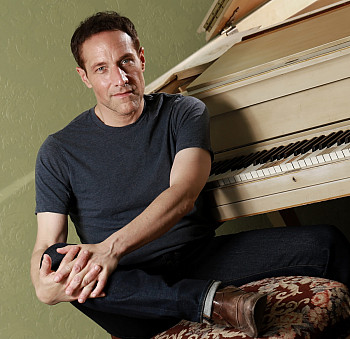
Jim Brickman will be holding his first songwriting bootcamp from July 26-29 in his hometown of Cleveland. This is right in his wheelhouse: Brickman is one of the most successful songwriters in the game, and unlike many tunesmiths who can't explain how the songs materialize, he can articulate exactly what he does to craft a song that is both listenable and meaningful.
He's known for his piano compositions, but Jim has created songs (including lyrics) in a number of genres, working with a litany of notables that includes Michael W. Smith, Kenny Loggins, Leslie Odom Jr., Martina McBride and Michael Bolton.
In his 2017 Songfacts interview, he explained many of the technical details of the craft ("you have to invent a B section that's complementary"), but made it clear that this is not about writing by algorithm. "When you write about people and relationships instead of about things or inanimate objects or weather or whatever, that's when it starts to connect because everybody can relate to it," he said.
Ahead of the Brickman Bootcamp, he shared four more of his songwriting tips and tricks.
He's known for his piano compositions, but Jim has created songs (including lyrics) in a number of genres, working with a litany of notables that includes Michael W. Smith, Kenny Loggins, Leslie Odom Jr., Martina McBride and Michael Bolton.
In his 2017 Songfacts interview, he explained many of the technical details of the craft ("you have to invent a B section that's complementary"), but made it clear that this is not about writing by algorithm. "When you write about people and relationships instead of about things or inanimate objects or weather or whatever, that's when it starts to connect because everybody can relate to it," he said.
Ahead of the Brickman Bootcamp, he shared four more of his songwriting tips and tricks.
1. A turn of a phrase can make a world of difference
What makes a great song is ultimately the sum of its parts, and even though specific lines can go by quite quickly, I believe that a turn of a phrase can make a big difference in taking a lyric from being average to being great.For example, in the song "Love of my Life" that I co-wrote with Tom Douglas, the chorus lyrics are:
You are the love of my life
And I'm so glad you found me
You are the love of my life
So baby put your arms around me
So ignoring the fact that "me" doesn't technically rhyme with "me" (whoops!), it's the turn of the phrase in the chorus that I think is noteworthy. "I'm so glad you found me" almost sounds like you're saying, wow, you're so lucky you found me, when actually what you're saying is I'm so glad you found me because you saved me.
Another example is the song "Said I Loved You... But I Lied." It sounds like one is saying, "I don't actually love you," but what one's really saying is "my feelings for you are consuming beyond words," etc.
2. Read your lyrics out loud as if they were simply lines
One of the things I've learned is to write lyrics in the same way that people talk. Read the lyrics from your favorite song out loud instead of singing them. Do they make sense in conversation before they're being sung? It's a super illuminating exercise.I think a good example from my own body of work is the song "You." The verse goes:
I never felt alone, I was happy on my own
Who would even know there was something missing
I guess I just didn't see the possibility
Even though it was waiting there all the time, it just never crossed my mind
Until I opened up my eyes
And there was you
Reading that aloud, you could carry a conversation with just that.
3. Start the song from the middle and not the beginning
I've found that starting at the beginning can be unnecessarily challenging - it's better to know what you're building to in order to construct the best arc possible.Brickman has placed on 21 different Billboard charts, including Hot 100, Adult Contemporary, Country Airplay, Classical Albums, Smooth Jazz Songs and Holiday Airplay.
He also has two Grammy nominations, a Dove Award, and two SESAC Awards for songwriting.
It's easy to get stuck in verse-verse-verse-land if you don't know where you're going. I've also noticed that when you start at the beginning, the really good stuff tends to be put in the first verse... then there isn't much left to say or reveal after that point.He also has two Grammy nominations, a Dove Award, and two SESAC Awards for songwriting.
4. Three things
I find that a helpful starting point for creating an overall concept for a song is the "three things" rule. Let's say you're going into writing a song, and you decide it's "three things" that remind you of someone, or three things you want to do before the end of your life, or three things that you love about someone. It lends structure to song concept and can give you a roadmap of the song.The Brickman Bootcamp takes place July 26-29, 2018. Get info at jimbrickman.com/songwriter-bootcamp/
Further reading:
Interview with Tom Douglas
Michael Bolton on songwriting
May 29, 2018
More Song Writing