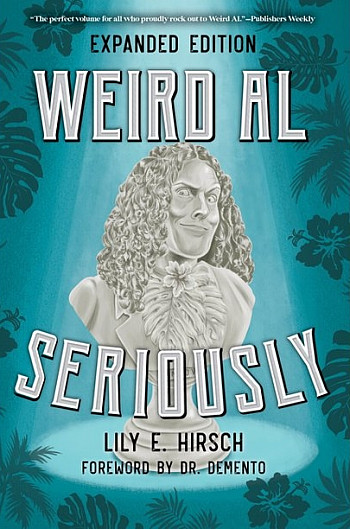
 Back in her college days, Lily Hirsch, author of Weird Al: Seriously, was more likely to be watching Murder, She Wrote than MTV, but one day she caught Weird Al Yankovic's "Smells Like Nirvana" video and something piqued her interest - but it took her several more years to explore it.
After earning a PhD in musicology from Duke University, Hirsch wrote books about music in the Nazi era and music in criminal law. Serious studies for serious subjects.
But comedy, she realized, is also a serious business. When she turned her eye toward humor in music, that old something about Weird Al resurfaced. She set out to prove there was much more going on underneath the curly mane and Hawaiian shirt than even his diehard fans realized.
Supported by interviews with Yankovic and his bandmates, Weird Al: Seriously is the first "Al-cademic" study of the parody master's work. Hirsch examines Al's place in the pop-culture landscape and suggests there's a thread of social and political commentary that runs through his songs, along with a hefty helping of food puns. First published in 2020, an expanded edition that covers Al's antics in the intervening years hit the shelves on April 15, 2022.
In this Songfacts interview, Hirsch shares insight into how Weird Al stays relevant and how videos like "Amish Paradise" have fun with puns.
Amanda Flinner (Songfacts): Throughout reading Weird Al: Seriously, I assumed you were a lifelong Weird Al fan and was surprised that you weren't a fan at all (or at least didn't know it yet) when you started the project. Why did you decide to write a book about him?
Lily Hirsch: I've always been interested in how we categorize music and the values attached to those categories. I have written before about the problem of fixed ideas of Jewish music and national music more generally. I have written too about the category of music itself - how people often view it as solely positive when it can be used in negative ways too (as torture and punishment, for example). I had decided I wanted to write about humorous music because it also seems misunderstood - dismissed or ignored as inconsequential or less significant than so-called "serious music." Once I had that idea, Weird Al was the obvious choice, especially since he's had such a long, successful career!
Songfacts: What was the most surprising fact you learned during your research?
 Lily Hirsch
Songfacts: In the book, you noted how the media always acts surprised that Al is still around. Why do you think he's stayed relevant for so long compared to other musical parodists?
Hirsch: Weird Al is very smart in the songs he chooses to parody and how he parodies them. He chooses songs that are generally significant, part of the then-Zeitgeist. And he tries to flip them in unique ways - in ways that will have longevity, sometimes with messages that have deep, enduring resonance (around being true to yourself, daring to "be stupid," or embracing your weirdness). That's part of the reason he shies away from politics - political issues can date the parodies. With a change in the news cycle, the song is immediately irrelevant. The songs are also so, so good (and that's some technical lingo, there).
Songfacts: As you've watched your kids become Weird Al fans, what differences do you notice in how kids relate to his music versus adults?
Hirsch: My kids don't often know the original songs, so they enjoy the parodies based on the parodies themselves - their goofiness or word play. Adults often seem to appreciate the whole package, but of course not always. I think adults also often have some nostalgic connection to Weird Al. They can appreciate his music on multiple levels but also reconnect with a fun, playful part of their childhood too.
Songfacts: You touched on how Al's parodies help introduce fans to different genres and artists they may otherwise not have listened to. Is there a Weird Al song that served as a musical gateway for you?
Hirsch: Yes! In researching his music, I got to know some musical artists I really didn't know much about before but really should have known. One, I have to say, was Devo, the basis for "Dare To Be Stupid." I did an unintentional deep dive there and was struck by that group's relevance today, the idea of de-evolution as well as their notion of art as a response to trauma.
Songfacts: In his music videos, visual gags help drive the puns home and sometimes even add new layers of meaning to the lyrics. What are some fun examples to be on the lookout for?
Songfacts: A fascinating section in your book touches on the evolution of language and how Al's songs can take on unintended meanings with the passage of time. What song has suffered the most as a result of new connotations?
Hirsch: There are a few to consider here. "Christmas At Ground Zero" comes immediately to mind. When Al wrote that song in 1986, it was a reference to the center of a nuclear blast. But, after the terrorist attacks of September 11, 2001, the term "ground zero" changed in meaning. And now that song just doesn't really work because most people assume it has something to do with 9/11, when, again, it does not.
Songfacts: Despite his claims to the contrary, you argue that Al often manages to make subtle political points in his songs while maintaining "plausible deniability" - which tune do you think is the greatest example of this?
Hirsch: There's a few, but "Trigger Happy" is a good one. The song takes aim at gun ownership and there is a hard juxtaposition between the happy, surfer sound and the lyrics, from the point of view of a gun nut. That clash is meant as commentary and criticism. As Al told me, he's not really a fan of guns. But there's always "plausible deniability" in parody. And listeners can and have missed the point. There are even those who have viewed that song as some sort of celebration of gun ownership.
Songfacts: For the uninitiated, where's the best place to start in Al's discography?
Hirsch: That's a good question. You can really start anywhere. My kids' teachers have invited me into the classroom to talk about parody. I brought in "Word Crimes" because it's such a fun tune and a clever use of language which, in this case, packs a language lesson too. I think the "Hamilton Polka" is great for the uninitiated also because it really showcases the musicianship and skill as well as the fun. I really don't think you can go wrong here, though. As Homer Simpson once said, "He who is tired of Weird Al is tired of life." I don't always agree with Homer Simpson, but, here, I agree completely!
April 18, 2022
Weird Al: Seriously is available for purchase on Amazon
Also check out our interview with Twisted Tunes creator Bob Rivers, best known for "The Twelve Pains of Christmas," and our interview with Devo.
More Song Writing