Brown was born Arthur Wilton in Yorkshire, England. Bridging the gap between Screaming Jay Hawkins and Alice Cooper, his incendiary hit was a sensation in 1968, but the flames burned out fast, as "Fire" proved to be his only chart entry.
Although the group is considered a one-hit wonder, there is a lot more to this album.
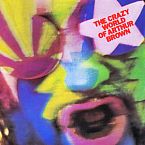
Growing up in England after World War II, Brown spent a lot of time around people whose lives were destroyed by the war, many of whom suffered from PTSD or other difficulties. When he started making music, instead of writing about girls, cars or relationships, he came up with a concept of an inner journey, developing a story about a man who faces his demons, heading into a figurative fire. Along this journey, he encounters the "God of Hellfire," who shows up in "Prelude/Nightmare," the first track on The Crazy World of Arthur Brown concept album. As the man enters the inferno, he finds himself deep in a psychedelic trip, which is described in the second track, "Fanfare/Fire Poem."
As he falls into an abyss, the character returns, telling him: "I am the god of hellfire, and I bring you... Fire."
This marks the beginning of the song "Fire," where our hero is taken to burn. While it works best within the concept of the album, it also serves as a standalone track, as the lyric on its own can be interpreted as a story about a man facing up to his past. Running 2:52 with the ear-catching spoken intro, it was a tasty, digestible slice of a much more complex work.
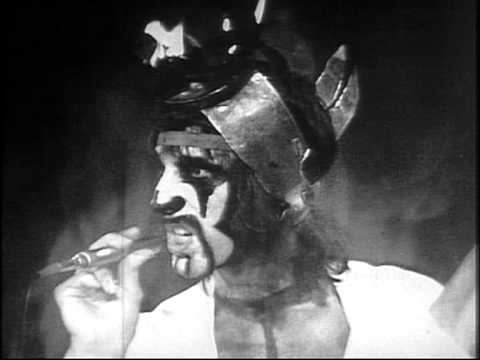
Brown often performed this song while wearing a flaming hat. He was known for his zany and outrageous stage act, as witnessed by British beat writer Charles Fox on the album notes: "At first - with Arthur Brown being lowered by crane on to the stage - it looked like being just another piece of zaniness. But once Brown began his (not legible) dancing, his face concealed inside a glistening helmet and visor, a saffron robe floating from his shoulders, one became aware of a uniqueness. He belongs to a tradition which goes beyond Music Hall, right back to Mummers' plays. Yet there is a sinister element, too, and one which recalls the smell of seaweed and the rattle of spades and pails. For somehow Arthur Brown contrives to be both the malevolent Punch and - in drag, with grotesque wig and flowered gown - a psychedelic Judy. The effect is disquieting, especially when joined to the singing - fastish blues, and sung exceptionally well, with a voice that can swoop and screech and flutter. So far the Hippies have done little except to opt for smugness instead of hypocrisy. Arthur Brown could easily be the first genuine artist to come out of our local underground. He's disconcerting, even faintly perverse, but distinctly original and very, very English."
Vocalist Brown and organist Vincent Crane are the genius behind the band. Their album is a unique insight into actions that lead to a miserable life. All cuts on the album were penned by Brown and/or Crane (they wrote "Fire" together) except for "
I Put A Spell On You" by Screamin Jay Hawkins and "Money" by James Brown.
Pete Townshend played a part in this song. The Who guitarist saw Brown perform at the UFO Club in London, and got Brown a deal with Track Records, the label owned by Townshend's manager, Kit Lambert, to record The Crazy World of Arthur Brown album. Lambert produced the album and Townshend, who later covered "Fire" as part of his 1989 musical The Iron Man, is credited as associate producer. Townshend and Brown worked together again when they appeared in the 1975 movie Tommy, where Brown played The Priest.
Brown wrote this song with the group's organist, Vincent Crane, who also provided the orchestral arrangements.
When this song took off, the band hit the road for a grueling tour schedule. They were taking lots of hallucinogens, which became a problem when their drummer, Vincent Crane, became an acid casualty. According to Brown, Crane was bipolar, and after he stopped his medication, he got spiked with LSD and had a bad reaction that landed him in a mental hospital for six months.
Drummer Drachen Theaker was next to fall, but he was replaced by a teenaged
Carl Palmer - quite a talent. Crane returned to the fold, but Brown says he turned down a record deal offered by Clive Davis, which drove away Palmer and Crane, who left to form Atomic Rooster (Palmer later formed Emerson, Lake, and Palmer). Brown embarked on a series of adventures, but never came near the notoriety he achieved with his Crazy World project.
At the famous Mothers Of Invention concert of December 4, 1971 at the Montreux Casino, a guy with a flare gun shot into the ceiling and a fire broke out. When the announcer, Mark Vollman, noticed the small fire, he joked, "The fire?... Arthur Brown in person Ladies and Gentlemen!" Later the casino burned down to the ground, an event documented in the song "
Smoke On The Water."
>>>
Suggestion credit:
Eberhard Hasche - Berlin, Germany
The Prodigy reinterpreted this song on their 1992 track "Fire," which appears on their album Experience
XL.
Brown got the idea for his flaming helmet after spotting a crown with candles in his Paris hotel. He was experimenting with makeup, costumes and other theatrical elements at the time, and when he tried on the crown, it sparked his imagination.
This song was often attributed to "The Crazy World of Arthur Brown" when actually that was the album title. The artist is simply Arthur Brown.
Somehow, two other songwriters ended up listed on the credits to this song: Michael Finesilver and Peter Ker. Some sources say it was over a lawsuit claiming their song "Baby, You're a Long Way Behind" was too similar to "Fire," but there appears to be no record of that song, which doesn't show up on writer's credits for either Finesilver or Ker. The connection could be with and artist called Elli (Elli Meyer), who released a single called "Never Mind" in 1967 that was written by Finesilver and Ker and featured piano by Vincent Crane.
As you would expect from Brown's stage performance, where he mixed mayhem with open flame, there were incidents. Jimmy Ryan, who backed him on bass in 1969, recalls a gig at Wollman Skating Rink in Central Park: "He simplified his attire with magician's robes, war paint and a burning lyre headdress/helmet, and we were made to wear warlock cloaks and hoods, but we were forgiven the face paint. We began our show, and with a little difficulty, I managed to keep my floor length, flowing cloak from interfering with my bass strings.
Did I mention, Arthur liked to light his head on fire? As we cranked through our dark, distorted organ, pounding and pulsing bass-and-drums set Arthur, in a moment of screaming, psychotic reverie, forgot I was behind him, and hurled his lighter fluid-fueled, blazing headdress up and backwards, where it came to rest beneath my cloak. I was looking at (keyboardist) Paul Glanz at the time and only realized what had happened when I felt some red alert heat creeping up my bare legs and private parts (it was summer - no pants under my cloak). I began to spew four letter words in rapid fire, screaming and leaping around the stage, initially dragging the burning helmet with me under the cloak, unable to kick it free. Arthur thought I was 'performing,' absorbed in his insane, hellfire thing and was cheering me on. I thought I was about to meet the real God of Hellfire and go up in flames like a suicidal monk, right on the stage in front of 3,500 people! The stage crew was on it and came racing at me with a fire extinguisher, but Murphy's Law of burning robes fortunately did not kick in. I managed to leap free before ignition/immolation, and they hosed the helmet instead of me. The irony was that Arthur kept going, unaware that anything was out of the ordinary, and the cheering crowd, pumping their two-fingered, metal head fists in the air, was treated to what they believed was me being possessed by demons, and doing the burning (literally) psycho hell dance."
Another mishap occurred at a concert in Lewes, England on August 25, 2007, when the fire in his flaming hat spread to Brown. He wasn't seriously hurt, but it did disrupt the performance.