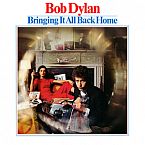
Dylanologists generally consider this song to be for Sara Lownds, the woman Dylan married the year the song was recorded and released. Many of his songs have been to or about her, including "
Sad Eyed Lady Of The Lowlands" and "
Sara."
Dylan wrote the song at the Chelsea Hotel while living there in Room 221. Lownds also lived in the hotel.
Sara Lownds studied Eastern philosophies, suggesting the connection to her in the line "My love she speaks like silence, without ideals of violence." In Taoism and Buddhism, silence and a still mind are the highest goods, and violence is rarely if ever acceptable.
The song also describes her as "like ice" and "like fire," meaning two opposite forces at once (Yin and Yang), another concept popular in Eastern philosophy (and one visually represented by the Tai Chi symbol).
The song was initially titled "Dime Store," which is a reference to the song's second line, "In the dime stores and bus stations."
Dylan performed the song live for the first time on February 12, 1965, at the Armory in Troy, New York. During the 1975–1976
Rolling Thunder Revue tours, it became a staple of Dylan's live shows.
Dylan recorded the song on January 13 and 14, 1965, in Studio A of Columbia Recording Studios.
The lyrical rhyme scheme changes from verse to verse. In the first verse, the rhyme scheme is AABCDEEC, meaning the first line rhymes with the second, the fourth line rhymes with the eighth, and the sixth and seventh lines rhyme. In the second verse, the scheme is AAABCDEF, meaning the first three lines rhyme with each other but none of the other lines do. This kind of sharp deviation from verse to verse is unusual in popular music, particularly popular music that relies so heavily on the lyrics.
Also, many of the rhymes are approximate, which also shows a level of poetic sophistication that was, and is, somewhat unusual for a musician. Approximate rhyme is also sometimes called "partial rhyme," "imperfect rhyme," "near rhyme," or "slant rhyme."
A simple exact rhyme is something like "dove" and "love," but Dylan in this song (as in most of his songs) he uses approximate rhymes such as "another" with "bother," "trembles" with "rambles," and even "fire" with "her." Using approximate rhyme opens up literary options because it's more flexible, though it can be more difficult than grabbing the low-hanging fruit of rhymes such as "run" and "fun."
Dylan references the Old Testament's Book of Daniel:
Statues made of matchsticks
Crumble into one another
Those lines hark to Daniel's prophecy that Nebuchadnezzar would build a statue of iron, gold, clay, brass, and silver, but then those things would crumble like "chaff" on a threshing floor (with threshing being a part of grain preparation in which the edible part of the grain is removed from its husk).
Then was the iron, the clay, the brass, the silver, and the gold, broken to pieces together, and became like the chaff of the summer threshing floors; and the wind carried them away, that no place was found for them: and the stone that smote the image became a great mountain, and filled the whole earth. (Daniel 2: 32–35)
Some see an allusion to Edgar Allen Poe's poem "The Raven" in the lines:
My love she's like some raven
At my window with a broken wing
Dylan's never said anything about this connection, though.
The cloak and dagger dangles is a play on words, as "cloak and dagger" is an old term generally used to indicate espionage and secrecy. The modern connotation of the term comes from two places. In the early 19th century, "cloak and sword" referred to a genre of writing and live theater that featured swashbuckling characters wearing those items. The term was also used in European martial arts in which a style of fighting using cloak and dagger was taught. In this style, the cloak concealed the dagger and also acted to deflect attacks. It was a fighting system of last resort, as the cloak was hardly an ideal shield and the dagger was inadequate against a sword or spear.
One line of heavy wisdom pops out of the song's fawning love imagery:
She knows there's no success like failure
And that failure's no success at all
Dylan often worked philosophical thoughts into otherwise mundane topics. The contrast accentuates the deep parts and makes them seem more profound than they might otherwise be. In Bob Dylan: The Essential Interviews, Dylan states that he didn't invent this technique and cites blues legend Robert Johnson as someone who did it long before him: "Robert Johnson would sing some song and out of nowhere there would be some kind of Confucius saying that would make you go, 'Wow, where did that come from?'"