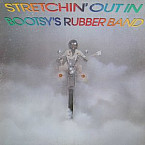
Stretchin' Out (In a Rubber Band)

Album: Stretchin' Out in Bootsy's Rubber Band (1976)
Play Video

Songfacts®:

  • Bootsy Collins is an iconoclastic funk bass player. On this song, he's stretching out to spread his groove far and wide, bringing the party with him. The "rubber band" represents his elastic bass grooves. That same year (1976), The Spinners had a hit with "The Rubberband Man," which is more literal, telling the story of a guy who uses an actual rubber band as a bass.
  • Bootsy Collins was part of the P-Funk universe led by George Clinton; he joined the group in 1972 and became an integral part of their look and sound. In 1976 Clinton helped Bootsy step out with his own spin-off group, Bootsy's Rubber Band. "Stretchin' Out (In a Rubber Band)" was their first single and the first track on their debut album, Stretchin' Out in Bootsy's Rubber Band.

    Bootsy wrote and produced the song with George Clinton, and the singers and musicians were all part of P-Funk, including the singers Gary "Mudbone" Cooper and Robert "Peanut" Johnson. P-Funk horn players Rick Gardner (trumpet), Fred Wesley (trombone) and Maceo Parker (sax) appear as "The Horny Horns." The other musicians are:

    Garry Shider - guitar
    Michael Hampton - guitar
    Bernie Worrell - keyboards
  • On this song, Bootsy goes into character as Casper The Holy Ghost (not to be confused with Casper The Friendly Ghost). Like most of P-Funk, Bootsy has various alter-egos. One of his favorites is Bootzilla, the "rhinestone rock-star."
  • Bootsy gets some of his signature catch phrases into this one, including "Dig!" and "Glory be, the funk's on me!" He broke out the "Dig!" again in 1990 when he appeared on "Groove Is in the Heart" by Deee-Lite.
  • When Bootsy says he's "calling short distance," it means he's right there, so close he can whisper and you'll hear it. It's the opposite of calling long distance, which could involve hefty fees back in 1976.
  • When Bootsy says, "I'm gonna hit ya with the one," he's referring to the first beat of every measure, which James Brown called "the one." Bootsy was in Brown's band in 1970 and 1971, and Brown taught him to hit that note hard instead of waiting for the second or fourth beat, which was more common. This was a musical signature of the funk sound Brown and Collins helped create.

    "When James Brown said, 'Play it on the one,' I didn't know what that meant," Collins told Songfacts. "But I had sense enough to ask him, because I wanted to know what this 'one' was he kept talking about. And once he explained it, I said, 'Oh, I get it now,' but I didn't really get it. I had my version of it, and he started smiling when I started playing, so that was good enough for me. I figured I had "the one" then."

Comments

Be the first to comment...

Editor's Picks

Director Mark Pellington ("Jeremy," "Best Of You")

Director Mark Pellington ("Jeremy," "Best Of You")Song Writing

Director Mark Pellington on Pearl Jam's "Jeremy," and music videos he made for U2, Jon Bon Jovi and Imagine Dragons.

Emmylou Harris

Emmylou HarrisSongwriter Interviews

She thinks of herself as a "song interpreter," but back in the '80s another country star convinced Emmylou to take a crack at songwriting.

Neal Smith - "I'm Eighteen"

Neal Smith - "I'm Eighteen"They're Playing My Song

With the band in danger of being dropped from their label, Alice Cooper drummer Neal Smith co-wrote the song that started their trek from horror show curiosity to the Rock and Roll Hall of Fame.

The Punk Photography of Chris Stein

The Punk Photography of Chris SteinSong Writing

Chris Stein of Blondie shares photos and stories from his book about the New York City punk scene.

Martyn Ware of Heaven 17

Martyn Ware of Heaven 17Songwriter Interviews

Martyn talks about producing Tina Turner, some Heaven 17 hits, and his work with the British Electric Foundation.

Ian Astbury of The Cult

Ian Astbury of The CultSongwriter Interviews

The Cult frontman tells who the "Fire Woman" is, and talks about performing with the new version of The Doors.