God Was Showing Off

Album: The Romantic (2026)
Charted: 67 28
Play Video

Songfacts®:

  • If you were to present a theologian with the premise of this song - that God created a woman so spectacular He couldn't resist a bit of celestial showing off - the poor fellow might reach for a footnote. Bruno Mars, meanwhile, reaches for a microphone. On "God Was Showing Off," he delivers a devotional love letter disguised as a theological argument: the woman he's singing about is so breathtaking that her existence feels less like biology and more like divine artistry.
  • Mars has long had a habit of placing himself several rungs below the woman in his songs. In "Grenade" (2010), he volunteers for a heroic menu of self-endangerment - catching grenades, taking bullets, and throwing his hand on a blade - all for someone who barely notices him. On "Risk It All" (2026), the devotion escalates further with vows to "swim across the sea" and even "sacrifice my life."

    "God Was Showing Off" continues this tradition, though with a slightly more ecclesiastical twist. Here the humility isn't physical but spiritual: Mars casts himself as the lucky bystander who gets to admire God's handiwork. When he sings "I was blind, but now I see," he's borrowing directly from the hymn "Amazing Grace," reframing romantic attraction as a moment of revelation.
  • Mars recorded the song for his fourth album, The Romantic, which threads Catholic and Christian imagery throughout its tracklist. Born Peter Gene Hernandez in Honolulu, Mars grew up at the intersection of two deeply Catholic cultures: his father is Puerto Rican and his mother Filipino. That background provided a childhood steeped in the language, symbols, and pageantry of Catholicism; the kind of imagery that tends to linger in an artist's imagination long after the incense clears.
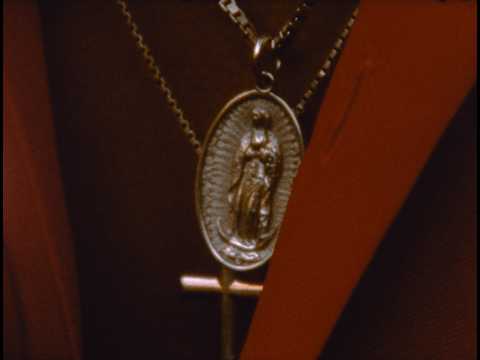
  • "God Was Showing Off" is the album's most overtly theological track, with the "Risk It All" video reinforcing the same themes visually. Mars wears a Miraculous Medal and a crucifix, performs outside the Guardian Angel Catholic Church in East Hollywood, and the wedding ceremony takes place before statues of Jesus and Mary.
  • Mars' repeated reference to an "earth angel" nods knowingly to "Earth Angel (Will You Be Mine)," the doo-wop classic by The Penguins that became the first independent-label release to appear on Billboard's national pop charts in 1954. Where the Penguins' original pleads for reciprocation, Mars uses the "earth angel" epithet to emphasize the metaphysical mechanics of creation rather than romantic longing.
  • Mars wrote the song with his regular collaborators - Dernst 'D'Mile' Emile II, Philip Lawrence, and James Fauntleroy - with additional credits for Homer Steinweiss, Leon Michels, and Dave Guy. Steinweiss, Michels, and Guy are members of the New York soul-funk outfit The Menahan Street Band, whose grooves have been sampled by artists such as Jay-Z and Kid Cudi. Their presence in the credits hints that part of the song's musical DNA may trace back to the band's catalog.
  • Placed as track 4 on The Romantic, "God Was Showing Off" acts as the emotional and spiritual summit of the first act. Following the funk of "Cha Cha Cha" and the disco of "I Just Might," it strips things back to pure devotion, reinforcing the album's central proposition: that romantic love, at its most sincere, borders on the religious.

Comments

Be the first to comment...

Editor's Picks

Andrew Farriss of INXS

Andrew Farriss of INXSSongwriter Interviews

Andrew Farriss on writing with Michael Hutchence, the stories behind "Mystify" and other INXS hits, and his country-flavored debut solo album.

Danny Kortchmar

Danny KortchmarSongwriter Interviews

Danny played guitar on Sweet Baby James, Tapestry, and Running On Empty. He also co-wrote many hit songs, including "Dirty Laundry," "Sunset Grill" and "Tender Is The Night."
Chris Frantz - "Genius of Love"

Chris Frantz - "Genius of Love"They're Playing My Song

Chris and his wife Tina were the rhythm section for Talking Heads when they formed The Tom Tom Club. "Genius of Love" was their blockbuster, but David Byrne only mentioned it once.

Dean Pitchford

Dean PitchfordSongwriter Interviews

Dean wrote the screenplay and lyrics to all the songs in Footloose. His other hits include "Fame" and "All The Man That I Need."
Who's Johnny, And Why Does He Show Up In So Many Songs

Who's Johnny, And Why Does He Show Up In So Many SongsSong Writing

For songwriters, Johnny represents the American man. He has been angry, cool, magic, a rebel and, of course, marching home.

Scott Gorham of Thin Lizzy and Black Star Riders

Scott Gorham of Thin Lizzy and Black Star RidersSongwriter Interviews

Writing with Phil Lynott, Scott saw their ill-fated frontman move to a darker place in his life and lyrics.