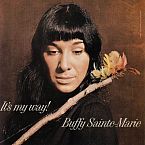

Now That The Buffalo's Gone

Album: It's My Way! (1964)

Songfacts®:

  • This passionate protest number from Buffy Sainte-Marie shines a light on the plight of Native Americans who are continuously forced from their land. She was specifically inspired by an incident in Jamestown, New York, where a Seneca reservation was about to be flooded to build Kinzua Dam.

    "I wrote it not to make anybody mad, but to kind of acknowledge the fact that a lot of people who are part Indian really would like to know and would care," she told Democracy Now! in 2009. "So again and again it says 'you, dear lady, and you, dear man.' You know, it's trying to explain something to people who don't usually get to know anything about Native American stuff, because you never hear about Indian people. The only time you hear about Indian people, like, for instance, Wounded Knee, when Nixon was president, what you'd see in the media was, you know, some Indian with a gun who was defending their land against things that shouldn't be going on."
  • The title refers to the near-extinction of the American bison, which was a primary source of food, clothing, and other essentials for Native Americans. In the mid-to-late 1800s, the US government purposefully slaughtered the animals en-masse to devastate the Native American population and force them into reservations.
  • While Sainte-Marie hoped listeners would acknowledge the pain her people suffered, she also wanted them to see the beauty of her culture. Unfortunately, it only reinforced white folks' expectations for her to dress up like Pocahontas and sing sad songs. She told The Guardian: "When I wrote 'Now That the Buffalo's Gone' I felt that if white people knew of the plight of contemporary Native American people they'd help, and to some extent they did, but to a bigger extent they didn't. It was just a song that made people say, 'Oh let's go and see the little Indian girl who makes us cry.' So I recorded things like 'Indian Cowboy in the Rodeo' because I was interested in shining a spotlight on the beauty of the people I saw at home. Yes, there were sorrowful things. Yes, there are tragedies. But there are triumphs and beauties."
  • Sainte-Marie re-rerecorded for her 1968 album, I'm Gonna Be A Country Girl Again, and her 1996 album, Up Where We Belong, slightly altering the lyrics to reflect the Native American issues of the time. After the latest version, she noted: "This song was on my first album and I'd have thought it would be obsolete by now. But governments are still breaking promises and stealing indigenous lands, and I still believe that informed people can help make things better."
  • This inspired the title of historian Alvin M. Josephy, Jr.'s 1984 book of the same name.

Comments

Be the first to comment...

Editor's Picks

Andrew Farriss of INXS

Andrew Farriss of INXSSongwriter Interviews

Andrew Farriss on writing with Michael Hutchence, the stories behind "Mystify" and other INXS hits, and his country-flavored debut solo album.

Danny Kortchmar

Danny KortchmarSongwriter Interviews

Danny played guitar on Sweet Baby James, Tapestry, and Running On Empty. He also co-wrote many hit songs, including "Dirty Laundry," "Sunset Grill" and "Tender Is The Night."

Chris Frantz - "Genius of Love"

Chris Frantz - "Genius of Love"They're Playing My Song

Chris and his wife Tina were the rhythm section for Talking Heads when they formed The Tom Tom Club. "Genius of Love" was their blockbuster, but David Byrne only mentioned it once.

Dean Pitchford

Dean PitchfordSongwriter Interviews

Dean wrote the screenplay and lyrics to all the songs in Footloose. His other hits include "Fame" and "All The Man That I Need."
Who's Johnny, And Why Does He Show Up In So Many Songs

Who's Johnny, And Why Does He Show Up In So Many SongsSong Writing

For songwriters, Johnny represents the American man. He has been angry, cool, magic, a rebel and, of course, marching home.

Scott Gorham of Thin Lizzy and Black Star Riders

Scott Gorham of Thin Lizzy and Black Star RidersSongwriter Interviews

Writing with Phil Lynott, Scott saw their ill-fated frontman move to a darker place in his life and lyrics.