
Then What

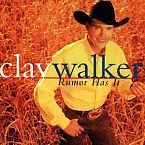
Album: Rumor Has It (1997)
Charted: 65
Play Video

Songfacts®:

  • Clay Walker can most likely be credited with introducing the steel drum into mainstream country music. It was such a departure for the genre that songwriter Randy Sharp worried it might not find an audience. But he loves the path least trodden, and thoroughly enjoyed what Walker did with this song. Says Sharp: "It was a writing session with my friend John Vezner, he co-wrote it with me. And John and I at that time were getting together every few months in my trips to Nashville, which I've been doing regularly since the early '80s, and we kind of always have written what we feel like is a little outside of the predictable for the Nashville scene. And that's been a good thing often, like in the case of 'Then What?' But many times I think because of our indulgence in trying to write things that are a little bit odd, it's probably kept us from getting more co-writes cut. But Clay Walker was someone that he knew, and he was able to actually get on his bus and play it for him in a rough guitar/vocal form, and got him excited about it just with that. So that was a real unusual story as far as how it got cut as well.

    We hadn't put a steel drum on the demo. The steel drum was all Clay. In fact, when he said he was going to do the song we hadn't even demoed it yet. That was just John getting on Clay's bus out somewhere in the middle of the country, where he ran into him, and saying, 'Here's something I'm working on,' played it on a guitar, and he just went for it."
  • As hard-core songwriters, Sharp and Vezner are prone to sitting down at a session and brainstorming ideas. "My memory on it is a little fuzzy," says Sharp, "but I'm guessing that we were probably talking about a mutual friend – and there's plenty of them that've had this experience - who stepped over that line, and all the trouble he got into for not thinking ahead, and going ahead and having that affair, and thinking he could pull it off, and thinking it wouldn't destroy everything. And I'm sure that's where the conversation started."
    When throwing ideas around a room, sometimes someone throws out a "little jewel," a phrase that scans well, and causes "everybody's eyes to get big, because we know what we want to write now." Such was the case with this song. "It's real easy to remember it this way – whether it's true or not – that we were telling these stories about our friend, and one of us, after a pause, just said, 'Well, then what do you do?' You know, once you've taken that step, and there's no going back over that bridge, then what happens? And that was basically it. John and I both also are real fans of playing with the language, and in that song there's a lot of that rapid-fire lyric, there's a lot of words in that song, which is always a challenge to make up. And the subject's pretty serious, but the delivery of it and the lyric, I think, there's a lightness to it, kind of a fun-ness to it, and we kept that in. And a lot of it has to do with just the way the words are working together and there's a lot of little tricky things we did in there purposefully just to take some of the darkness out of the theme."
  • "Pretty much it's 5-7 years before my stuff gets cut after I write it," explains Sharp. Which isn't uncommon in the music industry. "It gets pitched over and over and, because I don't tend to write for what's going on right now, I try to write a little bit outside of that, and kind of quirky. So it takes longer to find a home for these things. So the fact that John and I wrote this strange little song, and it found a home almost immediately, was really unusual. And without a real polished demo."
    And then, with that steel drum in the Country music format, "That's really surprising that it was such a big hit. I'm glad he did it that way. If he'd not felt like he had to groom it a little bit for the market, that was an obvious place to go, and he took that, and I'm really glad that he did. He did a real good job on it." (Read more in our interview with Randy Sharp.)

Comments: 1

  • Barry from Sauquoit, NyOn this day in 1998 {April 5th} "Then What?"* by Clay Walker peaked at #2 {for 1 week} on Billboard's Hot Country Singles chart, for the week it was at #2, the #1 record for that week was "Perfect Love" by Trisha Yearwood...
    "Then What?" also reached #4 on the Canadian RPM Country Singles chart...
    Between 1993 and 2012 the Vidor, Texas native had forty records on the Hot Country Singles chart, seventeen made the Top 10 with six reaching #1...
    He just missed having two more Top 10 records when both his "Where Do I Fit In The Picture" {1994} and "Live, Laugh, Love" {1999} peaked at #11...
    Ernest Clayton Walker Jr. will celebrate his 52nd birthday in four months on August 19th, 2021...
    * "Then What?" was the third of three of his records to peak at #2, his other two #2 records were "Who Needs You Baby" for two weeks in November of 1995 and "Hypnotize The Moon" for one week in April of 1996..
    And from the 'For What It's Worth' department, the remainder of the Hot Country Singles' Top 10 on April 5th, 1998:
    At #3. "If I Never Stop Loving You" by David Kersh
    #4. "Bye Bye" by Jo Dee Messina
    #5. "Nothin' But The Taillights" by Clink Black
    #6. "You're Still The One" by Shania Twain
    #7. "This Kiss" by Faith Hill
    #8. "Two Pina Coladas" by Garth Brooks
    #9. "Valentine" by Martina McBride with special guest artist Jim Brickman
    #10. "Dream Walkin'" by Toby Keith
see more comments

Editor's Picks

Joe Elliott of Def Leppard

Joe Elliott of Def LeppardSongwriter Interviews

The Def Leppard frontman talks about their "lamentable" hit he never thought of as a single, and why he's juiced by his Mott The Hoople cover band.

Laura Nyro

Laura NyroSongwriting Legends

Laura Nyro talks about her complex, emotionally rich songwriting and how she supports women's culture through her art.

Dwight Twilley

Dwight TwilleySongwriter Interviews

Since his debut single "I'm On Fire" in 1975, Dwight has been providing Spinal-Tap moments and misadventure.

Why Does Everybody Hate Nu-Metal? Your Metal Questions Answered

Why Does Everybody Hate Nu-Metal? Your Metal Questions AnsweredSong Writing

10 Questions for the author of Precious Metal: Decibel Presents the Stories Behind 25 Extreme Metal Masterpieces

Billy Joe Shaver

Billy Joe ShaverSongwriter Interviews

The outlaw country icon talks about the spiritual element of his songwriting and his Bob Dylan mention.

Gene Simmons of Kiss

Gene Simmons of KissSongwriter Interviews

The Kiss rocker covers a lot of ground in this interview, including why there are no Kiss collaborations, and why the Rock Hall has "become a sham."