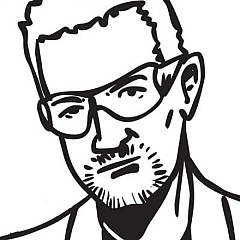
David Byrne was born in Dumbarton, Scotland, and moved with his family first to Canada and then to Maryland. The frequent relocations, combined with his strong accent and natural shyness, cemented a sense of cultural detachment that later became a recurring theme in his songwriting and stage persona.
Before forming Talking Heads, Byrne briefly pursued visual art rather than music as a career path. He attended Rhode Island School of Design during 1970-71 and later studied at Maryland Institute College of Art but dropped out of both. His exposure to Bauhaus-influenced design theory, conceptual art projects and hands-on work in printmaking and photography left a lasting imprint. That art-school perspective shaped the band's carefully constructed visuals, from album packaging to stage shows and music videos.
Byrne co-founded Talking Heads in New York in 1975 with fellow RISD students Chris Frantz and Tina Weymouth. They took the band's name from a television production term describing a tight camera shot of a person speaking directly to the viewer, typically a news anchor.
One of Byrne's earliest songwriting efforts became the band's signature track. "
Psycho Killer" was only the second song he ever wrote, yet it helped establish Talking Heads as a major presence in the emerging New York new-wave scene. Byrne also became known for his intentionally awkward and literal stage announcements, including the famously deadpan introduction, "The name of this band is Talking Heads."
In the late 1980s, Byrne expanded his creative reach by founding Luaka Bop, a label dedicated to promoting international artists. The project played a key role in introducing Western audiences to Brazilian, Cuban and African performers years before global music became widely marketed as "world music."
Byrne's interest in visual identity famously surfaced in the concert film
Stop Making Sense, where he wore
an oversized business suit. He conceived the costume as a conceptual art piece designed to exaggerate human proportions and highlight themes of identity and performance.
Away from Talking Heads, Byrne earned major film-music acclaim when he co-wrote the score for The Last Emperor, directed by Bernardo Bertolucci. The soundtrack won both Academy and Grammy awards, marking Byrne as a serious composer beyond the rock world.
Beyond music, Byrne has built a wide-ranging multidisciplinary career. He wrote and directed the Texas-set musical film True Stories, blending surreal humor, social commentary and songs inspired by real tabloid headlines. His theatrical concert production American Utopia featured musicians performing wirelessly while executing choreographed marching routines in matching grey suits. The show became a Broadway success and was later filmed by Spike Lee.
Cycling is another of Byrne's long-standing passions. He documented his global travels and observations about urban culture in his book Bicycle Diaries and even designed a series of playful public bicycle racks shaped like figures and animals that were installed in New York and at cultural venues, including Stanford's Cantor Arts Center.
Byrne describes himself as sitting somewhere on the autism spectrum, noting that intense concentration on drawing and music helped him channel early social awkwardness into creative expression. These traits surface lyrically in various early Talking Heads tracks such as "
New Feeling," a song that explores communication difficulties through anxious, repetitive imagery. Byrne later revisited these themes in the reflective solo track "
I'm An Outsider," this time approaching social displacement with humor and acceptance.