This song is about rock star excess and the easy life it brings compared with real work. Mark Knopfler wrote it after overhearing delivery men in a New York department store complain about their jobs while watching MTV. He wrote the song in the store sitting at a kitchen display they had set up. Many of the lyrics were things the workers actually said.
Sting sings on "Money For Nothing" and helped write it (he and Knopfler are the credited writers). That's him at the beginning singing "I want my MTV."
Sting didn't want a songwriting credit, but his record company, A&M, did because they earned royalties from it. They claimed it sounded very similar to a song Sting wrote for The Police: "
Don't Stand So Close To Me."
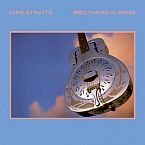
"Money For Nothing" was the lead single from Dire Straits' Brothers In Arms album, recorded at the tiny Caribbean island of Montserrat. There was a studio there called AIR (Associated Independent Recording), established by Beatles producer George Martin. It was active from 1979 until Hurricane Hugo wiped it out in 1989.
The Police recorded their Ghost In The Machine and Synchronicity albums there, so Sting knew it well. He took a working vacation to the island, dropping by to lend his vocals.
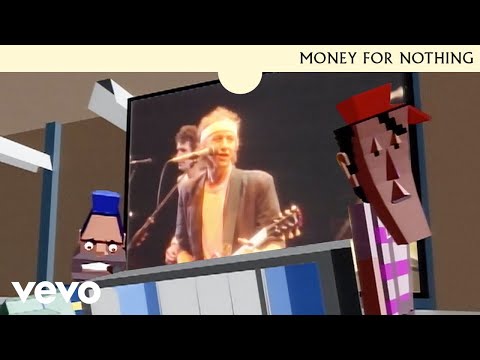
The innovative video was one of the first to feature computer generated animation, which was done using an early program called Paintbox. The characters were supposed to have more detail, like buttons on their shirts, but they used up the budget and had to leave it as is. It won Best Video at the 1986 MTV Video Music Awards.
The video was directed by Steve Barron, who also directed the famous a-ha video for "
Take On Me" and Thomas Dolby's "
She Blinded Me With Science."
In the book I Want My MTV, various people who worked at the network explain that Dire Straits' manager asked the network what they could do to get on the network and break through in America. Their answer was: write a hit song and let one of the top directors make a video. Mark Knopfler took the directive to write an "MTVable song" quite literally, using the network's tagline in the lyrics. The song ended up sounding like an indictment of MTV, but Les Garland, who ran the network, made it clear that they loved the song and were flattered by it - hearing "I Want My MTV" on the radio was fantastic publicity even if there were some unfavorable implications in the lyrics.
Steve Barron was dispatched to do the video, and charged with the task of convincing Mark Knopfler, who hated videos, to do one that was groundbreaking. Barron says that Knopfler wasn't into the idea, but his girlfriend - an American - was at the pitch and loved the idea. Knopfler agreed (in part because he didn't have to appear in it), and Barron hired a UK production company called Rushes to work on it. Said Barron: "The song is damning to MTV in a way. That was an ironic video. The characters we created were made of televisions, and they were slagging off television. Videos were getting a bit boring, they needed some waking up. And MTV went nuts for it. It was like a big advertisement for them."
The line "I want my MTV" was the basis of the cable network's promotional campaign. They played clips of musicians saying, and often times, screaming the line between videos.
The video was the first one played on MTV Europe when it went on the air August 1, 1987, six years after MTV in the US.
The album version runs 8:26 with an extended outro. The single was cut down to 4:38.
"Money For Nothing" was Dire Straits' biggest hit, going to #1 in America for three weeks. In the UK, the follow-up was the somber "
Brothers In Arms," but in America it was followed by the upbeat "
Walk Of Life," which also did well on MTV but with a very low-tech video filled with sports bloopers.
The album was huge, going to #1 in most territories and making Dire Straits global superstars. The following tour took them to 23 countries and lasted a year. By the end of it, they were fried and took a long hiatus. They didn't release another studio album until
On Every Street in 1991. It ended up being their last - Mark Knopfler found that he liked working on a smaller scale, often with somebody else in charge. He worked on various movie soundtracks, released some solo albums, and did lots of session work and touring for other artists, including Eric Clapton, Aaron Neville and George Jones.
Mark Knopfler played a Les Paul Junior plugged into a Laney amp on this track. Producer Neil Dorfsman recalled in Sound On Sound magazine May 2006: "We were going for a ZZ Top sound, but what we ended up getting was kind of an accident."
Bassist John Illsley added to Uncut magazine: "Somebody knocked over a microphone, it was lying on the ground, and Mark started playing. Neil Dorfsman stood up and said, 'Don't move anything, that's the sound.' So the rather extraordinary guitar sound on 'Money For Nothing' was produced by somebody knocking something over."
1985 was a big year for Sting, who released his first solo album,
The Dream Of The Blue Turtles, a few weeks after this song appeared on the
Brothers In Arms album. When "Money For Nothing" hit #1 in the US on September 21, 1985, Sting was also on the chart with "
Fortress Around Your Heart" and "
If You Love Somebody Set Them Free."
The song stirred up some controversy with the line, "See the little fa--ot with the earring and the makeup," as well as two other mentions of the word "fa--ot." At one point it was banned by the Canadian Broadcasting Corporation.
Mark Knopfler has pointed out that the song was written from the viewpoint of a stupid character who thinks musicians make their "money for nothing," and this guy's stupidity is what leads him to make ignorant statements. Speaking in late 1985 to Rolling Stone, the Dire Straits songwriter expressed his feelings about people who react angrily to the song. He said: "Apart from the fact that there are stupid gay people as well as stupid other people, it suggests that maybe you have to be direct. I'm in two minds as to whether it's a good idea to take on characters and write songs that aren't in the first person."
"Weird Al" Yankovic parodied this song for his 1989 movie
UHF. The parody is called "Beverly Hillbillies (Money For Nothing)" - it's a mashup with the
theme song to the TV series Beverly Hillbillies.
The guitar on the parody is pretty convincing - that's because it's Mark Knopfler! He agreed to the parody on the condition that he play on it.
In 2005, the duo Deep Dish sampled this on their song "Flashing For Money," which was based on their song "Flashdance" (not the Irene Cara song). It was the first time Dire Straits allowed one of their songs to be sampled. "Flashing For Money" was released on the B-side of Deep Dish's single "Say Hello."
Mark Knopfler was once a reporter working on the Yorkshire Evening Post. He told Uncut magazine that his journalistic experience fed into this song. "I was reporting, verbatim, what a particular guy thought about music," he said. "I transcribed his words there and then. He was a meathead. To him being a rock star was easy, hence 'that ain't working.'"
Keyboardist Alan Clark told Mojo magazine the song was transformed out of the ordinary because of Mark Knopfler's perfectionist nature. "In the beginning," he said, "'Money For Nothing' sounded more like a Stones track and it didn't have the iconic guitar riff. Mark developed that messing around to a click track on his own on Montserrat."
Dire Straits won the first of their two Grammy Awards when "Money For Nothing" took Best Rock Vocal Performance by a Duo or Group in 1986. The following year, they won Best Music Video, Short Form, for "Brothers In Arms."
Reel Big Fish released an album in 2007 called
Monkeys For Nothin' And The Chimps For Free. The title is a takeoff on this song.
>>>
Suggestion credit:
Bertrand - Paris, France
Fun fact: Before making it in music, both Sting and Mark Knopfler were teachers.
Anyone remember who went on before Queen wowed the crowd at Live Aid from the Wembley Stadium stage? It was Dire Straits with a two-song set: "
Sultans Of Swing" and "Money For Nothing," joined by Sting. "Sultans," though, was a 10-minute extended version.
At the time, Dire Straits was in the middle of a two-week run of shows at Wembley Arena, across the parking lot from Wembley Stadium. When they finished their Live Aid set, they walked over to their Arena gig.