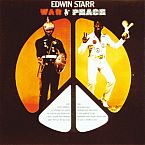
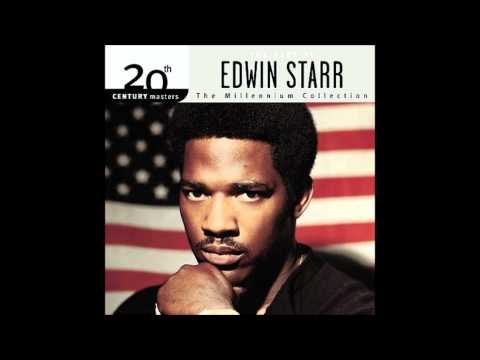
One of the most powerful and straightforward anti-war songs ever recorded, "War" was released at the height of the Vietnam War, but the song makes a broader statement of the need for harmony in our everyday lives. Edwin Starr explained to the UK newspaper The Voice in 2001: "The song was never about the Vietnam War. It was about the neighborhood wars and the racial wars that were going on inside America at the time. It just happened to coincide with the war in Vietnam."
Motown hitmakers Norman Whitfield and Barrett Strong wrote this song, and Whitfield produced it. Edwin Starr began his career recording for Ric-Tic Records, a Detroit label that was a rival to Motown. In 1968, Motown bought Ric-Tic, which gave Starr access to their writers and producers but put him in competition with established stars on the label like Marvin Gaye, The Temptations and The Four Tops. "War" was a big break for him.
"Before that came along I had no direction to go in and really didn't know what to do next, he told Disc and Music Echo. "I was very lucky to be offered 'War' because not only is it a fantastic song but because I really believe in the lyric. And I recorded it with as much conviction as possible. I was pleased to record it because the lyrics mean more than most songs."
The Temptations were the first to record this song; it was included on their 1970 album Psychedelic Shack. Motown had no intention of releasing it as a single, but many in the protest movement, especially college students, made it clear that the song would be a big hit if it was. Motown head Berry Gordy had other plans for The Temptations and didn't want them associated with such a controversial song, so he had Starr record it and his version was released as a single. Starr didn't have as big a fan base to offend.
The song was a huge hit, going to #1 in America and galvanizing the protest movement. It's very different from the folk songs of the '60s that made their case against the war with acoustic guitars and subtle references. By 1970, many Americans were at the shouting stage when it came to opposition to the Vietnam War, and Edwin Starr spoke for them in "War."
Starr added the interjections "good God y'all" and "absolutely nothing," which became some of the most famous ad-libs in music history.
Starr won the Grammy Award for Best R&B Male Vocal for this song.
This is a very sincere song about the horrors of war, but it has been used for comic effect in a number of movies and TV series. It appeared in Family Guy ("Bigfat" - 2013), The Simpsons ("Treehouse of Horror VIII" - 1997) and two episodes of Seinfeld ("The Marine Biologist" - 1994, "Highlights of a Hundred" - 1995). Movie uses include the 1988 blaxploitation spoof I'm Gonna Git You Sucka, and the 1998 film Rush Hour with martial arts star Jackie Chan and comedian Chris Tucker. Here are some others:
Movies
Teenage Mutant Ninja Turtles: Out of the Shadows (2016)
Grudge Match (2013)
Blood: The Last Vampire (2009)
Rush Hour 3 (2007)
Guy X (2005)
High Heels and Low Lifes (2001)
Backdraft (1991)
One More Saturday Night (1986)
Pacific Inferno (1979)
TV
Xena: Warrior Princess ("Lyre, Lyre, Hearts on Fire" - 2000)
Boy Meets World ("Cutting the Cord" - 1999)
The Wonder Years ("The Journey" - 1990)
Bruce Springsteen's version was a hit in 1986. It was the first single released from his boxed set, Live 1975-1985, and reached US #8 and UK #18. Springsteen first performed it on September 27, 1985 during his Born In The U.S.A. tour. He taped the lyrics to his arm so he wouldn't screw them up.
The Jam released their cover in 1982 as the B-side of their single "Just Who Is The 5 O'Clock Hero." Other artists to cover it include Frankie Goes to Hollywood, Joan Osborne and Maria Muldaur.
Edwin Starr died of a heart attack in 2003 at 61. His other big hit was "
Twenty-Five Miles," which reached #6 in 1969. His star fell in the late '70s but he revived his career by moving to England in 1983, where the audience was more receptive.
This song has a very distinct tambourine part, played by percussionist Jack Ashford. He was one of the Motown Funk Brothers who played on the track; bass player Bob Babbitt and guitarist Dennis Coffey were also part of it.
Coffey came up with the psychedelic guitar sound Norman Whitfield used on "
Cloud Nine" by The Temptations, which marked a musical shift for the label. In a
Songfacts interview with Coffey, he said: "Norman wanted to change the sound of Motown, and I was the guy that helped him do it. He wanted to get into that protest and social consciousness stuff, so I did that fuzz tone thing up high on 'War.'"
Starr's follow-up to "War" was "
Stop The War Now," a song with a very similar message and many of the same elements, including Starr's "Good God!" interjections. That song, which was also written by Norman Whitfield and Barrett Strong, was a modest hit, charting at #26.
It wasn't unusual for Motown to follow-up a hit song with a very close soundalike. Perhaps the most blatant example is "
It's the Same Old Song" by The Four Tops, which winks at the copycat nature in the title. That one is a clone of their hit "
I Can't Help Myself (Sugar Pie Honey Bunch)."
"War" was one of the first Motown songs to make a political statement. The label had always been focused on making hit songs, but around this time Motown artists like The Temptations and Marvin Gaye started releasing songs with social commentary, many of which were written by Norman Whitfield.
Edwin Starr wasn't happy with the way he was treated at Motown and he felt the label squandered an opportunity with him. Speaking with the magazine Blues & Soul, he explained: "When you look back to the time that 'War' was #1 around the world – bear in mind, this record was one of their biggest all-time sellers ever - I was never given the opportunity to go out on promotional trips and I seemed to get no real recognition," he said. "Lord, if I could ever have been a superstar, then that was the time."