A Fistful Of Dollars - Finale

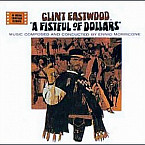
Album: A Fistful Of Dollars soundtrack (1964)
Play Video

Songfacts®:

  • In Sergio Leone's 1964 Spaghetti Western A Fistful Of Dollars, Clint Eastwood plays a gunslinger who arrives in a Mexican town and manipulates a feud between two rival families for his own gain.

    In the final showdown, Eastwood's unnamed stranger faces off against the surviving family to the strains of a solemn trumpet theme by Italian composer Ennio Morricone.
  • Leone originally wanted to use Dimitri Tiomkin's "El Deguello," which was used in the 1959 Western Rio Bravo, because he mistakenly assumed it was a much older song that was already in the public domain. Morricone was so offended by the idea that he quit.

    "I told him, 'If you use it, I quit.' And I did - in 1963, a year in which I was penniless!" Morricone recalled in his 2019 autobiography. "Shortly after, Leone stepped back and allowed me more freedom, although he was annoyed. 'Ennio, I ain't asking you to imitate it, just come up with somethin' similar.'

    What was he trying to say by that? That I had to stick to what that scene meant to him: a death dance fitting a southern Texas atmosphere, where, according to Sergio, the tradition of Mexico and the United States blended."

    Morricone already had a piece of music in mind - a lullaby he wrote for Eugene O'Neill's Three Plays Of The Sea, a made-for-TV adaptation of three of the playwright's sea-based plays.

    "I rearranged it in a more incisive way so as to extol the mounting solemnity of the trumpet leading the viewers into the duel. I played it for him at the piano, and I saw he was convinced," he explained. "'It's perfect, it's perfect. But you must make it sound similar to 'Deguello.'"
  • The iconic trumpet solo was played by Michele Lacerenza, an Italian musician who also performed on the soundtrack of the other two films in the Dollars trilogy: For A Few Dollars More and The Good, The Bad, And The Ugly.

    Morricone said he had Lacerenza in mind when he composed the solo, but Leone was adamant they use a famous trumpeter named Nini Rosso. Fortunately for Lacerenza, Rosso was too busy to take the gig, but Leone's rejection left him shaken during his performance. Morricone recalled in his 2019 autobiography:

    "Michele performed all the melismas and ornamentations I had written with the Mexican and military intention I requested, and added something more: during the final recording he played with tears in his eyes, well aware that Leone did not want him. 'Don't worry,' I told him, 'play this the for me with a kind of military timbre, a little Mexican flavor, let yourself be transported by the melismas I wrote, play them freely.'"
  • The famous scene shows up in Back To The Future Part II when Marty McFly finds Biff Tannen watching the movie in his hot tub. When Marty ends up in an Old West showdown with Griff Tannen in part III, he borrows Eastwood's idea for a makeshift bulletproof vest.
  • In the 2007 pilot episode of Chuck, Morgan plays this on the Buy More's sound system as Chuck vies against his nemesis for a managerial position.
  • This was used in Quentin Tarantino's Kill Bill Vol. 2 (2004) in a scene where Budd (Michael Madsen) incapacitates The Bride (Uma Thurman). Morricone also provided some music for Django Unchained and composed the Oscar-winning score to Tarantino's 2015 film, The Hateful Eight.

Comments

Be the first to comment...

Editor's Picks

Muhammad Ali: His Musical Legacy and the Songs he Inspired

Muhammad Ali: His Musical Legacy and the Songs he InspiredSong Writing

Before he was the champ, Ali released an album called I Am The Greatest!, but his musical influence is best heard in the songs he inspired.

Michael Sweet of Stryper

Michael Sweet of StryperSongwriter Interviews

Find out how God and glam metal go together from the Stryper frontman.

Devo

DevoSongwriter Interviews

Devo founders Mark Mothersbaugh and Jerry Casale take us into their world of subversive performance art. They may be right about the De-Evoloution thing.

Dennis DeYoung

Dennis DeYoungSongwriter Interviews

Dennis DeYoung explains why "Mr. Roboto" is the defining Styx song, and what the "gathering of angels" represents in "Come Sail Away."

Tom Bailey of Thompson Twins

Tom Bailey of Thompson TwinsSongwriter Interviews

Tom stopped performing Thompson Twins songs in 1987, in part because of their personal nature: "Hold Me Now" came after an argument with his bandmate/girlfriend Alannah Currie.

Evolution Of The Prince Symbol

Evolution Of The Prince SymbolSong Writing

The evolution of the symbol that was Prince's name from 1993-2000.