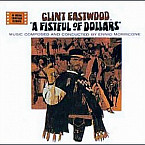
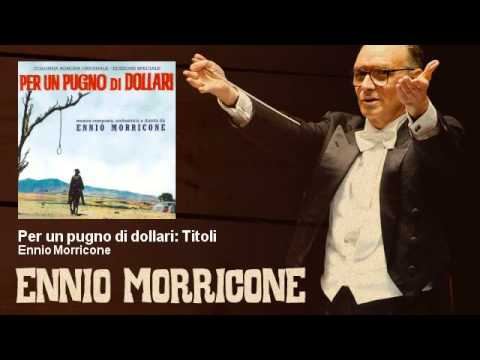
A Fistful Of Dollars - Titles

Album: A Fistful Of Dollars soundtrack (1964)
Play Video

Songfacts®:

  • A reworking of Woody Guthrie's "Pastures of Plenty," this instrumental arrangement by Ennio Morricone plays over the opening credits of A Fistful Of Dollars, a Spaghetti Western remake of Akira Kurosawa's 1961 Japanese samurai film Yojimbo. The movie is the first installment in Italian director Sergio Leone's Dollars trilogy. It stars Clint Eastwood (in his first leading movie role) as an unnamed stranger who gets mixed up in a feud between rival families of smugglers fighting for control of a small town on the Mexico-United States border.

    An international co-production between Italy, West Germany, and Spain, A Fistful Of Dollars debuted in Italy in 1964 and the United States in 1967. Although it initially received poor reviews in both countries, the movie was a hit with audiences and earned nearly $20 million worldwide - far exceeding its $200,000 budget.
  • A Fistful Of Dollars is Leone's first collaboration with Italian composer Ennio Morricone, who continued to work with the director on all of his other films, including the other two installments in the Dollars trilogy, For A Few Dollars More and The Good, The Bad, And The Ugly.

    During their meeting for the first film, Morricone played him an arrangement of Woody Guthrie's "Pastures Of Plenty," which was released as a single in 1962 with vocals by folk singer Peter Tevis. At Leone's insistence, he reworked the tune for the movie's opening titles.

    Reflecting the mood of Eastwood's lonely gunslinger, the instrumental builds on the gentle strains of an acoustic guitar and a whistled melody, joined by an electric guitar and punctuated by whip cracks, bells, flutes, and chants. Morricone liked to use unusual sounds to capture the tone of a film. He told Dazed in 2006: "For A Fistful Of Dollars, I was thinking about a peasant who lives in the countryside and listens to a faraway sound - a nostalgic sound."
  • Peter Tevis also recorded lyrics for the theme, but they weren't used in the final film. To coincide with the movie's US debut, United Artists Records tapped Little Anthony and the Imperials to record a version of Morricone's theme with new lyrics titled "Restless One." It appeared on the R&B groups 1967 album Movie Grabbers (which also featured their take on the James Bond theme "You Only Live Twice").
  • Morricone composed most of the score before the movie was filmed, which was an unconventional approach to making movie music, but one that Leone preferred. "For him, music really was as important as dialog and all the other components. Therefore, he felt it was important to ask me to write the music before he shot the film," Morricone explained in a 1994 interview.
  • The movie is credited with popularizing European-produced cowboy films dubbed Spaghetti Westerns because they were often made by Italian directors like Leone. Because the genre was new to Americans, many of the cast and crew members were forced to Anglicize their Italian and Spanish names in the movie's credits for the sake of marketability. Sergio Leone became "Bob Robertson" and Ennio Morricone became "Dan Savio."
  • Although Morricone created a large body of work outside of Spaghetti Westerns - including dramatic films of the '80s like The Untouchables, Casualties Of War, and Frantic - he didn't mind being associated with the genre. It was the terminology that bothered him. "Calling them Spaghetti Westerns is what really infuriates me," he told Dazed. "I never thought to call American Western films 'Yankee Westerns.'"
  • Morricone knew that he and Leone were doing something important in terms of Italian filmmaking, but he was surprised by the movie's reputation as a classic. When asked why the movie made such an impact, the composer told The Guardian: "I don't know. It's the worst film Leone made and the worst score I did."
  • According to Morricone, his childhood friend Alessandro Alessandroni whistled on the track, and Bruno Battisti D'Amario played the electric guitar.
  • Morricone's innovative theme was not typical of Western film music - especially his use of the electric guitar. But the instrument was not new to the composer's repertoire. He noted in his autobiography: "When A Fistful Of Dollars came out, many people praised it as a novelty, but the truth is I had already been using the electric guitar for years, albeit not as a solo instrument. Its tough and sharp timbre was perfect for the film's atmosphere."

Comments

Be the first to comment...

Editor's Picks

Tommy James

Tommy JamesSongwriter Interviews

"Mony Mony," "Crimson and Clover," "Draggin' The Line"... the hits kept coming for Tommy James, and in a plot line fit for a movie, his record company was controlled by the mafia.

Steely Dan

Steely DanFact or Fiction

Did they really trade their guitarist to The Doobie Brothers? Are they named after something naughty? And what's up with the band name?

David Gray

David GraySongwriter Interviews

David Gray explains the significance of the word "Babylon," and talks about how songs are a form of active imagination, with lyrics that reveal what's inside us.

JJ Burnel of The Stranglers

JJ Burnel of The StranglersSongwriter Interviews

JJ talks about The Stranglers' signature sound - keyboard and bass - which isn't your typical strain of punk rock.

Tim McIlrath of Rise Against

Tim McIlrath of Rise AgainstSongwriter Interviews

Rise Against frontman Tim McIlrath explains the meanings behind some of their biggest songs and names the sci-fi books that have influenced him.

George Clinton

George ClintonSongwriter Interviews

When you free your mind, your ass may follow, but you have to make sure someone else doesn't program it while it's wide open.