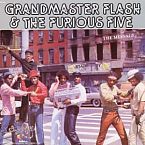
Album: The Message (1982)
Charted: 8 62
Play Video

Songfacts®:

  • "The Message" is the best-known track by legendary hip-hop innovators Grandmaster Flash and the Furious Five, and is a song that, without exaggeration, changed rap music's tone and content forever. With its hard-boiled chorus ("It's like a jungle sometimes / It makes me wonder how I keep from going under.") and unflinching observation of the perils and anxieties of contemporary urban life, "The Message" compelled Hip-Hop records away from their early emphasis on party anthems and empty braggadocio and toward the fearless social commentary that has dominated many of the form's most important recordings since. Indeed, when Public Enemy leader Chuck D proclaimed, famously, in the late '80s, that rap's ongoing documentation of problems for inner city African Americans made it "the black CNN," it was presumably songs like "The Message" and its inheritors that he had in mind. And while the song's importance cannot be overstated within the development of Hip-Hop, specifically, its influence extends well beyond popular music: as seen, for example, by its inclusion in academic texts like The Norton Anthology of African American Literature.
  • Ed "Duke Bootee" Fletcher, who was a staff songwriter as Sugarhill Records, started writing this song on a piano in his mother's basement in 1980. He made a demo of the song with his own raps and took it to label boss Sylvia Robinson, who asked Grandmaster Flash & the Furious Five to record it. Flash would later speak of the song as a landmark in the evolution of rap, but he and the group wanted nothing to do with the song, and even ridiculed it when he heard the demo. "The subject matter wasn't happy. It wasn't no party s--t. It wasn't even some real street s--t. We would laugh at it," said Flash.

    With the band balking at recording the song, she decided to record it with the group's rapper Melle Mel trading verses with Fletcher. At this point, Flash asked Robinson to let the entire group perform on the track, but she refused. Melle added some additional lyrics to the song as well.
  • Unlike many early hip-hop hits, like Sugarhill Gang's "Rapper's Delight" or Kurtis Blow's "The Breaks," which turned on thumping, up-tempo disco tracks, composers Ed "Duke Bootee" Fletcher and MC Melle Mel based "The Message" on a slow groove and a reverberated synthesizer hook. Fletcher, a Sugarhill Records session player and aspiring producer, created most of the background music and all but one of the verses himself. (Note that Grandmaster Flash actually had very little involvement on the track.) As Fletcher admitted later, he'd been moved to write something in the spirit of Zapp's "More Bounce To The Ounce" or Tom Tom Club's "Genius Of Love," both of which utilized synthesizer hooks over an amped-up funk bass. The effect of the more relaxed tempo on "The Message," was to highlight Melle Mel's gritty rap about ghetto poverty and violence. (The single was definitely no call to the dance floor or invitation to wave one's arms in the air.) Effectively, then, this aesthetic decision had other lasting effects beyond the changes in rap lyrical content it inspired. That is, in moving away from rap's early emphasis as a DJ-centered dance music borne from Bronx block parties and Manhattan discos, "The Message" argued for the growing importance of the MC as community voice and political poet. Whereas MCs had originally been envisioned as mere complements to the turntable pyrotechnics of innovative DJs like DJ Hollywood or Grandmaster Flash, from this point onward, they emerged as hip-hop's vital interlocutors for the underprivileged, and as the music's prime movers and celebrities.
  • "The Message" is ubiquitous in American popular culture, turning up on innumerable old school rap compilations, in video games like Grand Theft Auto: Vice City, Scarface: The World Is Yours, and in movies like Happy Feet and American Wedding. It has been sampled or alluded to by a wide range of hip-hop performers, all calling attention to its foundational place in the genre's evolution. In November 2011, the track's legacy was made even more clear, with a performance at the Nomination Concert for the 54th Annual Grammys that featured Grandmaster Flash and Melle Mel joined by their artistic heirs LL Cool J, Common, and Lupe Fiasco.
  • Songwriting credits on this one read: Clifton Chase/Edward Fletcher/Melvin Glover (Melle Mel)/Sylvia Robinson. Chase was a producer at Sugarhill Records who worked on the song, and Robinson owned the label. Notably absent from the credits are all members of the group except for Melle Mel.
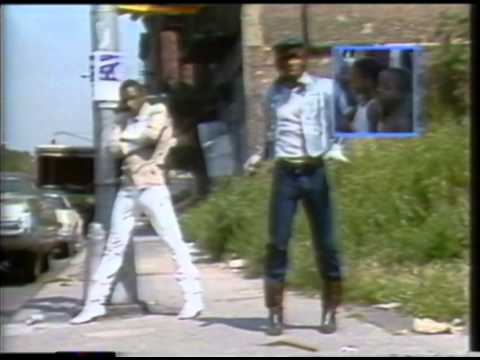
  • At the end of the song, the group does a skit where they are minding their own on a street corner when cops pull up and arrest them. This is the only time Flash & the Furious Five rappers besides Melle Mel appear on the track - the vocals were all Melle and Ed Fletcher. There was a video made for this song which showed Melle and Fletcher doing their verses while the other five guys hang out in the background. The skit gave them a brief acting role in the clip.
  • This was named the Greatest Hip-Hop song of all time in a 2012 list compiled by experts for Rolling Stone. The magazine said it was the first track, "to tell, with hip-hop's rhythmic and vocal force, the truth about modern inner-city life in America." Sugarhill Gang's 1979 hit "Rapper's Delight," was runner-up.
  • Some of Melle Mel's lyrics were recycled from the first Grandmaster Flash & the Furious Five single, "Superrapin," which was released in 1979. It contained the verse that begins, "A child is born with no state of mind..."
  • Rap songs often pilfer ideas from popular rock songs, but in this case, it was the other way around. Phil Collins got the idea for the lunatic laugh in the 1983 Genesis song "Mama" from this track.

Comments: 5

  • Ciccio from Cologne, GermanySorry, I got it wrong. Zircon is actually a gemstone by itself, used as diamond imitation.
  • Ciccio from Cologne, GermanyNicole, Strass (fake) jewellery often uses Zircon plating that gives a shiny effect like Platinum.
  • Brandi Nicole from IaWhat is a Zircon Princess reference too?
  • Matthew from Blue Ridge, GaKieran, Maytag was a brand name for a clothes washing machine. In other words, it's something that you stuff things in and it gets used a ton. Get it?
  • Kieran from Brisbane, AustraliaWhat does he mean when he says that you're a maytag?
see more comments

Editor's Picks

Director Mark Pellington ("Jeremy," "Best Of You")

Director Mark Pellington ("Jeremy," "Best Of You")Song Writing

Director Mark Pellington on Pearl Jam's "Jeremy," and music videos he made for U2, Jon Bon Jovi and Imagine Dragons.

Why Does Everybody Hate Nu-Metal? Your Metal Questions Answered

Why Does Everybody Hate Nu-Metal? Your Metal Questions AnsweredSong Writing

10 Questions for the author of Precious Metal: Decibel Presents the Stories Behind 25 Extreme Metal Masterpieces

Greg Lake of Emerson, Lake & Palmer

Greg Lake of Emerson, Lake & PalmerSongwriter Interviews

Greg talks about writing songs of "universal truth" for King Crimson and ELP, and tells us about his most memorable stage moment (it involves fireworks).

Paul Williams

Paul WilliamsSongwriter Interviews

He's a singer and an actor, but as a songwriter Paul helped make Kermit a cultured frog, turned a bank commercial into a huge hit and made love both "exciting and new" and "soft as an easy chair."

Harry Wayne Casey of KC and The Sunshine Band

Harry Wayne Casey of KC and The Sunshine BandSongwriter Interviews

Harry Wayne Casey tells the stories behind KC and The Sunshine Band hits like "Get Down Tonight," "That's The Way (I Like It)," and "Give It Up."

Tony Iommi of Black Sabbath, Heaven And Hell

Tony Iommi of Black Sabbath, Heaven And HellSongwriter Interviews

Guitarist Tony Iommi on the "Iron Man" riff, the definitive Black Sabbath song, and how Ozzy and Dio compared as songwriters.