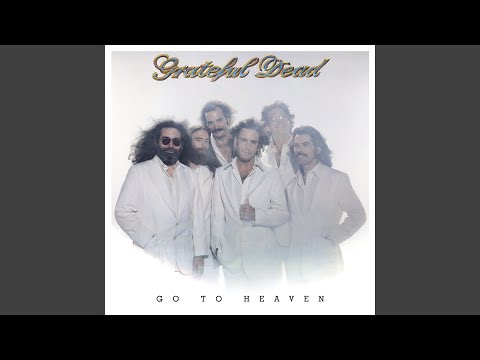
"Althea" is like pants with a sturdy elastic waistband: It grows and shrinks with listeners as they move through life, contracting and expanding, but always fitting. It follows the formula of Dead lyricist Robert Hunter (similarly employed by Bob Dylan, Neil Young, and others) in that it has simple central narrative that gets turned sideways by a few distinct lyrical points and allusions, turning a straightforward story into a pleasantly confounding mystery.
The song starts with our narrator "Jim," sung by Jerry Garcia (who wrote the music to go along with Hunter's words), telling Althea that he feels "lost." Althea responds that his "back might need protection," and Jim responds that he is indeed feeling torn apart by treachery. Jim then suggests that he was "born to be a bachelor," implying the relationship isn't working for him. Althea consents to the idea and breaks their partnership.
Jim realizes he's made a mistake. At the time of the song, he's "out trying to catch her." So, most of the Althea narrative happened prior to the moment the song is ostensibly being written from. All clear and good, but a few things give the song a mystical depth.
One verse in particular turns the song sideways and leaves us wondering:
Can't talk to you without talking to me
We're guilty of the same old thing
Thinking a lot about less and less
And forgetting the love we bring
The verse may be a simple philosophical musing, but it also casts confusion about who exactly has been speaking. Was the song all one streaming internal dialogue? Is Althea actually some part of Jim's psyche? Is Jim some part of Althea's? Are the mystics right that "all is one" and therefore we're always talking to ourselves - and if so, what does that imply for both this song and our lives? It's verses like this that turn an otherwise simple song into something perplexing and mysterious.
There are repeated allusions to Shakespeare's Hamlet in "Althea."
You may be a clown in the burying ground
Or just another pretty face
You may be the fate of Ophelia
Sleeping and perchance to dream
"To sleep, perchance to dream," is part of the famous "To be or not to be" soliloquy from Hamlet. The full line goes, "To sleep, perchance to Dream; aye, there's the rub."
Ophelia is a potential wife of Hamlet who ends up losing her mind and drowning. A minor character in the play is named First Clown, who is one of two undertakers who provide comic relief to the tragic story - literally a clown in a burying ground. Or, the clown might be referencing Yorick, the court jester and friend of Hamlet, whose skull Hamlet finds in an open grave dug for Ophelia.
What is to be made of these obvious Hamlet references? Everyone has an idea but no one knows for sure. That's the point: Hunter was too much a spiritual seeker and artist to have no specific meaning in mind, but he also knew no one would know exactly what his intended meaning was. That's where the magic is. That's why "Althea" can grow and shift with us as we evolve. That's why groups like the Dead mean so much more than just entertainment to their fans. In wrestling with the songs, they become extensions of the listener's psyche as much as they were of Hunter's.
In Greek mythology, Althea was the Queen of Calydon. Her name is derived from "Althaía," which means "healer." There's no obvious connection between her and this song, but there is another interesting overlap. In a popular myth of Althea, she gave birth to a son (Meleager) who was fated to die the moment a certain brand was lighted and placed in the family hearth. After Meleager kills his two uncles in a dispute over a boar's skin, Althea lights the brand and throws it in the fire, killing her son.
The "Althea" line "loose with the truth, maybe it's your fire" may be referencing that myth.
You may be Saturday's child all grown
This is a reference to the "Monday's Child" (1838) nursery rhyme, which ascribes a singular quality to a child of each day of the week. Saturday's child "works hard for a living."
Dead biographer
Dennis McNally told Songfacts that he was tempted to read the song as a message from Hunter to Garcia about Garcia's worsening drug addiction issues. Hunter, who never liked discussing the details of his song's meanings, never confirmed that suspicion. Other Dead scholars such as David Dodd, author of
The Complete Annotated Grateful Dead Lyrics and writer at Dead.net (the Dead's official website), have wondered about the same connection.
McNally also suggested that he felt the Dead overplayed the song in the early 1980s.
The Dead played "Althea" live 273 times, tying it with "Candy Man" and "Row Jimmy" for the 51st-most played Dead song.
Garcia sings, "Can't talk to you without to me." In his book of collected lyrics, Box of Rain, Hunter has it flipped around as "Can't talk to me without talking to you." Seeing as Hunter was the lyricist, his version was probably the original.