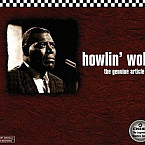
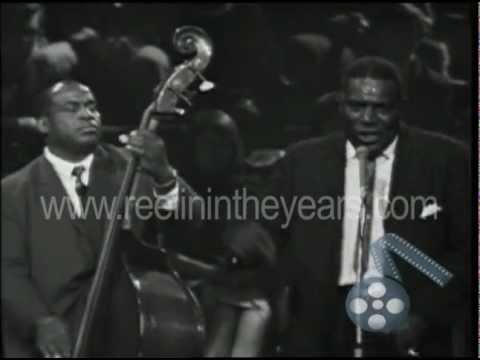
At night Chester Burnett would sit outside watching trains roll across the Mississippi countryside. Sometimes the trains' smokestacks shot off sparks. The image stuck in Burnett's mind, and one day he wrote a song around it. By that time, he was known around the world as Howlin' Wolf.
The song's original title was "Crying At Daybreak." The lyrics discuss an unfaithful woman and Wolf's heartbroken need to hop a train and leave town. The song's simplicity seems to conceal something darker and more mysterious. In discussing the strange power of "Smokestack Lightnin'," James Segrest and Mark Hoffman (authors of
Moanin' at Midnight: The Life and Times of Howlin' Wolf) captured it well when
they wrote, "It was not so much a song as a mood: insubstantial as a smoke ring melodically and lyrically, yet gigantic as a gathering storm in rhythm and power."
For his part, Wolf downplayed any deeper significance to the tune. Asked about the meaning, he replied, "Well, Smokestack Lightnin' means it's a train... that, uh, runs on the rails, you know."
Despite the wild implications of his show name, Howlin' Wolf was careful and deliberate in how he lived his life. He was also a shrewd businessman. Because of the financial reserves and reputation he built up, he regularly had his pick of the era's top musicians to back him, and some top-shelf musicians are heard on "Smokestack Lightnin'."
Wolf sang and played harmonica on the song. Backing him were multi-Hall-of-Fame inductee Willie Dixon on bass, Willie Johnson (inducted into Blues Hall of Fame in 2017) on guitar, Hosea Lee Kennard on piano, and Earl Phillips on drums. Hubert Sumlin, a regular in Wolf's backing bands, developed the hypnotic guitar line that is one of the song's most notable features.
The song's earliest incarnation was one of Wolf's first singles. He recorded it with RPM Records in 1951 under the title "Crying At Daybreak" and released it as the B-side to "Passing By Blues." Simultaneously, he released "Moanin' At Midnight" backed by "How Many More Years" under Chess Records (who, years later, would record the '56 version of "Smokestack Lightnin'" that's so revered today).
So, in a testament to the man's rare talent, two record companies were promoting his debut singles at the same time.
In 2001, erectile-dysfunction medication Viagra
ran a commercial with "Smokestack Lightnin'" playing in the background while a middle-aged gentleman in a cowboy hat harnessed horses to his pickup to get out of a mud pit.
Wolf started performing the song live as early as the 1930s.
Wolf likely took inspiration for the song's first line, "O-oh Smokestack Lightnin', shinin' just like gold, oh don't you hear me crying," from the Mississippi Sheiks' "Stop And Listen Blues," which includes the lyrics, "Cryin', Smokestack Lightnin', That bell that shine like gold, Now don't ya a-hear me talkin', pretty mama?" There's also a distinct similarity between the vocal delivery of the Sheiks' "be there ooh-ooh" and Wolf's "A-whoo-hoo."
"Big Road Blues" by Tommy Johnson and "Moon Going Down" by Charley Patton have also been cited as inspirations.
"Smokestack Lightnin'" hit #11 on the R&B chart in the US in 1956. It didn't chart in the UK but was popular with the youth there and was frequently covered by live bands. Pye International Records circulated it in the UK again on an EP in '63 and then as a single in '64. It peaked at #42 on October 6, 1964. The Pye release was probably the cause for the Yardbirds to cover "Smokestack Lightnin'" on their debut album, Five Live Yardbirds, in '64.
Yardbird Eric Clapton said the song was regularly the band's most popular live tune and that they'd sometimes extend the jam to as long as half an hour. According to Rhino Records' liner notes for Ultimate!, the Yardbirds' career retrospective album released in 2001, Wolf considered the Yardbirds version to be the definitive one.
Over the years, "Smokestack Lightnin'" has been covered by numerous artists, including:
John Lee Hooker
Bob Dylan
The Who
Widespread Panic
Lynyrd Skynyrd
Soundgarden
The Animals
Etta James
Quicksilver Messenger Service
The Yardbirds
In 1999 the song won a Grammy Hall of Fame Award.
"Smokestack Lightnin'" is universally recognized as one of the most important songs in blues history. Given the influence that blues had on American music and the influence American music had on world music, one could argue that status makes it one of the most important songs in modern history.
The Blues Foundation inducted the song into their Hall of Fame in 1985. The Rock and Roll Hall of Fame included it in a list of 500 Songs that Shaped Rock and Roll while Rolling Stone named it #291 on their list of the 500 Greatest Songs of All Time. The US Library of Congress added it to the National Recording Registry for permanent preservation in 2009.