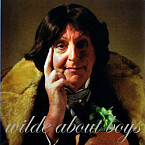

Wilde About Boys

Album: Wilde About Boys (2008)
Play Video

Songfacts®:

  • It is a sad fact that Phil Spector will probably be remembered as the murderer of actress Lana Clarkson rather than the inventor of the wall of sound. Terrible though Spector's crime was, it is possible to feel sympathy for him as a man driven by inner demons or just plain out of the loop. Just as sadly, Jonathan King will probably be remembered as a predatory paedophile rather than the composer of "Everyone's Gone To The Moon" or for all his other undoubted talents, but it is impossible to feel the slightest sympathy for him, although there is a school of thought that says that he and his ilk should be pitied.

    After serving a seven year gaol sentence for preying on young boys, King wrote a number of songs on related themes including "Vile Pervert". Having taken a swipe at the criminal justice system and what he sees as the hypocrisy and double standards of Western society, it was to be hoped he would have let it go. Alas, his convictions for the indecent assault and sodomizing of underage boys and the inability of all decent (and half-decent) people to share his depraved Weltanschauung has led him onto what undoubtedly he considers to be bigger and greater things, Vile Pervert: The Musical, which he refers to with his characteristic modesty as "The most exciting film of the century so far."

    "Wilde About Boys" is from this musical, and contains the refrain "There's nothing wrong with buggering boys". That may be King's view but it is one that is manifestly not shared by the people who run the criminal justice system, and at the very least he should watch his step as like convicted rapist Mike Tyson he is a high profile easy target for false allegations.
  • The apparent misspelling of Wilde is of course an allusion to Oscar Wilde, who shared King's ego as well as his disgusting sexual proclivities, though obviously King sees a parallel between the way Wilde was treated and his own fall from grace. Although he is regarded by many today as a gay icon, Wilde was anything but.

    The bisexual Wilde had it all, an attractive wife, two young sons, and his (much over-rated) plays and quick wit brought him fame, fortune and the adulation of Victorian London. Then he corrupted the son of the Marquess of Queensbury - not that "Bowsie" needed much corrupting. In his biography of Lord Alfred Douglas, H. Montgomery Hyde wrote that in private correspondence Douglas said that sodomy had not taken place between them although Wilde had "sucked" him, adding that these "perverted instincts" disappeared when he parted company with Wilde and his crowd.

    Wilde's downfall was not his sexuality - which though illegal would have been tolerated if as King points out he hadn't done it in the street and frightened the horses - it was his preying on younger men and then bringing an action for criminal libel against Bowsie's father, the Marquess of Queensberry. After this prosecution failed, Wilde found himself in the dock. Convicted at his retrial, he was gaoled for two years (five years less than King) and ended his days in Paris, in disgrace, poverty and degeneracy.

    Like "Vile Pervert" this is an excellent song, and for the same reason, it shows King the way he really is, a man who believes the trappings of wealth and fame give him a God-given right to corrupt the young. >>>
    Suggestion credit:
    Alexander Baron - London, England, for above 2

Comments: 1

  • Eli Ortega from Kingsville,texas 78363Yes, it was a big surprise that this happens. 1965 was a favorite year for everyone I'm sure. His big hit was very much enjoyable. People do change,and I am not one to judge, but there is always plenty of time for this to change for the best. Without Love there is no hope.
see more comments

Editor's Picks

Holly Knight ("The Best," "Love Is A Battlefield")

Holly Knight ("The Best," "Love Is A Battlefield")Songwriter Interviews

Holly Knight talks about some of the hit songs she wrote, including "The Warrior," "Never" and "The Best," and explains some songwriting philosophy, including how to think of a bridge.

Maxi Priest

Maxi PriestSongwriter Interviews

The British reggae legend tells the story of his #1 hit "Close To You," talks about his groundbreaking Shabba Ranks collaboration "Housecall," and discusses his latest project with Robin Trower.

Paul Stanley of Kiss, Soul Station

Paul Stanley of Kiss, Soul StationSongwriter Interviews

Paul Stanley on his soul music project, the Kiss songs with the biggest soul influence, and the non-make-up era of the band.

Second Wind Songs

Second Wind SongsSong Writing

Some songs get a second life when they find a new audience through a movie, commercial, TV show, or even the Internet.

Bob Daisley

Bob DaisleySongwriter Interviews

Bob was the bass player and lyricist for the first two Ozzy Osbourne albums. Here's how he wrote songs like "Crazy Train" and "Mr. Crowley" with Ozzy and Randy Rhoads.

Devo

DevoSongwriter Interviews

Devo founders Mark Mothersbaugh and Jerry Casale take us into their world of subversive performance art. They may be right about the De-Evoloution thing.