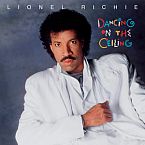
Dancing On The Ceiling

Album: Dancing On The Ceiling (1986)
Charted: 7 2
Play Video

Songfacts®:

  • Not to be confused with the slower 1930 Rodgers/Hart composition of the same name, the title track of Richie's third solo album is a show opener, and one that sets the mood for the rest of the concert, which in keeping with the major body of his work, is usually a fun affair. The song is about having a good time - and literally dancing on the ceiling. Lyrically, it's far from challenging, but Richie created a very memorable couplet with "Oh, what a feeling, when we're dancing on the ceiling."
  • Richie co-wrote the song with Mike Frenchnik and Carlos Rios, and spared no expense; the video is said to have cost a staggering $400,000! It was one of the most memorable clips of the '80s, using the rotating room effect made famous in the 1951 movie Royal Wedding, where Fred Astaire danced on the ceiling. The film was directed by Stanley Donen, and he was enlisted to do the same effect on Richie's video, which retained its wow factor 35 years later, taking it to another level by having a number of people rotating in the room at the same time, rather than just one. In 2010, the movie Inception used more complex variations on the same effect.
  • Released on the Motown label in 7-inch and 12-inch formats as well as a CD single, the song runs 4:21 and is backed by "Love Will Find A Way." >>
    Suggestion credit:
    Alexander Baron - London, England, for above 3
  • The direct-to-video "The Making Of 'Dancing On The Ceiling,'" available on laser disc and VHS, sold over 100,000 copies for about $20 each.

Comments: 1

  • David from Orlando, FlThe video alone for Dancing on the Ceiling launched my personal interest in music videos to the stratosphere! Everything from the gravity-defying trick photography techniques to the catchy tune accompanying the storyline (a surprise party for Lionel), along with the camaraderie of the people plus memorable cameos by Cheech Marin and Rodney Dangerfield made for a once in a generation (if not once in a lifetime experience). The rotating room (also referred to as a gimbel machine in a DVD bonus feature on the making of this video in Lionel Richie's video collection) was also used in High School Musical 3 on the Zac Efron solo musical number "Scream" (not to be confused with the Michael and Janet Jackson song). In Zac's case, he performed alone (as did Fred Astaire in Royal Wedding) and the effect was meant to showcase his world "spinning out of control", but still, I couldn't help get a kick out of comparing the two scenarios two decades apart, even if the "Scream" sequence only lasted around ten seconds of the three minute song. Lionel Richie remains my all-time favorite artist for a variety of reasons, mostly the well-written ballads, but it all started with a thrilling dance song and one of the greatest fantasies I have ever seen captured on film.
see more comments

Editor's Picks

Stephen Christian of Anberlin

Stephen Christian of AnberlinSongwriter Interviews

The lead singer/lyricist for Anberlin breaks down "Impossible" and covers some tracks from their 2012 album Vital.

Emilio Castillo from Tower of Power

Emilio Castillo from Tower of PowerSongwriter Interviews

Emilio talks about what it's like to write and perform with the Tower of Power horns, and why every struggling band should have a friend like Huey Lewis.

Art Alexakis of Everclear

Art Alexakis of EverclearSongwriter Interviews

The lead singer of Everclear, Art is also their primary songwriter.

Graham Bonnet (Alcatrazz, Rainbow)

Graham Bonnet (Alcatrazz, Rainbow)Songwriter Interviews

Yngwie Malmsteen and Steve Vai were two of Graham's co-writers for some '80s rock classics.

They Might Be Giants

They Might Be GiantsSongwriter Interviews

Who writes a song about a name they found in a phone book? That's just one of the everyday things these guys find to sing about. Anything in their field of vision or general scope of knowledge is fair game. If you cross paths with them, so are you.

Who's Johnny, And Why Does He Show Up In So Many Songs

Who's Johnny, And Why Does He Show Up In So Many SongsSong Writing

For songwriters, Johnny represents the American man. He has been angry, cool, magic, a rebel and, of course, marching home.