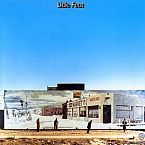
Little Feat guitarist/singer Lowell George wrote "Willin'" before the group was even formed. The song is about a truck driver in the American southwest who makes some extra cash smuggling cigarettes and transporting illegals across the border from Mexico. If you give him "weed, whites and wine" (the "three wicked W's") he's willin' to do the job.
"Whites" are amphetamines, often taken by truckers to stay awake on long hauls. The Grateful Dead also sang about colorful pills in their song "
Truckin'," released a year earlier, but their red pills are barbiturates:
Livin' on reds, vitamin C, and cocaine"Willin'" first appeared on Little Feat's 1971 self-titled debut album, but the version that has become famous was recorded for the follow-up, Sailin' Shoes, in 1972. The original version has a faster tempo.
Lowell George and Ry Cooder do some dueling slide guitar on this track. George had injured his left hand in a run-in with a model airplane, so he was bandaged up, and according to Little Feat keyboard player Bill Payne, bleeding all over his guitar when he played. Cooder was working on his first album in the same studio where Little Feat was recording theirs: Western Recorders in Los Angeles, so Feat's producer Russ Titelman asked him to come by and play on some tracks. There was a lot of tension between Cooder and George, but that competitive fire channeled into the song.
The opening line, "I been warped by the rain, driven by the snow," originated in a conversation between Lowell George and Richie Hayward who became the drummer in Little Feat. Hayward had used it to describe a rocking chair.
"Lowell was great at seeing, hearing, being around, and capturing things taht go on in everyday life that just kind of hit you," the band's guitarist, Paul Barrere, explained in the book Willin' The Story Of Little Feat.
Lowell George was a guitarist in Frank Zappa's band the Mothers Of Invention when he wrote "Willin'" in 1969. When Zappa heard the song, Frank encouraged him to form his own band, which became Little Feat. Mothers Of Invention bass player Roy Estrada also jumped ship and joined Little Feat, leaving in 1972 after the Sailin' Shoes album.
Zappa was very anti-drug, so when he heard George's song with drug references in the chorus, it was clear they were headed in different directions.
"I think Frank was both impressed and put off by the song because of the drug reference," Little Feat keyboard player Bill Payne told Bud Scoppa. "He was somewhat conservative on certain levels. He was afraid of the very thing that bit the hippie movement in the ass, which was the craziness of what would happen to people when they got fried on drugs - like Charles Manson."
George was never a good fit in the Mothers Of Invention. In addition to his drug use, his talents weren't being utilized. The only credit he has on one of their recordings is a song called "Didja Get Any Onya?" released in 1970 after his departure. In that song, George is the voice of a German border guard.
The band never had a charting single, but "Willin'" is probably Little Feat's best-known song. Their first two albums, which both included the track, flopped, but they found their stride with their third, Dixie Chicken, their first as a six-piece jazz-funk outfit (they were previously a country-rock quartet). They developed a reputation as a great live band, and "Willin'" was a concert favorite. As more people discovered the band, the song grew in popularity and even earned some airplay.
Little Feat split up in 1979 just months before Lowell George passed away; he was on tour as a solo artist when he died in a hotel room after suffering a heart attack, possibly brought on by drug abuse.
When the band re-formed in 1987, guitarist Paul Barrere took the lead vocals on "Willin'." He died in 2019.
Linda Ronstadt recorded "Willin'" on her 1975 album Heart Like A Wheel. While Ronstadt is certainly versatile, it's hard to imagine her at the wheel of a rig hauling freight (or contraband) across state lines. Around this time, Ronstadt and Lowell George had a fling - until she found out he was married!
Ronstadt wasn't impressed with his scruples but considered him one of the best vocalist in the game. "He was a truly singer," she said in Willin' The Story Of Little Feat. "He just had technical ability, proficiency that was just beyond the pale."
Jackson Browne and Little Feat were part of the same vibrant Los Angeles music scene in the 1970s. They often moved in similar circles, collaborating with and influencing each other's work. Browne told Uncut magazine of this acoustic country-blues tale of existential truckerdom.
"I think that's the first thing Lowell George ever wrote and it's one of the most eloquent songs you'll hear. Here's a young guy writing a song about having that determination and drive to keep going, to keep giving it your best. Sing it sincerely and it sounds amazing. It just goes to show that you can write stuff without having an enormous background in a subject."