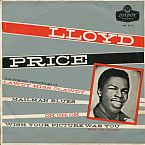
Lawdy Miss Clawdy

Album: Lloyd Price (1952)
Play Video

Songfacts®:

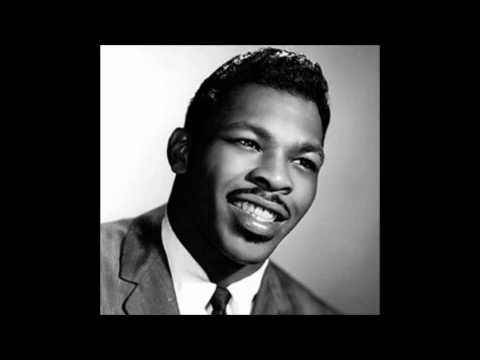
  • Nineteen-year-old Lloyd Price was nursing a broken heart when he wrote this influential R&B wailer on an old piano in his mother's popular New Orleans sandwich shop, Beatrice's Fish 'n' Fry. Borrowing the title phrase from James "Okey Dokey" Smith, a disc jockey for the local R&B station WBOK, Price bids a painful farewell to the good-looking gold-digger who uses and abuses him. With a rolling piano intro courtesy of Fats Domino, blaring saxes, and a signature backbeat from prolific rock n' roll drummer Earl Palmer, the song is hailed as a seminal rock n' roll tune.
  • As luck would have it, a prominent patron overheard Price's playing and introduced him to Art Rupe, a Los Angeles record executive who was in town looking for new talent, particularly young singers who would attract the growing market of teens tuning into R&B radio. The patron was Dave Bartholomew, a hot R&B producer who wrote co-wrote and arranged "The Fat Man" for Fats Domino two years earlier. "I had dropped in to get a sandwich when I heard Lloyd playing that piano," he told Marc Myers, author of Anatomy of a Song. "The feeling in his voice caught me. It was completely original." Rupe agreed and had Price record the tune with Bartholomew as producer.
  • Price told Myers about the recording session, which took place at Cosimo Matassa's J&M Studios in New Orleans. "When it was time to record 'Lawdy Miss Clawdy,' Fats Domino arrived and took over the piano. He started playing a boogie-woogie, but Dave stopped him. He wanted something different. So instead of playing boogie-woogie, Fats played the introduction like a tinkling piano roll. To this day, nobody has ever played that intro like Fats did that day."

    He continued: "The drummer Earl Palmer came in and I started singing, with the horns and the rhythm section behind me. Earl's beat was complex. He was hitting the second and fourth beats hard on the snare but also adding a 6/8 figure on the cymbal, picking up on Fats's piano triplets. The rest of Dave's band included Ernest McLean on guitar, Frank Fields on bass, Herbert Hardesty on tenor sax, Joe Harris on alto sax, and Jack Willis was on trumpet. There was no sheet music – it was all in their heads. We called it 'padding' – the horns playing held notes behind me while I sang."
  • Price wrote the second verse ("Because I gave you all my money, girl, but you just won't treat me right…") on the spot when Bartholomew decided the song needed more of a story. "It wasn't hard," Price recalled. "That's what my friends and I did all day – we'd make up lyrics. After we recorded this section, it was spliced in on the tape to lengthen the song."
  • Price didn't hear the song until it was played on the radio four weeks after the recording session. When the record came out, Price's mother moved it to the top spot on her shop's jukebox. "After that, every girl in Kenner wanted to ride in my car," he said. (Kenner is the New Orleans suburb where Price was born and raised.)
  • The song was released on Rupe's Specialty Records and went to #1 on the R&B chart. Although it didn't reach the pop chart, the song did sell well outside of the R&B market and is considered an early crossover hit.
  • At the time, many industry execs would tack their names onto songs they had little or nothing to do with to get a cut of the royalties. At best, the real songwriters would receive a sliver of the bounty, and at worst they wouldn't get credit at all. To his astonishment, Price was listed as the sole songwriter, with only the publishing rights going to Rupe.
  • Several artists have covered this, including Elvis Presley, Little Richard, The Hollies, The Dave Clark Five, Fats Domino, Conway Twitty, Carl Perkins, The Replacements, and Paul McCartney, among others. The Beatles also recorded it for their 1969 movie Let It Be.
  • Lloyd Price told Mojo the story behind the song: "I had taken it from an instant Maxwell House commercial from Okie Dokie Smith, our first big black disc jockey in New Orleans: 'Lawdy Miss Clawdy, eat your momma's homemade pies and drink Maxwell House coffee.'"

Comments: 1

  • Barry from Sauquoit, NyOn March 5, 1967, the Buckinghams had two records enter Billboard's Top 100 chart, their covered version of "Lawdy Miss Clawdy" at position #98 and "Don't You Care" at position #100...
    "Lawdy Miss Clawdy" was released on the U.S.A. Record label, while "Kind of A Drag" was on Columbia Records...
    Four weeks later "Lawdy Miss Clawdy" would peak at #41 {for 2 weeks} and it spent six weeks on the Top 100...
    "Don't You Care" reached #6 {for 1 week} and stayed on the Top 100 for fourteen weeks...
    The week "Lawdy Miss Clawdy" and "Don't You Care" entered the Top 100, the Chicago quintet's debut charted record, "Kind of A Drag", was at #4, three weeks earlier it had peaked at #1 {for 2 weeks}
see more comments

Editor's Picks

Gary Brooker of Procol Harum

Gary Brooker of Procol HarumSongwriter Interviews

The lead singer and pianist for Procol Harum, Gary talks about finding the musical ideas to match the words.

Andy McClusky of OMD

Andy McClusky of OMDSongwriter Interviews

Known in America for the hit "If You Leave," OMD is a huge influence on modern electronic music.

Waiting For The Break of Day: Three Classic Songs About All-Nighters

Waiting For The Break of Day: Three Classic Songs About All-NightersSong Writing

These Three famous songs actually describe how they were written - late into the evening.

Donald Fagen

Donald FagenSongwriter Interviews

Fagen talks about how the Steely Dan songwriting strategy has changed over the years, and explains why you don't hear many covers of their songs.

Graham Nash

Graham NashSongwriter Interviews

Graham Nash tells the stories behind some of his famous songs and photos, and is asked about "yacht rock" for the first time.

Michael Sweet of Stryper

Michael Sweet of StryperSongwriter Interviews

Find out how God and glam metal go together from the Stryper frontman.