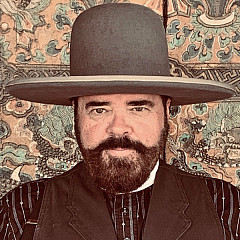
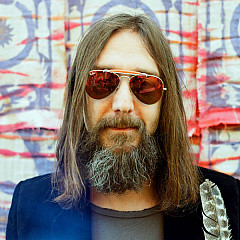
Look Mum No Computer is the alias of British inventor-musician Sam Battle, who was born in Grantham, Lincolnshire, in the late 1980s. As a child, Battle loved taking things apart to see how they worked. Toys, pedal cars, and domestic gadgets such as irons and toasters were all fair game.
Battle discovered the guitar at age 12 and spent the next four years absorbed in learning the instrument. Eventually the circuitry inside electronic gear proved more interesting than the strings on a fretboard. By his mid-teens he had become fascinated with circuit-bending, the practice of modifying electronic devices to create new sounds.
In his early 20s, Battle lived as a property guardian, a scheme where tenants occupy empty buildings in exchange for low rent. The arrangement gave him plenty of time - and inexpensive living space - to experiment with DIY electronics and start building the musical machines that would later define his career.
Before launching his solo project, Battle was the lead vocalist for the Kent indie rock band Zibra. The group appeared at Glastonbury Festival in 2015 through the BBC Introducing stage. Battle created his YouTube channel in 2013 to document Zibra's activities, but it gradually evolved into a showcase for his increasingly unusual musical inventions.
His stage name, "Look Mum No Computer," is a twist on the childhood boast "Look mum, no hands!" shouted by kids riding bicycles without holding the handlebars. Battle chose the name because many of his synthesizers and musical machines deliberately avoid conventional computers.
One of his most famous inventions is the Furby Organ, a fully functioning instrument built from 44 modified Furby toys wired into a modular synthesizer system, with a single "conductor" Furby perched on top. Posted online in February 2018,
the video of the instrument has accumulated millions of views.
Battle has also constructed
the Game Boy Megamachine, a massive synthesizer built from 48 linked Nintendo Game Boy units that operate together as a giant chiptune instrument.
Among his more theatrical creations is
a flamethrower organ, funded by Red Bull. Battle assembled much of it from copper plumbing supplies in his parents' driveway while they were away on holiday.
"I'd never worked with fire before, so I pretended that I knew what I was doing,"
he admitted to Music Radar. "I was asked if I was going to work with a professional and I was like 'yeah, sure.'"
In 2020 he completed the
1,000 Oscillator Megadrone (also known as the KiloDrone), a colossal synthesizer designed to generate vast droning soundscapes from a thousand oscillators running simultaneously. The instrument is built for creating enormous walls of sound rather than traditional melodies.
Battle also created the Kosmo modular synthesizer format, a DIY standard that fans can build themselves. Larger than the industry-standard Eurorack format, Kosmo uses bigger panels, knobs, and patch cables that make it easier to perform live. The system's simple circuits were designed so beginners could learn electronics while building instruments. The name originated from Battle's first DIY synthesizer, a homemade clone of the Korg MS-20 that he built because he couldn't afford the original.
Battle runs an interactive instrument collection in Ramsgate, Kent, called This Museum Is Not Obsolete, where visitors can play unusual synthesizers and experimental machines. In 2022 he began restoring a 1914 church organ there, documenting the project on his YouTube channel.
Other unusual creations include a lightsaber theremin and a Henry Hoover flamethrower, proof that in Battle's workshop, almost any household object can become a musical instrument with enough wires attached.
In February 2026, the BBC selected Battle to represent the United Kingdom at the Eurovision Song Contest 2026 in Vienna with his song "
Eins, Zwei, Drei." One of the most unconventional UK Eurovision entries in recent memory. Battle described it as "completely bonkers."