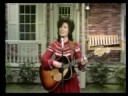
Fist City

Album: Fist City (1968)
Play Video

Songfacts®:

  • In this song, Loretta Lynn warns another woman that if she keeps eyeing her man, she's going to take her to "Fist City," where she will deliver a whoopin'. Lynn says that this really happened - this woman was trying to take Lynn's husband Doolittle away from her, so Loretta gave her a beat down.

    The exact location of Fist City is this woman's front porch, where Loretta confronted her. Lynn was the wrong woman to mess with: she grew up with four brothers, and she says she whooped all of them.
  • Lynn also took her husband to Fist City. "He never took me nowhere," she told NPR. "I had four babies, one after the other. He walked by and pulled one of my pin curlers, and it hurt - he was drinking a little bit. I turned around to hit him on the shoulder but I ended up hitting him in the mouth. Teeth flew everywhere."

    Lynn says that on this occasion, her husband walked away, but that at times he did turn violent. "When he hit me, I hit him twice," she said. "He got the wrong woman to fight with."
  • This was the second of 11 #1 Country hits for Lynn - "Don't Come Home A' Drinkin' (With Lovin' on Your Mind)" was her first. With Patsy Cline passing away in 1963 and Dolly Parton yet to make her ascent, Lynn was unquestionably the biggest female star in country music at this time.
  • Lynn recorded a new version of this song for her 2016 album Full Circle, which was released when she was 83 years old.
  • Lynn got wind of the affair while she was recording in Nashville and wrote the entire song during a furious 75-mile trip back home. Her husband didn't hear the tune until she sang it at the Grand Ole Opry. After the performance, he insisted the song would never make it big, but he underestimated all of the women who were dealing with cheating husbands. "I think my story sounded a little familiar," Lynn laughed.
  • Lynn's producer Owen Bradley assembled a team of musicians that included his brother Harold Bradley on bass, Grady Martin on lead guitar, Pete Drake on pedal steel guitar, Floyd Cramer on piano, and Buddy Harman on drums. Lynn told interview Marc Myers (author of Anatomy of a Song) she knew she had a hit when she heard the musicians trying to outplay each other while she was singing.
  • As for the song's homewrecker, Lynn is certain the woman in question knew it was about her. "After the record came out, she stayed away for a good long time," she explained to Myers. "Then, in 1996, when Doo was on his deathbed and I was taking care of him, the bell rang. When I opened the front door, this woman walked right past me. I didn't know who she was at first, but then I realized it was her. She found Doo in his bed and was talking to him. Can you imagine? Honestly, I felt like killing her. As you can probably tell, I still don't like her to this day."

Comments: 1

  • Jennifur Sun from RamonaWhoa! That is some kinda gull.
see more comments

Editor's Picks

Graham Nash

Graham NashSongwriter Interviews

Graham Nash tells the stories behind some of his famous songs and photos, and is asked about "yacht rock" for the first time.

Ralph Casale  - Session Pro

Ralph Casale - Session ProSongwriter Interviews

A top New York studio musician, Ralph played guitar on many '60s hits, including "Lightnin' Strikes," "A Lover's Concerto" and "I Am A Rock."

Rob Halford of Judas Priest

Rob Halford of Judas PriestSongwriter Interviews

Rob Halford dives into some of his Judas Priest lyrics, talking about his most personal songs and the message behind "You've Got Another Thing Comin'."

Corey Hart

Corey HartSongwriter Interviews

The Canadian superstar talks about his sudden rise to fame, and tells the stories behind his hits "Sunglasses At Night," "Boy In The Box" and "Never Surrender."

Incongruent Opening Acts

Incongruent Opening ActsSong Writing

Here's what happens when an opening act is really out of place with the headliner, like when Beastie Boys opened for Madonna.

Edwin McCain

Edwin McCainSongwriter Interviews

"I'll Be" was what Edwin called his "Hail Mary" song. He says it proves "intention of the songwriter is 180 degrees from potential interpretation by an audience."