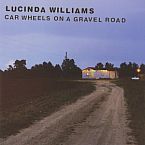

Car Wheels On a Gravel Road

Album: Car Wheels on a Gravel Road (1998)
Play Video

Songfacts®:

  • Lucinda Williams was born in Lake Charles, Louisiana, in 1953, into a family deeply rooted in the South. Her father, Miller Williams, was a noted poet and literature professor, and her mother, Lucille Fern Day, was an amateur pianist.

    Williams' early years were spent in a variety of locations, as her father's work took the family to various places in the Deep South. This nomadic lifestyle exposed Williams to a wide range of cultures and experiences that would later influence her songwriting. This song is a compilation of southern, rural imagery from her childhood.
  • "Car Wheels on a Gravel Road" is a southern gothic travelogue, humming with memory and loss. Williams sings of "cotton fields that stretch for miles," and "the telephone poles, trees, and wires fly on by" as she travels with her parents across the American South. She also captures the instability and forced transience (car wheels) as the narrative traverses from one Southern locale (the gravel road) to another.
  • Lucinda Williams recalled her father apologizing to her after a show at the Bluebird in Nashville. It was the first time he had heard "Car Wheels On a Gravel Road," and among the fields of cotton, smells of coffee, eggs and bacon, and sounds of Loretta and Hank, he identified the neglected child in the back seat as the young Lucinda: "Lookin' out the window. Little bit of dirt mixed with tears."

    "That was the most amazing moment," she told Uncut magazine. "But it was bittersweet. I didn't know why when I was writing it, it was this whole subconscious thing. I guess it's weird how you can take yourself by surprise by something you've written yourself? I thought I was writing in the third person, but actually I was writing in the first person."
  • "Car Wheels on a Gravel Road" is the title song from Lucinda Williams' 1998 album of the same name. A crunchy blend of country, rock and R&B, the song provides a lightning rod for the record's portrayal of Williams' experiences in the Deep South.
  • Car Wheels on a Gravel Road was met with widespread critical acclaim - The Village Voice hailed it as the best album of 1998 - and it clinched the Grammy Award for Best Contemporary Folk Album in 1999. Today, the record is considered a landmark in Americana and alternative country music.
  • Beyond critical acclaim, Car Wheels on a Gravel Road found commercial success, maintaining a presence on the Billboard 200 for over five months. It achieved a significant milestone by becoming Williams' first album to attain Gold certification from the RIAA.
  • Williams wrote "Car Wheels on a Gravel Road" herself. She recorded it at Room and Board Studio, Nashville and Rumbo Studio, Canoga Park, California with producers Steve Earle and Ray Kennedy.
  • Williams played the acoustic guitar. The other musicians are:

    Gurf Morlix: electric guitar
    John Ciambotti: bass
    Donald Lindley: percussion, drums
    Buddy Miller: mandoguitar, harmony vocals

    Curious about what a mandoguitar is? It's an instrument featuring a compact mandolin-like body paired with a nylon-stringed guitar neck. This design gives the mandoguitar a versatile tone that can range from the bright, high-pitched sounds of the mandolin to the mellow, warm tones of a guitar.

Comments

Be the first to comment...

Editor's Picks

Gary Brooker of Procol Harum

Gary Brooker of Procol HarumSongwriter Interviews

The lead singer and pianist for Procol Harum, Gary talks about finding the musical ideas to match the words.

Andy McClusky of OMD

Andy McClusky of OMDSongwriter Interviews

Known in America for the hit "If You Leave," OMD is a huge influence on modern electronic music.

Waiting For The Break of Day: Three Classic Songs About All-Nighters

Waiting For The Break of Day: Three Classic Songs About All-NightersSong Writing

These Three famous songs actually describe how they were written - late into the evening.

Donald Fagen

Donald FagenSongwriter Interviews

Fagen talks about how the Steely Dan songwriting strategy has changed over the years, and explains why you don't hear many covers of their songs.

Graham Nash

Graham NashSongwriter Interviews

Graham Nash tells the stories behind some of his famous songs and photos, and is asked about "yacht rock" for the first time.

Michael Sweet of Stryper

Michael Sweet of StryperSongwriter Interviews

Find out how God and glam metal go together from the Stryper frontman.