This is an instrumental song that is more than 25 minutes long. The most famous part is the intro, which was used as the theme to the 1973 horror movie The Exorcist.
Without words, this song conveys a rich texture of emotions that reflect Oldfield's state of mind when he wrote it. Oldfield was 17 when he started working on it, 19 when it was released. He was broke, living in a shoddy apartment in the North of London, and working as a bass player in the Arthur Lewis Band.
"I was so focused, and I put all my concentration and all my energy - emotional, spiritual, physical even - into it," he
told Top 2000 a gogo. "There's a lot of joy in it and there's a lot of suffering in it. There's good and bad, there's all areas of life: there's comedy, there's ugliness, there's beauty, there's everything in it, all made by my young self. I didn't know anything about the world, just for one reason or another - mental instability, some hallucinogenic drugs maybe, the circumstances of my childhood. The feeling of being different, being a kind of outsider, it all comes out in that music and maybe it appeals to people going through that stage. As they get into their teens, they think,
What is life, what am I supposed to do. It develops and encapsulates all of that."
Oldfield played most of the instruments himself, which required lots of overdubbing, trial-and-error and studio tricks. There were no synthesizers: the main theme was a combination of organ, grand piano and glockenspiel formed into a tape loop and pitched up by speeding up the tape machine.
The only instruments Oldfield didn't play were the flutes (done by Jon Field) and string bass (Lindsay Cooper). There is also a wordless chorus at the end of the track with vocalizations by Mundy Ellis and Oldfield's sister, Sally. The song took six days to record.
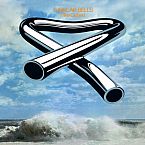
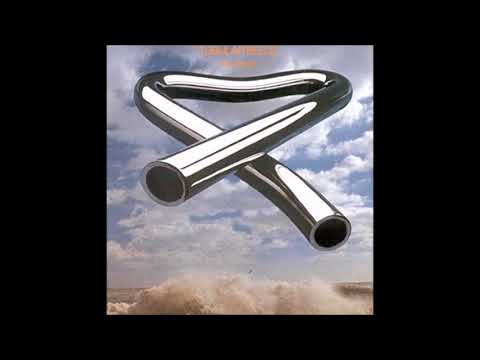
Some unusual instruments were used to record this, including a Farfisa organ, a Lowrey organ, and a flageolet (a kind of wind instrument). There were also flutes, a mandolin, and of course, tubular bells. The bells are represented on the album cover.
Oldfield has given different accounts of how he ended up with tubular bells at the session. In one account, he saw a set of tubular bells at Abbey Road studios, which gave him the idea to order them for the recording; in another, he saw the bells coming out of a John Cale session that preceded his and asked to use them. Either way, he wasn't sure how he was going to use them, but figured they might come in handy.
The actual tubular bell doesn't come in until 1:02. Its sound is distorted, which was Oldfield's doing: instead of using the small mallet provided, he whacked it with a hammer.
This makes up Side 1 of the album. "Tubular Bells (Part 2)" makes up Side 2 and is around 23 minutes long. Side 2 was recorded over about 4 months when Oldfield and his producers used studio time between sessions for other bands.
Oldfield made the demo for this song in 1971, playing the main section on a Farfisa organ and recording it on a Bang & Olufsen tape machine he hacked so he could multi-track. Oldfield pitched it to major record companies, but they all turned it down. He finally found a taker when he was working at The Manor, an old country house that Richard Branson had recently converted into a studio for his new label, Virgin Records. Tom Newman and Simon Heyworth, who were working on the studio, heard Oldfield's demo and became his producers. It took about a year, Oldfield eventually got a deal with Virgin to make the album. When it was finally completed, Branson wasn't thrilled with the album but released it anyway. It was the first release on Virgin, which grew into a massive company, with an airline, record stores, and cell phone interests. Some of the artists who recorded for Virgin Records included The White Stripes, Moby, Aimee Mann, and The Black Crowes.
Vivian Stanshall of the Bonzo Dog Doo-Dah Band serves as the "master of ceremonies" on this track, appearing near the end of the song when he introduces various instruments that then each play the same melody:
grand piano
reed and pipe organ
glockenspiel
bass guitar
double-speed guitar
two slightly distorted guitars
mandolin
Spanish guitar and introducing acoustic guitar
plus, tubular bells
Stanshall was available because the Bonzo Dog Doo-Dah Band was next up in the studio. According to Oldfield, getting Stanshall to say the words correctly was a challenge: he was sloppy drunk and kept getting them wrong. "Viv was standing next to me wearing a cowboy hat, reeling about because he was so drunk, Oldfield recalled to Q magazine. "I had to write down the words and point at the appropriate word just before he was due to say it."
The song got a big boost from the influential BBC DJ John Peel, who played it on his Top Gear show in May 1973. Peel gave some helpful background information on the song, listing some of the instruments used. He called it, "Mike Oldfield's rather remarkable 'Tubular Bells.'"
This ringing endorsement gave the song tremendous credibility and exposure.
The album hit #2 in the UK and #3 in the US. An edited version was released as the single and hit #7 in the US.
Oldfield released the album Tubular Bells II in 1992 and Tubular Bells III in 1998. In 2003, to commemorate 30 years since its release, Oldfield released a new version of the Tubular Bells album that he worked on for nine months, recording with modern equipment.
The UK release concluded with a rousing version of "The Sailor's Hornpipe" and a severely drunken Viv Stanshall babbling wondrously meaningless nonsense in an imitation of stuffy BBC announcers.
>>>
Suggestion credit:
Ekristheh - Halath
Oldfield told the Daily Mail March 14, 2008 that he'd been badgering Richard Branson and his business partner, Simon Draper of Virgin Records, to give him a break. He recalled: "They had been fobbing me off for a year. I was actually about to apply for citizenship of the USSR, where I thought I could become a state-funded musician. Then the phone run and it was Simon Draper asking me to come to dinner with Richard and his wife on their houseboat.
Eventually, he asked me what I needed to make an album. So I gave him a list of guitars, drums and pianos. Tubular bells weren't actually on the list. But, as I arrived at the studio, I noticed they were bringing some out from the last session, and I grabbed them. I had a hunch they might be useful."
Tubular Bells was one of the benchmark albums of the progressive rock era, spending 279 weeks in the UK chart and selling 15 million copies worldwide.
Speaking to The Daily Telegraph in 2014, Oldfield attributed much of Tubular Bells' success to its unusual time signature. "Most music is in 4/4 time, but that curious little figure at the beginning is in 15/8. It's like a puzzle with a little bit missing," he said. "That's why it sticks in the brain. And that's why it worked so well as the soundtrack to The Exorcist - with that little bit missing everything is not quite right."
Mike Oldfield wrote much of Tubular Bells on an old piano. He recalled to Uncut: "When I lived in Harold Wood, Redden Court Road, my grandma came to live with us. She was a pub pianist in the days when pubs were nice places, and people would go along for singalongs and could smoke. She brought her old piano to ours. It had a lovely vibe to it. Most of Tubular Bells was written on that piano."
Virgin boss Richard Branson wanted to name the album Breakfast In Bed, with a cover image of a boiled egg dripping blood. Oldfield fought him on it, eventually convincing him to go with Tubular Bells.
This won a Grammy Award for Best Instrumental Composition.
A version of this song truncated to 3:18 was released as a single in December 1973 when The Exorcist hit theaters. Stamped with the message, "Now The Original Theme From "The Exorcist", it rose to #7 US on May 11, 1974, thanks to the movie's tremendous success.