The Yellow Rose Of Texas

Album: single release (1955)
Charted: 2 1
Play Video

Songfacts®:

  • Written by an anonymous songwriter known as J.K., the earliest known version of this American folk song was found in Edwin Pearce Christy's 1853 songbook Christy's Plantation Melodies, No. 2. Christy was a balladeer and was widely known for Christy's Minstrels, a blackface minstrel show that started out of New York City in 1847. Sung from the perspective of an African American narrator, the tune follows his quest to find his lost love, a biracial woman he calls "The Yellow Rose of Texas."
  • This became associated with folk heroine Emily D. West, a free black woman from Connecticut who was contracted as an indentured servant for James Morgan at a hotel in Morgan's Point, Texas. During the Texas Revolution, West and the rest of the hotel residents were captured by Mexican troops led by General Antonio López de Santa Anna. According to legend, Santa Anna lost the ensuing 18-minute Battle of San Jacinto because he was in the middle of raping West when General Sam Houston led the attack on the Mexican camp. Houston allegedly told the story to Englishman William Bollaert, who wrote in his journal of the heroic "mulatta girl belonging to Col. Morgan who was closeted in the tent with Gen. Santana's troops during the Battle of San Jacinto and distracted the General while Texas troops advanced."

    West's story was further cemented in history when it became the basis for Anita Richmond Bunkley's 1989 novel Emily, The Yellow Rose.
  • Most of the ensuing versions replaced problematic racial terms such as "darkie" and "sweetest rose of color" with "soldier" and "sweetest little flower." This is the case with Mitch Miller's 1955 rendition, reworked by lyricist Don George, that topped the Billboard pop chart when it was used in the James Dean film Giant. Unfortunately, the altered lyrics also remove any indication that the tune arose from a significant piece of black history.
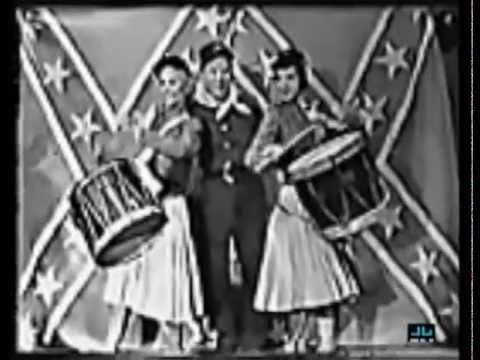
  • During the American Civil War, the Confederate soldiers in the Texas Brigade adopted this as a marching song.
  • Elvis Presley's version was used in his 1964 movie Viva Las Vegas.
  • Gene Autry performed this on his eponymous TV series. His version was included in the 1994 miniseries James A. Michener's Texas.
  • W. (2008), Thirteen Days (2000), Finders Keepers (1984), and Giant (1956). It was spoofed as "The Yellow Gold Of Texas" on the 2006 episode of The Simpsons, "The Seemingly Never-Ending Story."
  • Roger McGuinn, of The Byrds, has been keeping traditional folk music alive for years through the Folk Den section of his website, where he records and uploads his own versions of the songs, including this one. He tells Songfacts of the song: "It's historically interesting, because it was a song that was sung in the Civil War by the troops, and it was kind of a rallying song. It's gone through many stages, where people have interpreted it in different ways. I went back to look at the original, and it was totally different from what you would hear Mitch Miller do. But it's a great melody, and it was a great song."

    His version is included on the 2016 album The Folk Den Project: Twentieth Anniversary Edition.

Comments: 2

  • Elle from OhioLove these lyrics by Mitch Miller. This is the version my uncle sang to his wife.
  • M from Small Town WestThanks for the history. I get that songs like everything tend to evolve. But it saddens me that marching songs my ancestors sung have been twisted almost beyond recognition today. Cultural appropriation and political correctness are eating away at history.
see more comments

Editor's Picks

Muhammad Ali: His Musical Legacy and the Songs he Inspired

Muhammad Ali: His Musical Legacy and the Songs he InspiredSong Writing

Before he was the champ, Ali released an album called I Am The Greatest!, but his musical influence is best heard in the songs he inspired.

Michael Sweet of Stryper

Michael Sweet of StryperSongwriter Interviews

Find out how God and glam metal go together from the Stryper frontman.

Devo

DevoSongwriter Interviews

Devo founders Mark Mothersbaugh and Jerry Casale take us into their world of subversive performance art. They may be right about the De-Evoloution thing.

Dennis DeYoung

Dennis DeYoungSongwriter Interviews

Dennis DeYoung explains why "Mr. Roboto" is the defining Styx song, and what the "gathering of angels" represents in "Come Sail Away."

Tom Bailey of Thompson Twins

Tom Bailey of Thompson TwinsSongwriter Interviews

Tom stopped performing Thompson Twins songs in 1987, in part because of their personal nature: "Hold Me Now" came after an argument with his bandmate/girlfriend Alannah Currie.

Evolution Of The Prince Symbol

Evolution Of The Prince SymbolSong Writing

The evolution of the symbol that was Prince's name from 1993-2000.