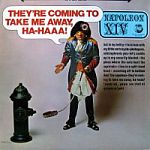
Napoleon is Jerry Samuels, a recording engineer from New York City. "They're Coming To Take Me Away, Ha-haaa" is about a guy who goes insane (like, to the funny farm) when his girl leaves him. Except it's not his girl who left - at the end of the song we find out it's his dog when Samuels intones:
They'll put you in the A.S.P.C.A.
You mangy mutt
In a Songfacts interview with Samuels, he explained: "It took me nine months to finish it. I wrote one verse and the chorus, and immediately I realized I was writing a sick joke. So I said, 'This is no good, I'll put it away.' Three months later it was still running through my head; I pulled it out again and wrote the second verse and it was an even sicker joke. Finally about six months after that I decided I was going to finish it, and I was going to do something in that last verse that would throw things off a little bit, so I referred to the object - 'They're coming to take me away because of what YOU did - I referred to YOU as a dog. The dog ran away. By doing that I felt I was lightening the sickness of the joke, and I probably was and it probably did some good for me, but that was the reason I went for that afterthought."
The song is known for the unusual vocal effect - the voice gradually goes up in pitch but stays the same tempo. David Seville had been speeding up vocals to create The Chipmunks, but "They're Coming To Take Me Away" used a different effect that was quite ear-catching and very hard to pull off in 1966. In his Songfacts interview, Jerry Samuels explained how he did it: "I was a recording engineer in New York at one of the hottest demo studios in town - Associated Recording Studios. I'd worked for them for quite a few years and we had started to do creative things together before that. We opened our own publishing company which I owned in conjunction with the owners of the studio and I'd written a hit song for Sammy Davis, a song called 'The Shelter Of Your Arms' and we published it.
We were doing some work for some advertising agencies - I think one of them was BBDO - we were doing 60-second spots - actually a 60-second spot is really 59 seconds. The spot had to come in at exactly 59 seconds, so if it was recorded and it came in a little slow or a little fast, we used a device called a VFO. The VFO was a Variable Frequency Oscillator. It connected directly to the hysteresis motor of the machine. That is the motor that controls the speed of the capstan. We're talking about a 15 IPS (inches per second) analog tape. A hysteresis motor works on 60 hertz. If you want to change the speed, you can't change the wattage because it will stop; you have to change the hertz, and the only way you can do that is with a VFO. The VFO is connected to that hysteresis motor, and then if you move it from 60 to 59 to 58 to 57, it slows down, and if you move it up it speeds up. They had the VFO rigged only to the mono machines, but I saw something. I realized that if you hooked it up to the multitrack machine - and we only had four tracks at the time, we had a Scully 1/2 inch 4-track - if you hooked it up to the 4-track, you could do things that weren't done before. I would be able to raise or lower the pitch of a voice without changing the tempo by hooking it up to that 4-track machine.
Based on that, I came up with the idea of 'They're Coming To Take Me Away.' I was sitting in a nice easy-chair one night. It had a little vibrator on it and I was stoned because I loved to smoke grass. What popped into my head was the old Scottish tune, 'The Campbell's Are Coming.' I didn't know the title, but I'll tell you who did - my friend Barry Hansen. He's Dr. Demento; we've known each other for many, many years. I hummed it to him and he said, 'Yeah, that's 'The Cambpell's Are Coming,'' and I thought, 'da da dat dat da dat da da da da da... they're coming to take me away, ha ha.' There it was, and by understanding what I could do with that piece of equipment, I wrote this thing.
I asked the owner of the studio, who was my partner in my publishing company, to adapt the VFO to connect to the Scully 4-track. He said, 'Why?' and I said, 'I can't explain it, all I can tell you is we're going to make a record called They're Coming To Take Me Away Ha Ha, and that's the only way to do it.' He had enough trust in me to say, 'OK, I'll do it,' so he built the necessary adapters and connected it, and he was in the control room when I dubbed the voice in."
When this novelty song became a surprise hit, the record company sent other people to perform it at live appearances while Samuels kept working in the studio.
No profession drummer was handy. So Jerry Samuels had to make do when it came time for percussion. He explained: "The first thing we did was lay down a drum and tambourine track. I brought a friend of mine into the studio - I had the studio at night every night. After everybody else went home I would stay there and sleep in the waiting room on the bench. I brought my friend in, and he wasn't the greatest drummer in the world. He went on to become a multimillionaire in another business, but he couldn't play the drums. We had to record a 7-second loop. He was able to do it on time for 7-seconds, so we recorded a loop, and then we copied it. That's why this thing is so perfect in rhythm, because what you're hearing is a drum loop. We didn't have the machines that we have these days that sound so real. We had to use a drummer."
Samuels explained the recording process to Songfacts: "I needed hand clappers, and I wanted a whole bunch of hand clappers, so I invited a bunch of my friends down to the studio at 2 o'clock in the morning, and only three of us showed up. I said, 'Look, there's only three of us, that's not enough hand clappers. What I want us to do, instead of clapping our hands, I want us to sit in a semicircle and I'll drop my Neumann microphone down in front of us, and we'll slap our thighs. If we slap our thighs, we'll have the sound of two claps rather than one. However, you cannot slap your clothes because the clothes muffle it - you have to slap your skin. What I want us to do is sit in a semicircle and drop our pants and do it.'
They wouldn't do it, so what we had to do was overdub. We bounced from track to track three times, so we wound up with nine hand clappers, but we also wound up with some noise because we were copying the noise level. There is an inherent noise level when you record analog, and the signal-to-noise ratio decreases as you overdub, but that's what we lived with.
The next thing was the siren, and that had to be overdubbed also because we rented a hand-crank siren for $5. When you first hear it, you only hear one siren, then you hear three, then you hear six - it's all overdubbed. Finally, what we wound up with was a total drum track, a total hand clap track and a total siren track. Next we have the fourth and final track. The other tracks are in perfect rhythm at 15 IPS. I go into the studio, my partner is in the control room, and I record the vocal. The only track recording is the vocal track; the other tracks are just playing back in my earphones. As we get to the chorus, he begins to take that VFO one notch at a time, and turn it down, so I'm hearing 'chunka, chunka, chuunka, chuuunka, chuuuuuunka, chuuuuuuuuuunka...' and I'm going, 'They're coming to take me away, ha ha. They're coming to take me away, ho ho, hee hee, ha ha. To the funny farm, where life is beautiful all the time.'
And right there I run out of breath. We rewind the tape and punch in just before 'time,' and I continue and finish the line. When you play that back at 15 IPS, the only thing that happens is the voice raises in pitch. It's in perfect rhythm because I'm listening to the track. That's how we did it."
Once a song is released, it falls into the realm of compulsory licensing, which means anyone can record it if they pay the statutory royalty rate. (This is a very complicated issue - you can learn all about it in the book
This Business Of Music). Since this has no melody, they were able to copyright it as a lecture intended for oral delivery instead of as a song. This meant other record companies couldn't copy it without permission.
Insanity was controversial subject matter for 1966, and the song eventually got banned on many radio stations. Says Samuels: "It was a hit before it got banned. Once it got banned, it was finished. I've had people approach me to do versions of the song with obscenities, but I've said no, I don't care how much money is involved."
The July 30, 1966 issue of
Billboard magazine contains an interesting bit
about the uproar this song caused.
Samuels used the drum loop again on his album cut "Where the Nuts Hunt The Squirrels."
The B-side of the single was the same song... recorded backward.
>>>
Suggestion credit:
Brad Wind - Miami, FL, for above 2
Jerry Samuels kept making songs, and kept them weird. "I made some records back then that I couldn't get released they were so bizarre," he said. "There's an album out now called Napoleon XIV The Second Coming, it's on Rhino. I also had an underground hit with a song called 'I Owe A Lot To Iowa Pond,' but the best recording I ever made was something called 'The Explorer.' It's 2 minutes and 4 seconds, and it is a gem."
A group called Josephine XV was created to record an answer song to this called "I'm Happy They Took You Away, Ha-Haaa!" Another answer song was Teddy And Daniel's "They Took You Away, I'm Glad, I'm Glad."
>>>
Suggestion credit:
Brandon - Seattle, WA
The comic rapper Biz Markie recorded his own version of this song in 1986.