There She Goes, My Beautiful World

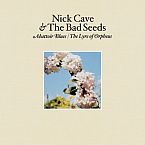
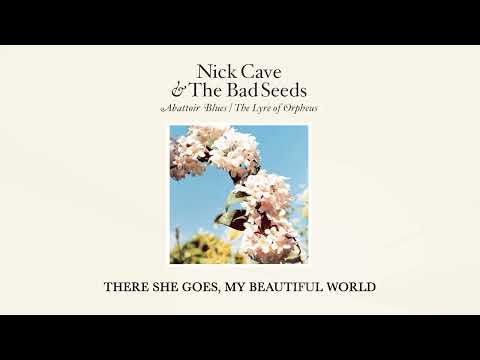
Album: Abattoir Blues/The Lyre of Orpheus (2004)
Play Video

Songfacts®:

  • In "There She Goes, My Beautiful World," Nick Cave's muse is personified as a woman that he's willing to serve eternally in return for inspiration. The desperate edge of each longing verse rises to triumphant chorus as his devotion pays off and she hits him with poetic illumination again.

    The song isn't mere hyperbole. For most of his professional life, Cave had an obsessive work ethic. It only began to mellow after the deaths of his sons Arthur (who fell from a cliff at age 15 in 2015) and Jethro (who died from unknown causes at 31 years old in 2022). By the time the Wild God album came out in 2024, he'd come to regret prioritizing work over family for so long.
  • The song appears on the Seeds' 13th studio album, Abattoir Blues/The Lyre of Orpheus. It was released as the B-side to "Breathless," the second of three singles released off the recording.
  • Cave mentions multiple historical figures that suffered for their creations.

    John Wilmot penned his poetry
    Riddled with the pox


    Wilmot, the 2nd Earl of Rochester (1647 - 1680), was an English poet infamous for his promiscuous lifestyle and for leading a group dubbed The Merry Gang - raucous artists who made carousing and womanizing a moral objective in defiance of puritanical religious standards. Though their exploits are frequently romanticized, they physically harmed women and killed some lawmen. The cause of Wilmot's death is uncertain, but syphilis is among the suspected culprits. Syphilis is sometimes called "the pox."
  • Nabokov wrote on index cards
    At a lectern, in his socks


    Vladimir Nabokov (1899 – 1977) was a Russian-born writer and entomologist (someone who studies insects) who achieved notoriety after moving to the United States in 1940. One of his most prominent works was Lolita, a novel that Cave's English-teacher father read to him as a child.
  • St. John of the Cross did his best stuff
    Imprisoned in a box


    St. John of the Cross (1542 – 1591) was a Spanish Roman Catholic priest, mystic, and writer. Many consider his Noche Obscura to be the greatest work of mystical Christian literature ever written. One of his best-known poems is "The Dark Night of The Soul," which Cave drew from for his song "Long Dark Night." In 1577 St. John was wrongly imprisoned over religious reforms. He produced some of his most powerful works during his harsh internment.
  • And Johnny Thunders was half alive
    When he wrote Chinese Rocks


    Johnny Thunders (1952 – 1991) played guitar with the New York Dolls and became legendary for his self-destructive behavior as much as his music. He released "Chinese Rocks" while leading Johnny Thunders and the Heartbreakers. Contrary to Cave's lyric, Thunders didn't write the song.

    Thunders died in 1991 at 38 years old from either a drug overdose or murder - the matter is still debated to this day. In a 2004 piece titled Dazed & Confused, journalist Barney Hoskyns asked Cave how he could include Thunders among the caliber of names mentioned in the rest of the song. Cave smiled "sheepishly" and said, "Well, the song is just asking, How did these people do it? How did Johnny Thunders write 'Chinese Rocks,' which is one of the great drugs songs. Obviously there was a certain humor to including him in that list."

    Cave discussed meeting Thunder in a "drug-infested flat" in London, mentioning that Thunders' hands were in "unbelievably bad condition" and that he wouldn't have traded the meeting for the world.
  • Karl Marx squeezed his carbuncles
    While writing Das Kapital


    Karl Marx (1818 – 1883) was the father of modern Communist thought. The Communist Manifesto is often mistaken to be his magnum opus, but Das Kapital was his real master work. Marx suffered from painful carbuncles, which are boils caused by bacterial infections, among many other physical ailments.
  • And Gaugin, he buggered off, man
    And went all tropical


    Gauguin (1848 - 1903) was a French artist and writer. His paintings and woodcuts are still studied today, and he's considered a major figure in the Post-Impressionist and Symbolist art movements. He moved to Panama with dreams of buying land on a small island and living off the land but wound up working as a laborer on the Panama Canal. He was miserable there and contracted yellow fever or malaria, which nearly killed him. He left as soon as he discovered that the land he wanted to purchase was well beyond his means.
  • While Philip Larkin stuck it out
    In a library in Hull


    Poet and novelist Philip Larkin (1922 – 1985) spent most of his working years in an English port city named Kingston upon Hull, often simply called "Hull." He frequently wrote about the location. There's a statue of him there today.
  • And Dylan Thomas died drunk in
    St. Vincent's hospital


    Dylan Thomas (1914 – 1953) was a Welsh poet and one often associated with the "tortured, alcoholic artist" archetype that continues to captivate people's imaginations (and that Thomas despised being associated with). His poem "Do not go gentle into that good night" is still a staple in literature classes and collections across the Western world. He was in the United States giving a reading tour of Under Milk Wood when pneumonia got the better of him. After a long coma, he died in Saint Vincent's Hospital in New York.
  • "There She Goes, My Beautiful World" was the theme song for "Lowdown", an Australian television show that ran for two seasons from 2010 to 2012.

Comments

Be the first to comment...

Editor's Picks

Wedding Bell Blues

Wedding Bell BluesSong Writing

When a song describes a wedding, it's rarely something to celebrate - with one big exception.

Judas Priest

Judas PriestSongwriter Interviews

Rob Halford, Richie Faulkner and Glenn Tipton talk twin guitar harmonies and explain how they create songs in Judas Priest.

Billy Joe Shaver

Billy Joe ShaverSongwriter Interviews

The outlaw country icon talks about the spiritual element of his songwriting and his Bob Dylan mention.

John Kay of Steppenwolf

John Kay of SteppenwolfSongwriter Interviews

Steppenwolf frontman John Kay talks about "Magic Carpet Ride," "Born To Be Wild," and what he values more than awards and accolades.

Pam Tillis

Pam TillisSongwriter Interviews

The country sweetheart opines about the demands of touring and talks about writing songs with her famous father.

Glen Burtnik

Glen BurtnikSongwriter Interviews

On Glen's résumé: hit songwriter, Facebook dominator, and member of Styx.