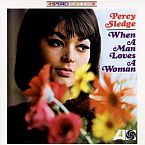
This song is a huge part of music history, as it is the first #1 Hot 100 hit recorded in Muscle Shoals, Alabama, where Aretha Franklin, Paul Simon, The Rolling Stones and many other famous musicians would later record some of their classic songs. It's a legendary love song and a huge hit, but the story of its writing and recording is quite murky. Sledge, who died in 2015 at age 74, told very florid tales about coming up with the song, but Quin Ivy, who produced the track, has a much more pedestrian story.
A little background: FAME studios in Muscle Shoals was run by Rick Hall, and was picking up steam in the mid-'60s, with successful recordings by Jimmy Hughes, Joe Tex, The Tams and Joe Simon. Ivy was a songwriter there, and also a DJ at the local radio station WLAY. He set up his own record store/recording studio nearby called Norala Sound Studios to handle the overflow work, since so many artists wanted to record at FAME.
Sledge was an orderly at Colbert County (Alabama) Hospital in the daytime and sang with a local band, The Esquires Combo, at night. As Sledge tells it, one night while performing with The Esquires Combo, he was upset about a woman - a broken relationship - so upset that he couldn't concentrate on the music he was supposed to sing. He was so overcome with emotion as the group started their set in a Sheffield, Alabama club, that he turned to his bass player Calvin Lewis and organ player Andrew Wright and asked them if they could play a slow blues backing - any key, their choice - to which he could sing. After a quick conference (one source indicated that the "conference" consisted of glances and shrugs), the band started to play and Sledge vented in song for about six minutes.
In Sledge's story, Quin Ivy was at the show and approached the band about polishing the song and recording it. Sledge says he worked on the lyrics with Lewis and Wright, and recorded it at Norala Sound with Ivy producing.
Quin Ivy's sound studio was also a record store, and Ivy says that he met Sledge when the singer walked into the store one day and they were introduced by a mutual friend. Sledge and The Esquires tried recording the song at FAME, but it didn't work, so the engineer there, Dan Penn, sent them over to Norala to record with Ivy, complete with their big B-3 organ for Wright to play. This recording was a success, and the song got proper distribution when Ivy played it for FAME's owner Rick Hall, who contacted Jerry Wexler at Atlantic Records (who knew there was talent in Alabama and told Hall to call him if he found any), who signed Sledge and released the song, which became a massive hit.
In Sledge's version of the story, he co-wrote the song with his bandmates Calvin Lewis and Andrew Wright, but let them have sole composer credits, since they gave him the opportunity to sing his heart out. Whether Sledge was acting out of the goodness of his heart or had nothing to do with writing the song is a matter of debate, but the writing credit had huge implications, resulting in a windfall for Lewis and Wright, who get the royalties every time it is played. Since the song went on to be covered by many artists, they get paid for those as well. If it was a goodwill gesture by Sledge, it cost him millions of dollars.
The musicians who played on this song were many of the same guys who recorded at FAME, and later at Muscle Shoals Sound Studios, a competing studio that opened in 1969. This included
Spooner Oldham on organ, Marlin Greene on guitar, Junior Lowe on bass, and Roger Hawkins on drums.
Trained musicians can tell that the horns on this song are out of tune, and this didn't escape the ear of Jerry Wexler at Atlantic Records. He sent back the original version so this could be fixed, but the fix never made it to the shelves. David Hood, who became the bass player in the Muscle Shoals Rhythm Section,
told Songfacts: "Wexler thought the horns on the original version were out of tune - and they were - and he wanted them to change the horns. They went back in the studio and changed the horns, got different horn players to play on it. But then the tapes got mixed up and Atlantic put out their original version. So that's the hit."
Percy Sledge said that when he originally sang this, he had in mind Lizz King, his girlfriend of three years who left him for a modeling job in Los Angeles. Said Sledge: "I didn't have any money to go after her, so there was nothing I could do to try and get her back."
A year after this was released, Procol Harum used the unusual chord progression as the basis for their song "
A Whiter Shade Of Pale."
This song had a completely different title and meaning when it started. Sledge recalled in 2010: "When I wrote the song at first, it was called 'Why Did You Leave Me Baby.' And I changed it from that to 'When a Man Loves a Woman.' I just reversed it. Quin told me that if I was to write some lyrics around that melody and the expression I'd put into 'Why Did You Leave Me Baby,' he believed it would've been a hit record. He was one of the top disc jockeys at that time. Sure enough, he asked me if I had any lyrics for that. He said, "That's it! Write a story around that title! What a song that would be with that feeling you had!" It was a song that was meant to be. It wasn't just what I had done; it was the musicians, the producer, the background singers, the right time."
In 1987, this was used in
Levi's commercials in England. It was re-released to capitalize on the exposure and went to #2 UK, behind "
Stand By Me," by Ben E. King, which was used in the same series of ads. This was #4 in the UK when it was first released in 1966, but the Levi's ads brought it to a new audience and it got an even higher chart position.
This was by far the biggest hit for Sledge, and his only Top 10 in the UK or US. His next release was "Warm and Tender Love," which made #17 US, #34 UK. His second-biggest US hit was "Take Time to Know Her" in 1968.
Bette Midler's version was a #35 hit in the US in 1980. Luba covered this song in 1988. Fellow Canadian Burton Cummings covered it as well.
>>>
Suggestion credit:
Brian - Melfort, Sask, Canada
Sledge performed this at the induction ceremony when he entered the Rock and Roll Hall of Fame in 2005. He sang it as a tribute to his wife Rosa, and included her name in the lyrics.
This is a very popular wedding song, and it was especially effective if Sledge showed up to sing it. That's what happened when E Street Band guitarist Steven Van Zandt's married Maureen Santora on December 31, 1982 at the Stone Pony in Asbury Park, New Jersey.
>>>
Suggestion credit:
Bertrand - Paris, France
This was a big song at the time of the Vietnam War, and very popular with many American soldiers. It was featured in the 1987 war movie Platoon, which helped revive the song.
There were more polished recordings made of this song after the first version was sent to Atlantic Records, so different guys may have played on different takes, and it's hard to tell who ended up in the final mix. It's likely that Larry Cartwright, who is credited on the original album, played bass on at least one version of the song. His wife Anita tells us that Larry did play on it and it was his favorite of all the songs he worked on, which include cuts by Marvin Gaye, Wilson Pickett and many other greats. Larry said that it ended up being the most soulful recording he ever played on, and "There was something magical about it." Other tracks Larry played on include "Heard it through the Grapevine," "Mustang Sally" (which he also sang backup on), "Working in a Coal Mine," "Soul Man," "Willie and the Hand Jive," "Raining In My Heart," "Cry Baby," "In the Midnight Hour" and "Bony Maronie."
Among this song's many admirers is John Fogerty. When asked which song he wished he'd written, he answered without hesitation, "When a Man Loves a Woman."
When A Man Loves A Woman is the title of a 1994 movie starring Andy Garcia and Meg Ryan, about a man struggling to cope with his wife's alcoholism. The song is included on the soundtrack.
This was featured in a commercial for Tony's frozen pizza as "When A Man Loves A Pizza."
The backup singers on "When A Man Loves A Woman" were Jeanie Greene, Donna Thatcher, Mary Holliday and Susan Pilkington. Greene was the wife of Marlin Greene, who played guitar on the track. Thatcher, her good friend, later married Keith Godchaux, took the name Donna Jean Godchaux, and became a member of the Grateful Dead. Pilkington and Holliday were students at Auburn who were called in to the session.
"The whole thing that happened with Percy was very, very organic,"
Donna Jean Godchaux told Songfacts. "It was the magic in Muscle Shoals coming together, and all of a sudden here is this massive hit record recorded in this little northwestern podunk town in Alabama."
Godchaux, Greene, Mary Holliday and her sister Ginger Holliday later sang on the Elvis Presley songs "
Suspicious Minds" and "
In The Ghetto."