This was influenced by the '60s soul music Gabriel listened to as a teenager, in particular Otis Redding, who Peter saw perform at the Ram Jam club in London in 1967. The horn section was typical of this sound.
This song is about sex, and the lyrics are loaded with phallic symbols. In addition to the word "sledgehammer," other references to the male member include the train, bumper cars, and the big dipper. The innuendo was typical of the blues music Gabriel drew from.
Gabriel said regarding the theme of this song: "Sometimes sex can break through barriers when other forms of communication are not working too well."
Some of the lyrics were inspired by a quote from German philosopher Friedrich Nietzsche, who said a good book breaks through like "an ax in a frozen sea."
Gabriel used a horn section (the legendary Memphis Horns, who played on several hits from Stax Records) on this song, which led to criticism that he was trying to copy the style of Phil Collins to gain commercial success. Collins was using horns and getting a lot of radio play with songs like "Easy Lover" and "
Sussudio." Gabriel has said that this was never his intent and that he was more of an influence on Collins, his bandmate with Genesis.
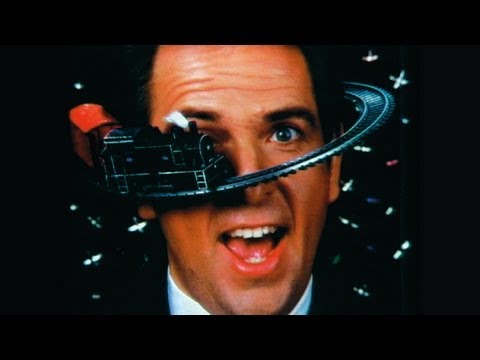
The wildly innovative video was directed by Stephen R. Johnson and featured stop-motion claymation techniques. It swept the MTV video music awards in 1987, and is considered a major breakthrough.
Johnson directed the Talking Heads video for "
Road To Nowhere" the previous year, where he used many of the techniques that would appear in "Sledgehammer." Jeff Ayeroff at Gabriel's record company showed Peter the clip and had him work with Johnson, who says he didn't even like the song. "I thought it was just another white boy trying to sound black," he said in the book
I Want My MTV.
Johnson, an American who died in 2015, enlisted a team of animators, including the British team the Quay Brothers, to work on the clip, preparing a rough cut on a video tape machine that could job through frames of video for reference.
Typical of animated videos at the time, the concepts were bigger than the budgets and the timeframe - the chickens were supposed to do a more complex dance, but they ended up doing a some simple steps instead, as the real chickens (the kind you buy in the grocery store) they used for modeling turned foul quickly. There were also some problems with electrical current running through Gabriel when he put on a lighted suit for the ending scene. This was solved by covering a suited Gabriel and the rest of the set in Scotchlite tape. The video starts with an egg being fertilized, then ends with Gabriel wandering into the cosmos, providing an interesting storyline centered on the continuum of life to go along with the eye-catching effects. Johnson also worked on Gabriel's videos for "
Big Time" and "
Steam."
According to some sources, this is the most-played video of all-time on MTV. When the network listed their 100 Greatest Music Videos in 1999, "Sledgehammer" was #4. The Top 3:
1) "
Thriller" (1983)
2) "
Vogue" (1990)
3) "
Smells Like Teen Spirit" (1991)
It is plausible that "Sledgehammer" aired more than these, as early on they had fewer videos to choose from and played the hits in a tighter rotation. "Thriller" probably didn't get as much airplay because it was a very long video with a twist ending that once revealed, didn't stand up to many repeat viewings.
During an episode of Johnnie Walker's Long Players on BBC Radio 2, Gabriel recounted how he spent 16 hours lying beneath a heavy sheet of glass for the video, while each frame was shot, one after the other.
Gabriel recalled in the same program that stop-motion animator Nick Park of Wallace & Gromit fame worked on the famous scene involving oven-ready chickens dancing to a flute solo.
This was Gabriel's first #1 single in the US. His former band, Genesis, had their first #1, "
Invisible Touch," shortly before Gabriel did, hitting the top spot on July 19, 1986, while Gabriel held the #2 spot that week. On July 26, 1986, Gabriel unseated his former bandmates to take the #1 position, and Genesis fell to #3.
The "Big Dipper" is a reference to a wooden roller coaster at Blackpool Pleasure Beach in England.
The song's video received 10 nominations at the 1987 MTV Video Music Awards, setting a record for the most nominations for a single video. The clip went on to win a record nine VMAs. Lady Gaga's video for "
Bad Romance" also received ten nominations in 2010, but only won seven.
Grammy voters were less kind to Gabriel, and gave the award for Best Concept Music Video to Genesis for "
Land Of Confusion," which featured puppets rather than the band. It remains the only Grammy award Genesis ever won.
The So album was largely recorded at Gabriel's Ashcombe House home studio near Bath, Somerset, England, with finishing touches at London's Townhouse Studios. Ashcombe's recording facility was housed in the former cow shed of a converted farmhouse.
Producer Daniel Lanois didn't think the locale was quite up to snuff, but it did the job. He told Sound On Sound in 1987: "A fantastic place but the truth of it is that there was good equipment there but not very well installed. All this has changed now that Peter has had a new studio complex built but So was done in the old place, where it was a bit 'functional,' you know. The new place is totally amazing and he's called it The Box. It's in the same district but in another valley.
Technically, there were some difficulties with So. It's a good-sounding record. When I hear it on the radio I think, 'Hmmm, now that's got something.' We captured a sound and I'm very pleased about that."
The original version of this song ran nearly double the length of the five-minute single release. Sound engineer Kevin Killen explained to Sound on Sound: "In its extended version, it sounded like a really cool track that needed to be edited down into a more manageable form so that its great ideas could be presented in a more concise fashion, possibly with a view to being a single."
Killen explained how producer Dan Lanois crafted the unique sounds on the track by creating an illusion: "During recording, Dan really liked this idea of combining instruments to create a new part," he said. "So, it wasn't unusual to have Dan playing a 12-string electric guitar, David Rhodes playing his Steinberger six-string guitar or Strat, and Peter playing the CP70, Fairlight or Prophet 5. Instead of their instruments being recorded to three discrete tracks, all of them were treated as a single sound source and recorded to a mono or stereo track to create a sound illusion/part.
"As we processed each sound source, it informed and affected how David, Dan and Peter would play and, given there was so much interplay between the part and the processing, it really did produce some unique sounds. We tried to avoid recording stock sounds, but they had to have a familiar - yet not instantly recognisable - footprint. In essence, the parts sounded much more keyboard-based or slightly guitar-based, but typically they were neither."
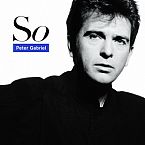
Prior to So, Gabriel's first four solo albums were all self-titled (though the fourth was called Security in the US). "I originally thought I would avoid titles and make my records like magazines," he told Spin. "When you look at home at a pile of magazines, you remember them usually by the picture on the cover; I wanted it to look like a body of work."
He gave the new album a "universal title so that people won't end up buying the same record twice."
Gabriel credits the music video for the success of the song because, he told Rolling Stone, "I think it had a sense of both humor and fun, neither of which were particularly associated with me. I mean - wrongly in my way of looking at it - I think I was seen as a fairly intense, eccentric Englishman."
An extended dance mix was also released in 1986. This remix was done by John Potoker, who had a lot of material to work with, since Gabriel recorded lots of jams for the song. Potoker also did a lot of work remixing songs for Gabriel's former Genesis bandmate Phil Collins.
This hit #1 in America on July 26, 1986. On November 14 that year, it was used in the Miami Vice episode "Better Living Through Chemistry," one of seven songs Peter Gabriel placed on the series. Miami Vice got the rights to many songs while they were still hot, adding to the contemporary feel of the show. For the artists, the placements earned them not just exposure, but also cachet, as the show was undeniably cool.
Movies to use this song include Rebound (2005), Big Momma's House 2 (2006) and Snow Angels (2007).
During the making of
So, Gabriel, Lanois, and Rhodes would show up to recording sessions wearing yellow construction hardhats as a way to lighten the mood if things got too tense. Lanois thinks the gimmick helped inspire the tune.
"We decided that we would establish a regime, like a work ethic," he said in a
Songfacts interview. "So, we had a bit of fun with the idea that we were turning up for work as if we were constructions workers. We'd wear these yellow hardhats!
We'd show up for work wearing the hardhats, and I'd always say, 'Let's hit with a sledgehammer!' We'd get through the work day, and there were a lot of references to the sledgehammer. I think that's where Peter got the title. So, we had fun and work, combined."
When Gabriel toured behind the
So album in 1986 he didn't bring a horn section so it fell on his keyboard player, David Sancious, to create those sounds, which was no easy task in a live environment. In a
Songfacts interview with Sancious, he explained:
"This was the early days of sampling, so a lot of devices that exist now didn't even exist then, but you could sample, and he sampled the notes from the original horn section - The Memphis Horns. But there were no phrases recorded. We took the actual notes from the horns in parts, and then I assigned them to part of the keyboard, so it was up to me to figure out how much of the keyboard that sound section would take up. There are about four different horn parts and different slides and punctuations and things that happened, so I had to spread that out over the length of the 88-note keyboard. And then there's also the organ sounds in it, and a shakuhachi flute sound I had to play. It's fun to set up and a minute to program it, but every time you heard that horn section, that's me physically playing on the instrument, and with the horn samples, that was the real sound."
He added: "We used Akai samplers that had floppy disks - you had to put a floppy disk in these things. And we had so many samples that it took two Akai samplers on top of each other to give me all the sounds that I would need for a particular song. So during the set, my technician would be next to my keyboard rig and he would pop in the samples for, say, "Sledgehammer," but you had to wait for it to load, and Peter would have to kill time at the microphone. He would glance back at me and I had to give him the high sign to say, 'Yeah, you can start the song now because all the samples are ready to go.'"
The opening groove inspired the rhythm of Billy Joel's "
Storm Front," from his 1989 album of the same name.