Explaining this song to Q magazine in 1992, lead singer Michael Stipe said: "The words come from everywhere. I'm extremely aware of everything around me, whether I am in a sleeping state, awake, dream-state or just in day to day life. There's a part in 'It's The End Of The World As We Know It' that came from a dream where I was at Lester Bangs' birthday party and I was the only person there whose initials weren't L.B. So there was Lenny Bruce, Leonid Brezhnev, Leonard Bernstein... So that ended up in the song along with a lot of stuff I'd seen when I was flipping TV channels. It's a collection of streams of consciousness."
This was heavily influenced by Bob Dylan, especially the way Dylan sang "
Subterranean Homesick Blues." Stipe had once imitated Dylan in a low-budget film called
Just Like a Movie, which was a play on the Dylan song "
Just Like A Woman."
Stipe claims to have a lot of dreams about the end of the world, destroyed buildings and the like. His stream-of-consciousness writing style in this is very similar to the way a dream moves.
This started off as a song called "
Bad Day," and had lyrics decrying the politics of the Reagan administration. R.E.M. finally released "Bad Day" on their 2003 hits compilation album,
In Time: The Best of R.E.M. 1988-2003.
When R.E.M. played this live, the audience reacted with a party vibe that threw off the band. They thought the apocalyptic lyrics would create a more subdued response.
Michael Stipe said that the lyrics were written to make people smile. The words he used tend to make your mouth smile when you speak them.
>>>
Suggestion credit:
Andy - Indiana, PA
In the last verse, the line, "The other night I tripped at Knox" refers to Knox College in Galesburg, Illinois, where the band had a night of fun.
This appears in the movies
Dream A Little Dream,
Independence Day,
Tommy Boy and
Chicken Little.
>>>
Suggestion credit:
Jonathan - Johnstown, PA and John - Mountain Lakes, NJ
The government of the Soviet Union allowed this to appear on a 1990 Greenpeace album that was distributed there.
Billy Joel had a huge hit two years later when he used the rapid-vocal, stream-of-consciousness lyric style on "
We Didn't Start The Fire."
This appeared in an episode of
The Simpsons when Homer and Moe are fighting about Moe's new bar. Homer opens his own bar in his garage and then lies to REM about why they are playing there.
>>>
Suggestion credit:
chet - saratoga springs, NY
Brett Anderson, lead singer of the all-girl band The Donnas, told
Rolling Stone magazine that she is an "R.E.M. geek" and can recite all of the lyrics to the song.
>>>
Suggestion credit:
Bri - Chelmsford, MA
The song's title was used as the name of a two-part episode in season 2 of
Grey's Anatomy.
>>>
Suggestion credit:
Rachel - Albany, NY
The opening lyrics, "That's great; it starts with an earthquake," could be a biblical reference, as earthquakes are sometimes seen a sign of the end times. It could also be REM's interpretation of the Book of Revelations. Here's Revelation 11:19 - "And the temple of God which is in heaven was opened; and the ark of His covenant appeared in His temple, and there were flashes of lightning and sounds and peals of thunder and an earthquake and a great hailstorm."
>>>
Suggestion credit:
Robbie - Dallas, TX
Although the official lyrics are "Don't get caught in foreign tower," many students at Boston University heard this line as, "Don't get caught in Warren Towers," which is an undesirable dorm where many freshmen at the university end up living.
The Mayans' doomsday prophesy of the end of the world for December 21, 2012, may not have happened, but this song registered a hefty surge in sales and airplay in the days before the potentially apocalyptic event. Most notably in Calgary, Canada, where according to a tweet of theirs, the alternative CFEX (X92.9) station played this tune "156 times in a row by our count."
Peter Buck tells a different story about the "jelly bean. Lester Bangs, boom" reference in the song. In the liner notes for Part Lies, Part Heart, Part Truth, Part Garbage 1982-2011, he writes that he and Stipe went to a party at a journalist's house in 1980 when they first came to New York. "The guys from Joe King Carrasco and Lester Bangs were there. And all they had was birthday cake and jelly beans, and we were starving and ate that. A random story that popped into a song eight years later. At the time, I was really proud of that song."
Stipe remembers writing the lyrics while the rest of the guys went out for dinner. "It was pretty much done by the time they got back, and Peter hated it. He capitulated finally and it made the record. Thank God we have always had each other to convince ourselves how wrong and right we can be. He got me back with '
Electrolite.'"
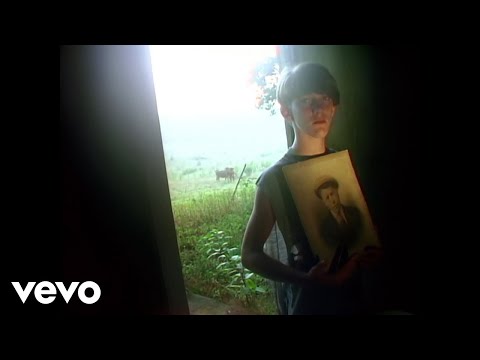
The music video, directed by James Herbert, follows a young boy (Noah Ray) scavenging in a decrepit farmhouse. While the experience would seem like a dream come true for any teenager, the fallout from appearing in the video was a nightmare for Ray. "I was a poor white trash kid in high school, and all of a sudden, I had more popularity than the popular kids," he said in an interview for a making-of-the-video documentary. "Popular kids don't like to lose their popularity, especially to white trashy kids. It just made it rough."
Filming the video wasn't too bad, though. He recalled: "The only thing in the beginning that I was really made aware of was that [director] Jim had seen some kind of TV special on dream therapy, and there was a child who had lost a brother in Vietnam who kept having a dream where he was holding his brother's picture in an old house." He continued: "He'd give me guidelines, like telling me to rifle through stuff - not like a director in a movie sense. He just wanted to get me in front of the camera, and then focus on images. Most of it was people making suggestions, like 'Oh, yeah, this would be cool.'"
The first major usage of the title phrase appears to be in the 1972 film Conquest of the Planet of the Apes, where a human says in preparation for battle with apes: "If we lose this battle, that's the end of the world as we know it."
Interest in the song skyrocketed in March 2020 amid growing global concern over the coronavirus outbreak. In the tracking week ending March 12, on-demand US streams increased from the previous week by 48% to 746,000, according to Nielsen Music/MRC Data. It was also the most-viewed Songfacts entry around this time.
On August 30, 2025, Michael Stipe jumped into one of rock's longest-running party tricks: trying to recite every word of R.E.M.'s rapid-fire "It's the End of the World As We Know It (And I Feel Fine)." He
posted a meme poking fun at the idea that nobody can decipher the whole thing, simply captioning it: "I can."
Stipe went further, using the opportunity to clear up a couple of the most misheard lines. For years, fans thought the lyric was "Left of west and coming in a hurry," but Stipe corrected it to:
Left her, wasn't coming in a hurry
With the Furies breathing down your neckHe also clarified that what listeners heard as "Look at that low plane, fine, then" was actually:
Look at that low playing, fine, thenIt was a rare peek behind the curtain from the famously private frontman, and a reminder that even decades later, R.E.M. songs can still spark lyrical debate.