Swings Both Ways

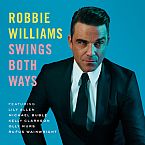
Album: Swings Both Ways (2013)
Play Video

Songfacts®:

  • This is the title track of Robbie Williams' second Swing album. The British singer previously released a similarly flavored record in 2001 with Swing When You're Winning. Williams' love of Swing is not an affectation; the former Take That singer has always listened to the Jazz genre because his father was a fan. "It's very camomile, isn't it? I suppose it was a safe place when I was growing up," he told The Daily Telegraph. "Also my dad left a load of records when he left home – all these brilliantly crafted standards. Nat King Cole was his favourite. And I've always been in love with Dean Martin. And Ella Fitzgerald, Mel Tormé, and of course, Frank."
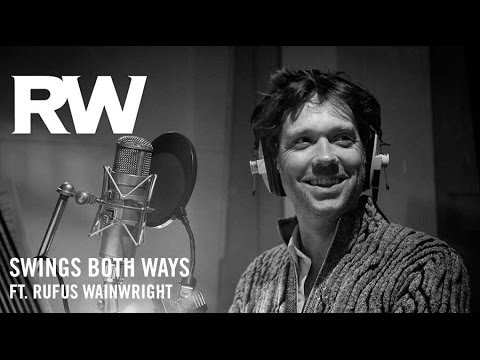
  • The song is a duet with Rufus Wainwright, who is also a fan of the swing era. The openly gay American singer recorded an entire album of songs made famous by Judy Garland. The pair met through Williams' songwriter partner Chambers, who was working on Wainwright's album at the Chateau Marmont Hotel in LA. "I had a week with Rufus on my own," Chambers told The Daily Telegraph. "I knew he had a big crush on Rob and wanted to meet him, and Rob is a fan of Rufus and has covered one of his songs. We had dinner together and we wrote 'Swings Both Ways' the following afternoon."
  • The tongue-in-cheek lyrics were influenced from the time Robbie joined Take That as a 16-year-old. He recalled to The Sun: "When I joined Take That, we toured gay clubs for 18 months. It always used to confuse me and make me laugh when a lot of the gay people I was hanging out with were insistent that everybody was gay. (Adopting a camp voice) 'Oh, well you know about her.' 'What?' 'Oh, yes... definitely. And she helps out when the team's short – do you know what I mean?'"

    "According to my manager at the time, I definitely swung both ways," Williams continued. "And I wouldn't judge anybody for judging us back then. So for me, the start of the song was a homage to being a teenager in those clubs and being told, 'oh yes, everybody's gay. Everybody swings both ways.' I'm really proud of that song."
  • So does Robbie actually swing both ways? "I have a lot of gay friends,' Chambers told The Daily Telegraph, "and a typical question is, 'Is Rob a little bit… or is he actually?' and I always say the same thing, which is, 'No, I' ve never seen any evidence of it.' But he likes playing with the ambiguity."
  • Williams and Wainwright recorded the song at Abbey Road Studios with an 80-piece orchestra.
  • Swings Both Ways was the 1,000th #1 album in the history of the UK charts. The Swing theme of the set is appropriate, since Frank Sinatra topped the first UK album chart in July 1956 with Songs For Swingin' Lovers. Williams said the fact that both the first and 1,000th chart-topper was a swing album showed the genre's long-lasting appeal. "I think in these days, with people taking their clothes off and doing drugs and being cynical in whatever way possible to get attention, and good luck to them, I think there is a market for middle-of-the-road entertainment," he said. "It harks back to a simpler time."

Comments

Be the first to comment...

Editor's Picks

Andrew Farriss of INXS

Andrew Farriss of INXSSongwriter Interviews

Andrew Farriss on writing with Michael Hutchence, the stories behind "Mystify" and other INXS hits, and his country-flavored debut solo album.

Danny Kortchmar

Danny KortchmarSongwriter Interviews

Danny played guitar on Sweet Baby James, Tapestry, and Running On Empty. He also co-wrote many hit songs, including "Dirty Laundry," "Sunset Grill" and "Tender Is The Night."

Chris Frantz - "Genius of Love"

Chris Frantz - "Genius of Love"They're Playing My Song

Chris and his wife Tina were the rhythm section for Talking Heads when they formed The Tom Tom Club. "Genius of Love" was their blockbuster, but David Byrne only mentioned it once.
Dean Pitchford

Dean PitchfordSongwriter Interviews

Dean wrote the screenplay and lyrics to all the songs in Footloose. His other hits include "Fame" and "All The Man That I Need."
Who's Johnny, And Why Does He Show Up In So Many Songs

Who's Johnny, And Why Does He Show Up In So Many SongsSong Writing

For songwriters, Johnny represents the American man. He has been angry, cool, magic, a rebel and, of course, marching home.

Scott Gorham of Thin Lizzy and Black Star Riders

Scott Gorham of Thin Lizzy and Black Star RidersSongwriter Interviews

Writing with Phil Lynott, Scott saw their ill-fated frontman move to a darker place in his life and lyrics.