According to legend, "Cross Road Blues" is about Robert Johnson selling his soul at a crossroads to become a great musician. Proponents of the legend say the story is buried between lines in the song's lyrics. Surprisingly, some evidence exists to support the claim.
Hoodoo is a brand of African American folk magic that holds crossroads to be magical, liminal (meaning "between worlds") spaces where summoning the supernatural is possible if one knows how to play the right keys. Hoodoo was practiced in the Mississippi Delta region from which Johnson came, so it's likely that he knew of this tradition. The general idea of crossroads as magical places goes back at least as far as Ancient Greece and spans multiple cultures.
Contemporary to Robert Johnson's time was Tommy Johnson (1900 - 1952), who was unrelated to Robert but was also a bluesman widely reputed to have sold his soul for music. The two men shared mutual associates in figures such as Son House and Willie Brown, so Robert almost certainly heard Tommy's story.
The "Cross Road Blues" legend goes that Johnson stepped off his Mississippi-plantation home one night, walked to a crossroads, and summoned the Devil (or something like the Devil). The figure took Johnsons' guitar, played a few songs, and handed it back. From that point on, Johnson went from being a passable musician to a great one, traveling around the Mississippi Delta, playing packed houses, and seducing women everywhere he went.
During a seven-month stretch, 27-year-old Johnson met a record-label talent scout who recorded several of his songs and significantly amplified his fame and fortune. Then, just a year after that landmark event, Johnson was dead. His death was (and still is) mysterious, with some believing he had syphilis and others (including Sonny Boy Williamson, who claimed to be there when it happened) reporting that he was poisoned by a jealous lover.
Whatever the cause, Johnson's sudden fortune followed by an even more sudden death fueled rumors of a deal with the Devil. Notable bluesman Son House vouched for the story when he told historian Pete Welding that Johnson had disappeared and returned significantly improved as a performer, and that the explanation had to be supernatural. At least part of the tale might have stemmed from the fact that Johnson spent a year studying guitar under Isiah "Ike" Zimmerman, who was reputed to have taken his own guitar lessons from supernatural beings in graveyards. Some early variations on Johnson's soul-selling story, in fact, were said to take place in a graveyard rather than a crossroads.
Things get murky as no other journalists or historians were ever able to get House's confirmation of this story. Furthermore, it's now believed that two years passed between Johnson's disappearance and reemergence as a master bluesman - plenty of time for someone to improve naturally with focused practice.
Johnson's story is supposedly buried in the lyrics in "Cross Road Blues." The problem is, if it is indeed "buried," it's buried so deep that one has to seriously stretch their imagination to find it.
Thankfully for those who like some mystery and magic in their music, historical records from the time were so scant that there is little to definitively support or refute the legend that Johnson sold his soul at a crossroads. We still aren't even sure where his true burial site is or what he died from. So, even in the internet age, it looks like the crossroads tale will always remain a titillating mystery with no conclusion.
Taken at face value, "Cross Road Blues" doesn't discuss any demonic deals at all. It's a song about feeling lonely while trying unsuccessfully to hitch a ride before the sun goes down. Some historians have read other implications into the song, such as a potential fear of being caught after dark in a "sundown town," referring to American towns that would arrest Black Americans for being out after curfew.
Other Johnson songs, such as "Hellhound On My Trail" and "
Me And The Devil Blues," make more overt arguments for black-magic workings than "Cross Road Blues," and both have helped fuel the legend.
As with many folk tales of the era, the "Devil" might have been a general categorization of a dark entity rather than a specific reference to the being of Christian lore. The African tradition that informs Hoodoo has a trickster spirit named Papa Legba, and Legba was frequently associated with crossroads.
You can run, you can run, tell my friend Willie Brown
Historians aren't certain who was being referenced here, but it was likely the bluesman Willie Lee Brown, a Delta blues trailblazer who performed with Son House. Brown and House both knew Tommy Johnson.
Many crossroads have been claimed as the place where Johnson sold his soul, including the intersection of Highways 1 and 8 in Rosedale, Mississippi. None of them have anything definitive to back their claim, especially considering that the legend has never been proven.
Johnson plays solo on this Delta blues recording. He sings and plays acoustic slide guitar without any backers.
Johnson started performing the song as early as 1932 but didn't record it until 1936. He had been traveling and performing for some time before auditioning for a talent scout named H.C. Speir. Speir got him a second audition with Ernie Oertle, who brought Johnson down to San Antonio, Texas, to record. Over the course of three days, Johnson recorded 22 songs for ARC Records.
He did two takes of "Cross Road Blues" on the third session on November 27, 1936 - a Friday. The first take was used as the single. The second take dropped the first's fifth verse:
And I went to the crossroad, mama, I looked East and West
I went to the crossroad, baby, I looked East and West
Lord, I didn't have no sweet woman, ooh well, babe, in my distress
In 1937, ARC released the first take as Johnson's third single, with "Ramblin' On My Mind" as the B-side. The recording was a local hit but failed to break out from his local Mississippi Delta area.
The single was released again in 1961 off a compilation album titled King of the Delta Blues Singers. This one got broader play.
Both takes are similar, but the tempos are slightly different. The first comes in at 106 beats per minute and the second at 96.
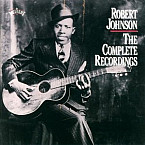
The songs disappeared from circulation for years until they were included in the 1990 box set The Complete Recordings, which sold over a million copies and won a Grammy Award for Best Historical Album in 1991.
The song sounds simple, but Johnson does some interesting, subtle things in it. He deviates from the typical 12-bar blues structure and uses uneven verses in his slide-guitar styling.
Elmore James recorded "Cross Road Blues" twice, each time under the title "Standing At The Crossroads." He also notably covered Johnson's "
Dust My Broom."
His first cover was recorded by Modern Records in August 1954 and released as a single with "Sunny Land" as the B-side. Acclaimed blues producer Maxwell Davis supervised the recording. It was a regional hit but didn't crack the national charts. James recorded it again in 1959 with Fury/Fire/Enjoy. In both versions, James used session musicians for backup.
After James died in 1965, Flashback Records released the song as a single with "The Sky Is Crying" as the B-Side.
"Cross Road Blues" is considered a blues staple. It was inducted into the Blues Foundation Hall of Fame as a "Classic of Blues Recording." In honor of its historical significance, it won a Grammy Hall of Fame Award in 1998.
The song has been covered too many times to list them all. Some notables include Cream,
whose version is probably the most widely heard of the modern era.
Lynyrd Skynyrd performed the song as their standard encore before "
Free Bird" took over that role. They have a live version on their 1976 album
One More from the Road.
Texas Alexander recorded the song with Freedom Records in 1950. It was his final single.
In 1997 Anheuser-Busch used the song in commercials for their "Cross Roads Beer" campaign. Toyota used it in 2000 for their "Crossroads of American Value" campaign.