Driving Wheel

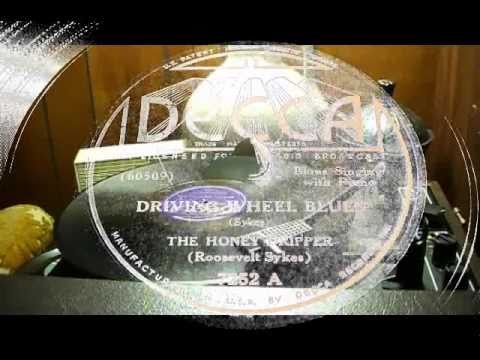
Album: The Original Honeydripper (1936)
Play Video

Songfacts®:

  • Roosevelt Sykes first recorded this song with Decca Records on February 18, 1936. It pretty quickly went on to become a blues standard and has been covered by many different artists. It was held in high regard from the start but didn't attain a chart position simply because Billboard wasn't yet monitoring sales at that time. Sykes plays piano and sings on the original.
  • The lyrics are simple, with Sykes declaring he is his woman's "driving wheel," meaning he takes care of everything. She doesn't have to "work or steal," because he takes care of business. In the modern age this seems pretty chauvinistic, but it's well intentioned in this song.

    His woman seems to have left him, though. At least, he seems to fear she has, with the lines:

    She left me this mornin', said she'd be back at soon
    She left me this mornin', but she said she would be back soon
    She'd be back early Friday morning or late Saturday afternoon


    So, his insistence that he is her "driving wheel" is his attempt to remind her of his worth and to win her back.

    I want you to c'mon baby, this is where you get your steak, potato's and tea

    This would hardly be considered a romantic notion in the modern age, and maybe it wasn't even all that romantic then. Maybe that's one of the reasons she left to begin with, whether he realizes it or not. Those were different times, though, and that sort of macho caretaking sentiment wouldn't be as off-putting as it is today. It was, at least partially, an accurate reflection of the times.
  • Junior Parker's 1961 release of the song was the first to chart, peaking at #5 on the R&B chart and #85 on the pop chart. Parker's changes to the song were carried through to most future releases, which often misleads people into thinking he was the first to record it.
  • Al Green had a hit in 1971 with the song, taking it to #46 on the R&B chart and #115 on the Bubbling Under Hot 100 Singles. B.B. King also released the song on his My Kind of Blues album in 1961.
  • In 1974, Luther Allison covered the song on his Luther's Blues album. It wasn't released as a single so it didn't chart, but Gérard Herzhaft's Encyclopedia of the Blues singles it out as one of the best versions ever recorded.

Comments: 1

  • Hanry Scrotes from MoNothing wrong with a man taking care of everything like in this song. That is what a woman wants. Only a real weak submissive soyboy thinks it is chauvanistic because he knows he has nothing to offer a woman, so he says it is "offputting", because he can not do so. Jealous, weak, no value. Trying to bring down the high level man, out of weakness and jealousy. It will not work, soyboy.
see more comments

Editor's Picks

Melanie

MelanieSongwriter Interviews

The singer-songwriter Melanie talks about her spiritual awakening at Woodstock, "Brand New Key," and why songwriting is an art, not a craft.

We Will Rock You (To Sleep): Pop Stars Who Recorded Kids' Albums

We Will Rock You (To Sleep): Pop Stars Who Recorded Kids' AlbumsSong Writing

With the rise of Kindie rock, more musicians are embracing their inner child with tunes for tots - here, we look at pop stars who recorded kids' albums.

Michael Franti

Michael FrantiSongwriter Interviews

Franti tells the story behind his hit "Say Hey (I Love You)" and explains why yoga is an integral part of his lifestyle and his Soulshine tour.

Tom Keifer of Cinderella

Tom Keifer of CinderellaSongwriter Interviews

Tom talks about the evolution of Cinderella's songs through their first three albums, and how he writes as a solo artist.

Lori McKenna

Lori McKennaSongwriter Interviews

Lori's songs have been recorded by Faith Hill and Sara Evans. She's performed on the CMAs and on Oprah. She also has five kids.

Stand By Me: The Perfect Song-Movie Combination

Stand By Me: The Perfect Song-Movie CombinationSong Writing

In 1986, a Stephen King novella was made into a movie, with a classic song serving as title, soundtrack and tone.