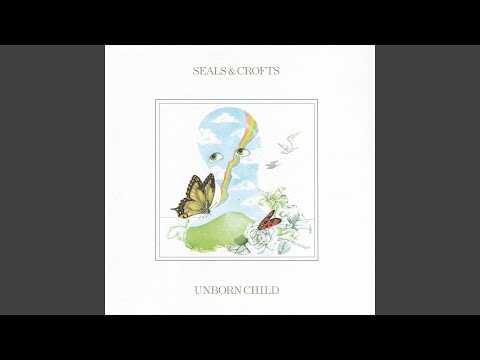
Unborn Child

Album: Unborn Child (1974)
Charted: 66
Play Video

Songfacts®:

  • On January 22, 1973, the US Supreme Court made a landmark decision in the case of Roe v. Wade that deemed a state law banning abortion was unconstitutional. The outcome was hotly debated between pro-lifers and pro-choicers, but no one expected Seals & Crofts - the soft-rock duo behind the airy hit "Summer Breeze" - to weigh in on the controversial issue. In 1974, they shared their stance in the blatantly pro-life song "Unborn Child," which was written from the perspective of an aborted fetus.

    That same year, Jim Seals spoke about their decision to record the tune, which was also the title track of their sixth studio album.

    "This is the first time that we've felt we wanted to write anything like that. We felt a lot of people were already thinking about abortion and this would start a lot more thought," he told Circus Raves. "My favorite lines are near the end:

    Think of all the great ones who gave everything
    That we might have life here, so please bear the pain
    "
  • The idea for the song came from Lana Day Bogan, the wife of their recording engineer Joseph Bogan, who attended a religious gathering with the duo where the topic of abortion was being discussed.

    Seals & Croft were followers of the Baha'i Faith, a 19th-century religion that is based on the idea of unity and equality among all people. The pair managed to work around the religion's rule against proselytizing by incorporating references to their faith in their songs and giving sermons after their concerts to curious stragglers.

    In Atlanta, they co-hosted a gathering with fellow members of the faith, where they discussed the issue of abortion, a topic that wasn't clearly defined in their spiritual guidelines at the time. After arguing the pros and cons for an hour, they couldn't come up with a solid answer, but Bogan was staunchly against the practice. Seals agreed, citing the faith's assertion that life begins at conception.

    While Seals & Crofts were working on their new album a few months later, she approached Seals with a poem she wrote after watching a documentary about abortion. She asked him to add music to her pro-life message, and the result was "Unborn Child."

    "The point is not to point any fingers," Seals explained in 1974, "but to let people know that life begins at conception. And all life is precious. Like, suppose they'd aborted an Abraham Lincoln or a John F. Kennedy - the world would have been deprived tremendously. Of course every human case is different, though, and I'd be the last person on earth to say what a person should or shouldn't do."
  • Seals claimed the song reflects the Baha'i principle of a unified humanity that's prevalent in the rest of their work, but people were too distracted by the abortion angle.

    "What we had done is we had taken a single issue. Before, we were dealing with the general concept of things," he told Goldmine Magazine in 1992. "I think everybody in the world, regardless of whether they've previously been a racist, or an atheist or whatever, can accept, without getting too upset, the fact that mankind is one family. We're all here on one dot and we need each other. It's obvious. But when you pull it down and start taking the different really hot issues, if a person is not looking at the overview that you are, then they're not gonna connect the parts together. They just see one thing."
  • Warner Bros. warned Seals & Crofts that the anti-abortion track was too controversial for radio, but they went ahead and released it anyway. As predicted, it caused a huge backlash and several radio stations pulled it from the air, causing the single to stall at #66. Although abortion-rights advocates boycotted the album (and Seals & Crofts' concerts), it still managed to earn a Gold certification in the US.

    "It was a double-edged sword," Crofts told Goldmine Magazine of the uproar. "It hurt us in one way, and helped us in another. It turns over fans, is what it does. If you're against something, you lose those fans. But if you're for it, you gain some fans. And that's kind of what happened."
  • Seals & Crofts went on to notch a few more hits in the '70s, most notably the Top 10 entry "Get Closer," but they pulled the plug on their partnership in 1980. "Unborn Child" marked the beginning of their downward spiral - mostly because their hearts were no longer in it.

    "I thought either it would be very much accepted, on the strength of the song itself, or that it would be the biggest bomb that we ever had," Seals admitted. "But it was incidental by that point, because the music was gone. I was out of gas already."
  • In 1974, this won the "Keep Her In Her Place" award, a prize given by the National Organization for Women as a jab at male chauvinism. It tied with Paul Anka's chart-topping hit "(You're) Having My Baby."
  • Seals explained why they chose to name the album after the song. "We found after listening to all the tunes that it represented a good concept for the album better than any," he told Circus Raves. "But the reason we originally liked it, was its musical appeal more than the idea."
  • The S.O.S. Band covered this on their 1981 album, Too.

Comments

Be the first to comment...

Editor's Picks

Art Alexakis of Everclear

Art Alexakis of EverclearSongwriter Interviews

The lead singer of Everclear, Art is also their primary songwriter.

La La Brooks of The Crystals

La La Brooks of The CrystalsSong Writing

The lead singer on "Da Doo Ron Ron" and "Then He Kissed Me," La La explains how and why Phil Spector replaced The Crystals with Darlene Love on "He's A Rebel."

Trans Soul Rebels: Songs About Transgenderism

Trans Soul Rebels: Songs About TransgenderismSong Writing

A history of songs dealing with transgender issues, featuring Pink Floyd, David Bowie, Morrissey and Green Day.

Lajon Witherspoon of Sevendust

Lajon Witherspoon of SevendustSongwriter Interviews

The Sevendust frontman talks about the group's songwriting process, and how trips to the Murder Bar helped forge their latest album.

Jon Anderson of Yes

Jon Anderson of YesSongwriter Interviews

From the lake in "Roundabout" to Sister Bluebird in "Starship Trooper," Jon Anderson talks about how nature and spirituality play into his lyrics for Yes.

Angelo Moore of Fishbone

Angelo Moore of FishboneSongwriter Interviews

Fishbone has always enjoyed much more acclaim than popularity - Angelo might know why.