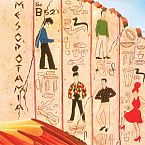
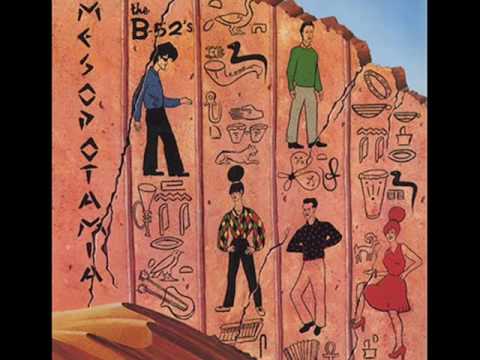
Mesopotamia

Album: Mesopotamia (1981)
Play Video

Songfacts®:

  • On this song, The B-52s go back to ancient times, meeting up in Mesopotamia. Probably best not to use it as a history lesson, as Fred Schneider admits in the song, "I ain't no student of ancient culture." He does know that there are a lot of ruins in Mesopotamia.

    If Schneider was a student of ancient culture, he would tell you that Mesopotamia is the name for the historical region of the Tigris and Euphrates Rivers, in modern times situated between Iraq, Kuwait, Syria, and Turkey. It is true, as the lyric states, that "six or eight thousand years ago they laid down the law," referring to the Cradle of Civilization and one of the most important starting points of the modern world. This was the time period when small Neolithic settlements started becoming larger and more complicated, with writing systems starting to appear.

    The song further mentions the "third pyramid," which may refer to three Pyramids of Giza, the third of which is the Pyramid of Menkaure. This isn't located in Mesopotamia, but in Cairo, Egypt. The time periods are also different, as the Pyramid of Menkaure is thought to have been built at around 2510 BC, about 4,500 years before the song "Mesopotamia."

    There's rarely a reason to suspect too much at play in any inconsistencies in B-52s songs, though. They are, by their own account, a party and dance band that's happy with that identity.
  • Fred Schneider and Kate Pierson handle the lead vocals on this one. Their bandmate, Cindy Wilson, explained in a 2019 Songfacts interview how it came together. "'Mesopotamia' was a cool song," she said. "It came from a poem Fred had. We were all jamming on it, so Kate and I got out licks like, 'Throw that beat in the garbage can!' That's one of my favorites now - I wasn't so crazy about it at the time, but now it's really one of my favorites."

    Cindy's brother, Ricky Wilson, was the guitarist in the band and added an inventive touch to this song. Said Cindy: "Ricky's guitar, oh my God, it's so modern. It still sounds so modern to me. But Kate and I got to jam on that one and put our touch on it."
  • Talking Heads leader David Byrne produced the 6-track Mesopotamia EP. It seemed like a strange pairing, the exacting Byrne and the let-it-hang-loose B-52s, but Byrne has an irreverent side (on display in the Stop Making Sense concert film), and was able to coax a new strain of party music out of the group.

    Hiring Byrne meant firing their longtime producer, Chris Blackwell, who happened to be their label boss at Island Records as well. The first three B-52s albums were recorded at Blackwell's Compass Point Studios in the Bahamas.

Comments: 2

  • Glenn Franxman from IndianaI’ve always heard it as third pyramid, but Ur Pyramid makes more sense and sounds so close.
  • Gareth Flâneur from Isle Of ManIs it not the "Ur Pyramid" or "Ziggurat of Ur" which is in Mesopotamia? Anyway, I just re-listened to the song and it sounds more like "Good Pyramid" or "Very Pyramid" than "Third Pyramid".
see more comments

Editor's Picks

Gary Lewis

Gary LewisSongwriter Interviews

Gary Lewis and the Playboys had seven Top 10 hits despite competition from The Beatles. Gary talks about the hits, his famous father, and getting drafted.

Jack Tempchin - "Peaceful Easy Feeling"

Jack Tempchin - "Peaceful Easy Feeling"They're Playing My Song

When a waitress wouldn't take him home, Jack wrote what would become one of the Eagles most enduring hits.

Keith Reid of Procol Harum

Keith Reid of Procol HarumSongwriter Interviews

As Procol Harum's lyricist, Keith wrote the words to "A Whiter Shade Of Pale." We delve into that song and find out how you can form a band when you don't sing or play an instrument.

Richie Wise (Kiss producer, Dust)

Richie Wise (Kiss producer, Dust)Songwriter Interviews

Richie talks about producing the first two Kiss albums, recording "Brother Louie," and the newfound appreciation of his rock band, Dust.

Donald Fagen

Donald FagenSongwriter Interviews

Fagen talks about how the Steely Dan songwriting strategy has changed over the years, and explains why you don't hear many covers of their songs.

Don Dokken

Don DokkenSongwriter Interviews

Dokken frontman Don Dokken explains what broke up the band at the height of their success in the late '80s, and talks about the botched surgery that paralyzed his right arm.