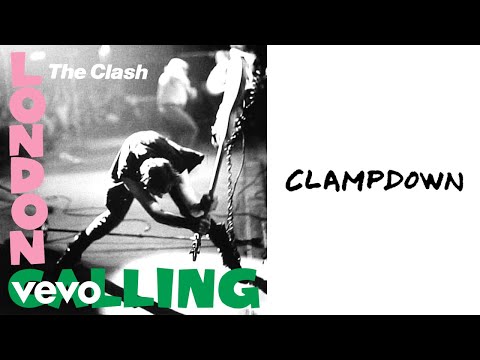
Clampdown

Album: London Calling (1979)
Play Video

Songfacts®:

  • Singer Joe Strummer's mumbled vocals in the intro are famously hard to decipher. If you're struggling, the full transcript of these opening lyrics is as follows:

    The kingdom is ransacked
    The jewels all taken back
    And the chopper descends
    They're hidden in the back
    With a message on a half-baked tape
    With the spool going round
    Saying I'm back here in this place
    And I could cry/and there's smoke you could click on...


    It leads into the rousing chant of "What're we gonna do now?" a phrase lifted from Spike Milligan's TV comedy show Q5.
  • The lyrics as a whole continue the themes previously explored in The Clash first-album track "Career Opportunities" of striving to do more in life than be stuck in a dead-end job and conforming to your superiors, insisting, "Let fury hath the hour, anger can be power."

    The lyrics, "So you got someone to boss around, it makes you feel big now," could have been suggested by bassist Paul Simonon after his experience working in a John Lewis warehouse. "There was a lot of shop floor fascism - I got the s--t end of the stick," he told Melody Maker in 1988.
  • The opening line, "Taking off his turban, they say is this man a Jew?" is commonly misunderstood, with some claiming it was anti-Semitic. In fact, singer Joe Strummer, who co-wrote the song along with guitarist Mick Jones, was making a point about nationalistic stereotypes and illogical suspicion of foreign peoples in the rise of the far-right parties such as the National Front - this being written 30 years before the rise of the English Defence League.
  • Cover versions of this song include Rage Against the Machine at various live shows, Indigo Girls on their 2005 Rarities album, The Strokes in 2004 concerts, Hot Water Music on the City Rockers tribute album, Sinisters on the Backlash tribute album, and Poster Children on their 2004 On the Offensive album. The Indigo Girls' cover also appears on the Clash tribute album, 1999's Burning London: The Clash Tribute.
  • "Clampdown" went through several name changes in its inception, with an early demo version under the title "Working And Awaiting" appearing on the Vanilla Tapes bonus CD on the 25th Anniversary Edition of London Calling. It was apparently also briefly known as "For F--ks Sake," before the lyrics were added and the title of "Clampdown" - a shortening of "Working For The Clampdown" - was settled on.
  • Joe Strummer claimed that the "nuclear meltdown at Three Mile Island got me started" on this song. The incident in question was a massive atomic accident at the Three Mile Island nuclear power plant in Harrisburg, Pennsylvania, one that is referenced by name in the lyrics ("Yeah I'm working hard in Harrisburg... waiting to be melted down...").
  • The Clash played this live for the first time in Minneapolis in September 1979, and the song remained an integral part of their set until their breakup in 1985, being a firm favorite both for the band to play and for the fans. An acclaimed live recording of the song from the Lewisham Odeon in February 1980 appears on the greatest hits compilation The Essential Clash, and the live footage of this performance was used as a music video for the song and later appears in the 2002 documentary film Westway to the World.

Comments: 4

  • AnonymousIt's about war
  • Wes From Regular Chino, Ca But Not from Chino HillsAmazing analysis but i think it’s a bit of a stretch. If these guys spoke out specifically about the record company they were under screwing them, then maybe it’s in the realms of possible but these guys were more socially political in there lyrics. About others suffering and them relating with a message. Consider ‘straight to hell’ or ‘Spanish bombs’ for example. This song was inspired apparently from a nuclear meltdown at a plant in PA. Imo It’s definitely a repressive state kinda song with a message to say rise above
  • Jeff from Berkeley"You start working for the blue and brown" is NOT about a record company. Sometimes, songs about the repressive state are ... songs about the repressive state.
  • Steve from Chino Hills, CaIt sounds like a song about anarchy. Yet I've been surprised to learn that strongly worded songs (Everything counts-Depeche Mode, Death on two legs-Queen) are often about the record company or management. Equating having a recording contract and selling out your art in the name of profits for a large corporation to being suppressed by a Nazi regime probably doesn't go over well. I think what this song is saying is that having a recording contract is enticing from the outside but once your beholding to the label you'll regret it. The factory (record company) is full of old, cunning men and evil presidents who have paid their dues to Satan by working in the industry. The "kick over the wall "line" I believe is aimed at industry censorship by the state run radio of the BBC. No airplay means no exposure.
see more comments

Editor's Picks

Does Jimmy Page Worship The Devil? A Look at Satanism in Rock

Does Jimmy Page Worship The Devil? A Look at Satanism in RockSong Writing

We ring the Hell's Bells to see what songs and rockers are sincere in their Satanism, and how much of it is an act.

Bryan Adams

Bryan AdamsSongwriter Interviews

What's the deal with "Summer of '69"? Bryan explains what the song is really about, and shares more of his songwriting insights.

Rush: Album by Album - A Conversation With Martin Popoff

Rush: Album by Album - A Conversation With Martin PopoffSong Writing

A talk with Martin Popoff about his latest book on Rush and how he assessed the thousands of albums he reviewed.

Spooner Oldham

Spooner OldhamSongwriter Interviews

His keyboard work helped define the Muscle Shoals sound and make him an integral part of many Neil Young recordings. Spooner is also an accomplished songwriter, whose hits include "I'm Your Puppet" and "Cry Like A Baby."

Gary Brooker of Procol Harum

Gary Brooker of Procol HarumSongwriter Interviews

The lead singer and pianist for Procol Harum, Gary talks about finding the musical ideas to match the words.

Who's Johnny, And Why Does He Show Up In So Many Songs

Who's Johnny, And Why Does He Show Up In So Many SongsSong Writing

For songwriters, Johnny represents the American man. He has been angry, cool, magic, a rebel and, of course, marching home.