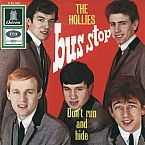


Bus Stop

Album: Bus Stop (1966)
Charted: 5 5
Play Video

Songfacts®:

  • This was written by Graham Gouldman, who went on to form the band 10cc, best known for their hit "I'm Not In Love." Gouldman was just 19 when he wrote "Bus Stop," but he had already written three Yardbirds songs: "For Your Love," "Heart Full of Soul" and "Evil Hearted You."
  • This song is about a couple who meet one rainy day at a bus stop. Love blooms when they share an umbrella.

    In a Manchester newspaper, Graham Gouldman said he wrote it whilst riding on the No. 95 bus, which ran from East Didsbury - the route went through Manchester city centre, to Sedgeley Park, Cheetham Hill, Prestwich, and on to Whitefield near Bury. Gouldman was living with his family on this route in Broughton Park Salford at the time. >>
    Suggestion credit:
    Ian Williams - Manchester UK, England
  • Graham Gouldman's father was a talented and creative writer who often helped his son with song ideas. Graham had the idea for bus stop setting, and his dad came up with the first line: "Bus stop, wet day, she's there, I say, 'please share my umbrella.'" From that starting point, he was able to finish the song.

    In a Songfacts interview with Gouldman, he explained: "He gave me those words and I immediately, as I was reading them, heard the melody in my head, and it just kind of wrote itself. And then the middle part of the song I wrote - I got the melody and the words all in one chunk."
  • The timeline in this song is a little askew. We know that love bloomed over the summer, but then we get the line, "Came the sun, the ice was melting." This harkens spring, so apparently time has passed. In Gouldman's Songfacts interview, he clarified: "Winter is over, the snow is passed because the sun has melted it, so there's no need to shelter anymore under the umbrella. You could say the snow is underfoot so you don't need an umbrella anyway, but it's poetic license: it could have been snowing so the umbrella can protect you from the snow as well as the rain."
  • Graham Nash of The Hollies recalls learning about this song when their manager, Michael Cohen, told them about "this little Jewish kid who lives down the street," which was Graham Gouldman. When Gouldman played it for them, they knew they had a winner. Nash says they recorded it in just an hour and 15 minutes.
  • According to Gouldman, this song's middle eight was one of the few instances in his songwriting career when he had a sudden inspiration rather than having to resort to hard toil. He explained to Mojo magazine in a 2011 interview: "You have to be working to make something happen. Occasionally you can wait for some magic, like McCartney waking up with Yesterday already written in his mind, which does happen - it's like a gift from your own subconscious. Or sometimes, it's like a tap's turned on. When I'd written most of 'Bus Stop,' I was actually on a bus thinking about how the middle eight should go. And this whole, 'Every morning I would see her waiting at the stop / Sometimes she'd shop...' that all came to me in one gush, and I couldn't wait to get home to try it. When that sort of thing happens, it's really amazing. But that's rare. Mostly, you have to do the slog."
  • Herman's Hermits also recorded this song in 1966. They got first crack at many of Gouldman's songs because their manager was married to his sister.

    In the Songfacts interview with Peter Noone, the Herman's Hermits frontman explained: "'Bus Stop' went to the Hollies before us, because Graham didn't think it was the kind of song that we would like. Then when we heard it, it was like, Are you kidding me? We want that. Luckily John Paul Jones heard it when we were trying to figure it out and he said 'Nah, I've got it,' and he re-invented the song. That's John Paul Jones who turned that into a hit record, nobody else. It is not a hit song. If you listen to the Hollies demo version of it, it's just not good. He reorganized the song and made it what it is: serious art work."
  • There is a short instrumental passage midway through the song, but the vocals, sung by Allan Clarke, carry the day. The only real verse section is in the middle - the rest is chorus and bridge, which at the end of the song is flipped - "Every morning I would see her waiting at the stop" comes in before the "bus stop, wet day" part, providing a bookend.

    With so little verse, there are very few details - we have no idea what the bus or people look like - but that works to the song's advantage because the listener can fill in the gaps. It's a technique Gouldman picked up listening to The Beatles. "Sometimes it's what's left out that makes it work," he says.

Comments: 26

  • Sam A Burkes Lll from Philadelphia, Miss.Hi, I'm an erstwhile prof. musician, have played this gem of a Hollies/Graham Gouldman song in a couple of cover bands..It's imoeccable! Cannot believe they recorded it in that short span of time. The vocals, both lead, Allan Clarke, and the harmonies, by stalwarts Graham Nash and Tony Hicks are the epitome of excellent "part crossings", opening up at times..The mystery to me, good ear I used to have figuring material out aurally, is how they played that rounddelay/call-and-answer acoustical lead part!! I STILL can't figure it out after 56 years!! Sounds partly Indian, partly Greek, Slovakian, that I'll of motif!! A quintessential gem of a mid-sixties British hit by a great bunch of Manchester gents!!#
  • Ian Spencer from SolihullAs a bass player, the main bass riff and song structure is almost identical to Things We Said Today, so there is a verse, then a chorus that returns to the verse pattern and then a bridge. Although the chords of the chorus and bridge are a different progression, add in identical tempo and emphasis changes, the feel of Bus Stop is closer to Things We Said than an even a Ed Sheeran original composition ;)
  • Ed from Philadelphia, Pa UsThere is a resemblance to Things We Said Today but it's not a total steal. That would be like accusing John Lennon of stealing the first few bars of Merry Month Of May and turning it into I'm Happy Just To Dance With You.
  • Poppi from The New England Point of obvious fact, Mike Douglas was a moron.
  • Spoiler from HeeThe Beatles recorded this song before it was written. It was called "Things We Said Today."
  • Lisa from North CarolinaThere is a device in the song called a contraction of time, where months pass in the description, but it sounds like only a few days or weeks have gone by. From my perspective (and therefore, not worth much :) ), the song starts on a rainy, late spring day, and goes through to early spring the next year. It’s not the whole story told, just enough to make it sweet and romantic.
  • Torq2 from UkThis song doesn't make a lot of sense. It implies that it is winter, "came the sun the ice was melting" but then it clearly states by August, so it is summer. Even in England it doesn't rain all summer. He then says that she shows him what she bought. In the morning? Shops weren't open that early in England in the sixties. But who cares, its a great song.
  • Barry from Sauquoit, NyOn September 10th 1966, the Hollies performed "Bus Stop" on the ABC-TV program 'American Bandstand'...
    At the time the song was at #9 on Billboard's Hot Top 100 chart; the very next day on Sept. 11th it would peak at #5 {for 3 weeks}...
    On the same 'Bandstand' show they also performed "I Can't Let Go"; earlier in the year on May 1st, 1966 it peaked at #42...
    {See next post below}.
  • Barry from Sauquoit, NyOn July 17th 1966, "Bus Stop" by the Hollies entered Billboard's Hot Top 100 chart at position #98; and on September 11th, 1966 it peaked at #5 (for 3 weeks) and spent 14 weeks on the Top 100...
    And on September 5th, 1966 it reached #1 (for 1 week) on the Canadian RPM 100 Single chart...
    Between 1964 and 1983 the group had twenty-four Top 100 records; six made the Top 10 with "Long Cool Woman (In A Black Dress)" being their biggest hit, it peaked at #2 (for 2 weeks) in 1972...
    The two weeks that "Long Cool Woman" was at #2, the #1 record for both those weeks was "Alone Again (Naturally)" by Gilbert O'Sullivan.
  • Esskayess from Dallas, TxSome people think even the squeaky-cleanest songs have drug references in them. :-(
  • Brendan from Dublin, IrelandBears more than a passing resemblance to 'Things We Said Today'.... Great song but obviously a total steal
  • Steve from Great Wakering, United KingdomGreat song, wonderful harmonies. A song about falling in love with someone at a bus stop, which is a great idea because in England you can wait ages for a bus, then three will turn up at once! Definitely no drug references- in England it's advisable to carry an umbrella at times even in the summer as you just never know when it's going to rain here! I never tire of hearing this song.
  • Ted from Phoenix, AzTo Fyodor in Denver: While "Bus Stop's" instrumentation may have been recorded in one take, the lead vocals certainly were not. If you listen closely to the verses you can hear the lead voice is being double-tracked.
  • Trina from New York, NyThis song is totally not a drug song. It's a love song. I happen to love it, it's one of my fave oldies :)
  • John from San Diego, CaRegarding the "drug reference," I saw a guest on the Mike Douglas show not long after this was a hit, warning parents about the dangers of drug references in song lyrics. He said "umbrella" was a synonym for a popular barbiturate, what we called "downers" in those days. No idea whether there is any truth in it. He also mentioned Donovan's "Mellow Yellow" and the alleged lesbian reference.
  • Ed from Houston, Txclassic song writing genius , move over Beethoven.
    E
  • Kurt from Dallas, TxI have always heard it was banned because "we shared my umbrella" was a drug reference.
  • Rodney from Toronto, Canada"Bus Stop" has always been one of my favorite records by the Hollies and one of my favorite songs, period.

    The same goes for Herman's Hermits' "No Milk Today" by the same songwriter.
  • Fyodor from Denver, CoI heard they recorded this live (as in no overdubs) and it was just part of their set which they just ran through in its entirety in the studio. The fact that it wasn't written by a bandmember (nor a cover, right?) makes me wonder about that, though.
  • Stefanie from Rock Hill, ScBanned by the BBC? You have to be kidding me! This is a great song!
  • Tom from Washington, DcSongwriter,Graham Gouldman,also wrote and recorded a minor hit ,"Sausalito" ,attributed to bubblegum group Ohio Express in 1969.
  • Teresa from Mechelen, Belgium"Every morning I can see her waiting at the stop"
    this is my favorite song of the Hollies. It must me great waiting at the bus stop and falling in love.
  • Jerry from Brooklyn, NyI have heard this this sweet, simple, tender song was once banned by the BBC. I can't for the life of me see why. Anybody know about this?
  • Victor from San Diego, CaGraham Gouldman also wrote "For Your Love" (The Yardbirds), "No Milk Today", "Listen People" and "East, West" (Herman's Hermits) and others.
  • Nessie from Sapporo, JapanThey had uneven songs. This one is awesome.
  • Mike from Mountlake Terrace, WashingtonProbably one of the very first rock songs I could not hear enough of.
    This and "Stop, Stop, Stop" also by the Hollies!
see more comments

Editor's Picks

Stephen Christian of Anberlin

Stephen Christian of AnberlinSongwriter Interviews

The lead singer/lyricist for Anberlin breaks down "Impossible" and covers some tracks from their 2012 album Vital.

Emilio Castillo from Tower of Power

Emilio Castillo from Tower of PowerSongwriter Interviews

Emilio talks about what it's like to write and perform with the Tower of Power horns, and why every struggling band should have a friend like Huey Lewis.

Art Alexakis of Everclear

Art Alexakis of EverclearSongwriter Interviews

The lead singer of Everclear, Art is also their primary songwriter.

Graham Bonnet (Alcatrazz, Rainbow)

Graham Bonnet (Alcatrazz, Rainbow)Songwriter Interviews

Yngwie Malmsteen and Steve Vai were two of Graham's co-writers for some '80s rock classics.

They Might Be Giants

They Might Be GiantsSongwriter Interviews

Who writes a song about a name they found in a phone book? That's just one of the everyday things these guys find to sing about. Anything in their field of vision or general scope of knowledge is fair game. If you cross paths with them, so are you.

Who's Johnny, And Why Does He Show Up In So Many Songs

Who's Johnny, And Why Does He Show Up In So Many SongsSong Writing

For songwriters, Johnny represents the American man. He has been angry, cool, magic, a rebel and, of course, marching home.