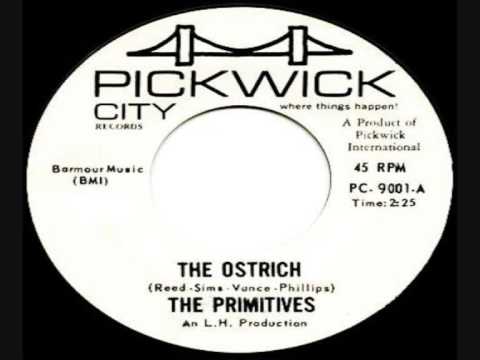

The Ostrich

Album: single release only (1964)
Play Video

Songfacts®:

  • This ostrich is not a ratite bird that buries its head in the sand, but a dance, though it remains to be seen if anyone ever performed it.

    The lead vocalist may sound familiar: it's Lou Reed.

    This song is historically - if not musically - significant as it got what would become The Velvet Underground together. Lou Reed at the time he was working as an in-house musician for Pickwick Records, recording copies of hit songs to be sold in drug stores and supermarkets. To promote this song, Reed got together with John Cale, and the two began working together. They added Reed's Syracuse University classmate Sterling Morrison to the fold the next year, and became The Velvet Underground.
  • Running to 2 minutes 25 seconds, the song is credited to The Primitives - a studio-only outfit and not to be confused with the later UK group of the same name. Reed wrote the song with three other songwriters who were working at Pickwick: Jimmy Sims, Jerry Vance and Terry Phillips.
  • The record's producer, Lee Haridan, was an imaginary person. The B-side, "Sneaky Pete," was credited to the same team. This record was also the first Reed recorded using his ostrich tuning, that sees the six strings of the guitar all tuned to the same note, which is generally acknowledged to give a droning effect, although one that can clearly be pleasing. >>>
    Suggestion credit:
    Alexander Baron - London, England, for above 2
  • Along with Lou Reed and John Cale, the other two members of The Primitives were Tony Conrad and Walter de Maria. Cale told the story to Gadfly in 1999: "Tony Conrad, Walter de Maria and I were picked up one night at a party because we had long hair, and they told us, 'You look commercial. We think you'd make a great band, why don't you come out and visit us.' Okay, so we go out to Pickwick Records on Long Island City, go into the back room of this plant that manufactures LPs of second-rate orchestras playing concertos. The back room had one Ampex two-track tape recorder. There were three guys milling around. One of these guys was Lou, who looked suitably funky, and two other guys, they were into trying anything. They played me this thing that they recorded on their two-track. All three of them had bottles of vodka and downed them in one night, and each had a guitar tuned to one note. Exactly the kind of spirit in which most things were done. That's the same spirit in which you get things like Beck's 'I'm a Loser, Baby, Why Don't You Kill Me' suddenly popping out of the chute. Spirit of rock and roll. You don't know why it works, but it does. It's not marketing from record executives, knowing which area to pinpoint this record, it's really exorbitant ideas that are a little bit out of control."
  • Want to do The Ostrich? Here's how Lou Reed described how: "You put your head on the floor and have somebody step on it."

    He added: "It was years ahead of its time."
  • This song, along with others from Reed's days as a pop songwriter, later appeared on various bootlegs and compilations. Other tracks from this era include "Cycle Annie" (credited to The Beachnuts) and "You're Drivin' Me Insane" by the Roughnecks.
  • Reed got the idea for the lyrics from a clothing trend: ostrich feathers.
  • The Seattle band Pickwick, inspired by this song, took their name from Pickwick Records, which released the single.

Comments

Be the first to comment...

Editor's Picks

Gary Lewis

Gary LewisSongwriter Interviews

Gary Lewis and the Playboys had seven Top 10 hits despite competition from The Beatles. Gary talks about the hits, his famous father, and getting drafted.

Jack Tempchin - "Peaceful Easy Feeling"

Jack Tempchin - "Peaceful Easy Feeling"They're Playing My Song

When a waitress wouldn't take him home, Jack wrote what would become one of the Eagles most enduring hits.

Keith Reid of Procol Harum

Keith Reid of Procol HarumSongwriter Interviews

As Procol Harum's lyricist, Keith wrote the words to "A Whiter Shade Of Pale." We delve into that song and find out how you can form a band when you don't sing or play an instrument.

Richie Wise (Kiss producer, Dust)

Richie Wise (Kiss producer, Dust)Songwriter Interviews

Richie talks about producing the first two Kiss albums, recording "Brother Louie," and the newfound appreciation of his rock band, Dust.

Donald Fagen

Donald FagenSongwriter Interviews

Fagen talks about how the Steely Dan songwriting strategy has changed over the years, and explains why you don't hear many covers of their songs.

Don Dokken

Don DokkenSongwriter Interviews

Dokken frontman Don Dokken explains what broke up the band at the height of their success in the late '80s, and talks about the botched surgery that paralyzed his right arm.