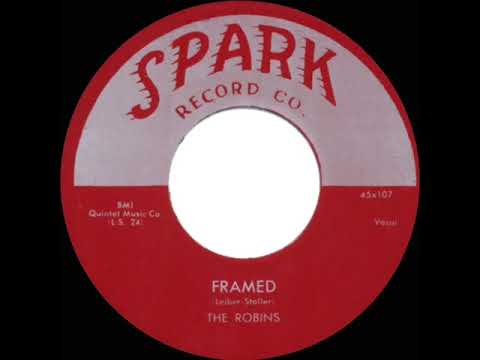
Framed

Album: The Best of The Robins (1954)
Play Video

Songfacts®:

  • "Framed" was written by the legendary songwriting team of Jerry Leiber and Mike Stoller as a spoken-sung crime tale, utilizing the conversational, proto-rap style they helped pioneer long before the term was associated with hip-hop. The song follows an innocent man who is arrested, convicted, and swallowed up by a justice system that has already decided his guilt. While it plays as a comedy on the surface, the humor masks a much sharper bite.

    In the book, Hound Dog: The Leiber and Stoller Autobiography, Leiber explains: "We called it 'Framed' and gave it a subtext that, despite the humor, refers to the legal brutality that impacted the black community."

    Like many of the duo's best tracks, it sneaks serious social commentary into a package that feels like pure entertainment.
  • Much like Leiber and Stoller's earlier track for The Robins, "Riot In Cell Block #9," "Framed" is a narrative-driven song that trades traditional romance for colorful characters, bad luck, and cinematic plot twists. Leiber and Stoller also produced the original recording, cutting the track in Los Angeles in August 1954. It was released that October on their own Spark Records label as the B-side to "Loop De Loop Mambo."
  • While it wasn't a hit, "Framed" became one of those songs musicians couldn't resist borrowing, reshaping and passing along. Ritchie Valens released it as the B-side of "Come On, Let's Go" in 1958. Lowell George and the Factory reworked some of the lyrics in 1969, while Jerry Reed recorded it under the guidance of Chet Atkins. Burton Cummings also tackled the tune, and comedy duo Cheech & Chong predictably steered it further toward laughs.
  • Perhaps the most unforgettable interpretation came from the Sensational Alex Harvey Band, who made "Framed" the title track of their 1972 debut album. Harvey amplified the song's themes of persecution into full-blown theater. During a show in Berlin in October 1976, he deliberately adopted Nazi imagery as part of the character, slicking his hair to one side, fashioning a moustache from gaffer tape and painting a swastika on the back of his leather jacket before declaring, "I didn't do nothing, I was framed!"

    The stunt horrified some of those around him. "We said, 'Alex, please don't do it,'" bassist Chris Glen told Uncut magazine.

    Producer and sound engineer Dave Batchelor admitted the performance was nerve-racking, particularly in Berlin, where the symbolism carried obvious weight. "I was in the audience and I really didn't know how it would land," he said. "But Alex, being Alex, got the message across of what he was really talking about. It could have gone wrong on a big scale and in exactly the wrong place, but he absolutely knew what he was doing. He always pushed the boundaries. He wouldn't ever play safe. At the end of the song, Harvey growled, 'In case you get the wrong idea, Hitler was a bastard."

Comments

Be the first to comment...

Editor's Picks

Five Rockers Who Rolled With The Devil

Five Rockers Who Rolled With The DevilSong Writing

Just how much did these monsters of rock dabble in the occult?

Dave Edmunds

Dave EdmundsSongwriter Interviews

A renowned guitarist and rock revivalist, Dave took "I Hear You Knocking" to the top of the UK charts and was the first to record Elvis Costello's "Girls Talk."

History Of Rock

History Of RockSong Writing

An interview with Dr. John Covach, music professor at the University of Rochester whose free online courses have become wildly popular.
David Bowie Lyrics Quiz

David Bowie Lyrics QuizMusic Quiz

How well do you know your David Bowie lyrics? Take this quiz to find out.
Ed Roland of Collective Soul

Ed Roland of Collective SoulSongwriter Interviews

The stories behind "Shine," "December," "The World I Know" and other Collective Soul hits.
Adam Duritz of Counting Crows

Adam Duritz of Counting CrowsSongwriter Interviews

"Mr. Jones" took on new meaning when the song about a misguided view of fame made Adam famous.