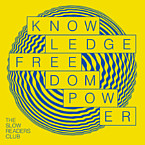
Knowledge Freedom Power

Album: Knowledge Freedom Power (2023)
Play Video

Songfacts®:

  • The Slow Readers Club is an English post-punk band hailing from the heart of Manchester. They were born from the ashes of the earlier band Omerta, which rocked the scene in the mid-2000s.

    When Omerta called it quits, vocalist Aaron Starkie and bassist James Ryan weren't about to let their music die. They kept the flame burning, jamming together and eventually birthing The Slow Readers Club in 2009.

    "Knowledge Freedom Power" is the title track from their sixth album. Aaron Starkie leads the charge on vocals, his brother Kurtis Starkie shreds on guitar and contributes backing vocals, James Ryan brings the thunder on bass, and David Whitworth pounds the skins on drums.
  • Knowledge. Freedom. Power
    All this is yours
    Knowledge. Freedom. Power
    Tear down the walls


    The song cuts through the noise with a straight-to-the-gut hook. It drives home the crucial message that there's an alternative to an increasingly authoritarian world that disregards the needs of the many, favoring only the privileged few. Aaron Starkie, a proud product of a Manchester's council estate, knows firsthand such limitations and challenge.

    "Growing up as a council estate kid in Manchester, I was keenly aware of the limited horizons," he explained. "I had a chip on my shoulder and a burning desire to make my mark."

    "It's that background that inspired both our band name and the album's title track 'Knowledge Freedom Power,'" Starkie continued. "It is an exercise in positive sloganeering, a mantra for education as a means of a way out from social and psychological confinement."
  • Starkey told The Sun about this motivational track. "'Knowledge Freedom Power' is about recognizing there's a lot of opportunity out there," he said. "We live in a country where education and libraries are free and reading, learning, can be a passport to a better life."
  • "Knowledge Freedom Power" underwent several transformations before settling into its final form. Starkie told Analogue Trash that it started with a drum and guitar loop, but as the song progressed, it veered away from its original concept and leaned towards a more prominent synth-driven sound. The synth part initially mirrored the vocal melody of the verse, drawing inspiration from Blossoms' "Charlemagne," but the band decided to take a different path.

    During the creative process, there was a period where only the synth introduction, verse, and chorus were established, and the band found themselves caught in a cycle of experimentation. Everything fell into place when they introduced the middle section with the line, "won't you say a little prayer." Suddenly, the song clicked, and its structure and purpose became crystal clear.
  • In the early days of 2022, The Slow Readers Club stepped into the studio with producer Joe Cross (Hurts, Courteeners), ready to face the shadows head-on. "The world had got so bleak it felt a little indulgent to paint apocalyptic pictures when they were out in the real world," said Aaron Starkie. "I thought people would probably want to hear more uplifting things, it was my intention to be a bit more positive. There's still a lot of melodrama in there and it's still dystopian in places but there's more positive shades in this record."
  • Knowledge Freedom Power peaked at #29 on the UK albums chart, the band's fourth consecutive UK Top 40 album.

Comments

Be the first to comment...

Editor's Picks

Sarah Brightman

Sarah BrightmanSongwriter Interviews

One of the most popular classical vocalists in the land is lining up a trip to space, which is the inspiration for many of her songs.

Al Kooper

Al KooperSongwriter Interviews

Kooper produced Lynyrd Skynyrd, played with Dylan and the Stones, and formed BS&T.

Reverend Horton Heat

Reverend Horton HeatSongwriter Interviews

The Reverend rants on psychobilly and the egghead academics he bashes in one of his more popular songs.

90210 to Buffy to Glee: How Songs Transformed TV

90210 to Buffy to Glee: How Songs Transformed TVSong Writing

Shows like Dawson's Creek, Grey's Anatomy and Buffy the Vampire Slayer changed the way songs were heard on TV, and produced some hits in the process.

Van Dyke Parks

Van Dyke ParksSongwriter Interviews

U2, Carly Simon, Joanna Newsom, Brian Wilson and Fiona Apple have all gone to Van Dyke Parks to make their songs exceptional.

Richard Marx

Richard MarxSongwriter Interviews

Richard explains how Joe Walsh kickstarted his career, and why he chose Hazard, Nebraska for a hit.