The Spencer Davis Group

The Spencer Davis Group Artistfacts

  • 1963–1969, 1973–1974
    Spencer DavisRhythm guitar, backing and lead vocals, bass1963–1969, 1973–1974
    Steve WinwoodLead vocals, lead guitar, keyboards1963-1967
    Muff WinwoodBass1963-1967
    Pete YorkDrums1963-1968
    Eddie Hardin lead vocals, keyboards1967–1969, 1973–1974
    Phil SawyerLead guitar1967
    Ray FenwickLead guitar, vocals1967-1969
    Dee MurrayBass1968-1969
    Nigel OlssonDrums1968-1969
  • The Spencer Davis Group were a Birmingham beat combo whose fusion of gritty American R&B and blue-eyed soul made them one of the defining sounds of the British Invasion, even though their lead singer was barely old enough to leave school. Fronted in the studio and onstage by the astonishing voice of Steve Winwood, the band turned out a run of tough, horn-punched hits that showed how convincing a young British crew could sound channeling Ray Charles without descending into novelty.
  • One night in early 1963, Spencer Davis, a Swansea-born folk and blues guitarist who had settled in Birmingham, wandered into a pub to catch a set by the Muff Woody Jazz Band. "I walked into this pub room, and I was totally blown away," Davis told Mojo magazine in 1997. "Steve did a version of One Mint Julep on a melodica, like Ray Charles. I didn't even hear him sing, but I immediately went up and asked him if he wanted to play with me."

    And so The Rhythm and Blues Quartette (later renamed The Spencer Davis Group) were born.
  • Island Records founder Chris Blackwell was tipped off about the group by a mutual contact. He described to NPR's Fresh Air climbing the stairs to see them play before he'd even laid eyes on the band. "I was hearing this voice, which was incredible, sounding like Ray Charles on helium," Blackwell said. "And when I finally got there, it was this very young lad, I would think 16 or 17. And it was Steve Winwood."
  • Winwood was in his mid-teens when Blackwell discovered him - reports place his age anywhere from 14 to 16 - and Blackwell offered to manage and produce the group on the spot. Surprisingly, the band turned him down at first.

    "It wasn't that we didn't like him," his brother, bassist Muff Winwood, told Mojo. "But we were doing so well playing five or six nights a week in the Midlands area. We were making seriously good money, in cash. Why change it? Of course we eventually decided that was crazy."
  • Blackwell's one condition for signing them was that they ditch their clunky "Rhythm and Blues Quartette" handle for something with more commercial punch. The name "Spencer Davis Group" came down to practical laziness: Spencer was the only member who actually enjoyed answering press questions. "So I pointed out that if we called it the Spencer Davis Group, the rest of us could stay in bed and let him do them," Muff explained.
  • After Blackwell secured the group a record deal with Fontana in the UK, their massive breakthrough hits, "Keep On Running" and "Somebody Help Me" (both UK #1s), were written by Jamaican singer-songwriter Jackie Edwards, an Island Records labelmate whom Blackwell brought in specifically to supply Winwood with ready-made hit material.

    By late 1966, Winwood was writing his own classics for the band, co-penning the explosive UK/US Top 10 smash "Gimme Some Lovin'" and the driving R&B track "I'm A Man."
  • Winwood's rapid growth as a singer, songwriter, and multi-instrumentalist eventually outgrew the group. He left in the spring of 1967 at just 18 years old to form Traffic with Jim Capaldi, Chris Wood, and Dave Mason, launching the new group with their breakthrough single "Paper Sun." Muff Winwood left the same year to become an A&R executive at Island, a move he later viewed as inevitable: "It was awkward for all of us, in a way, because he shone above us all."
  • Spencer Davis kept the band name going without Winwood, soldiering on until 1969 and reviving the group periodically over the following decades. He released a solo album, So Far, in 2006, and continued touring into his late 70s, often appearing alongside fellow 1960s veterans on package tours billed as the Rock and Roll Army.
  • Davis died on October 19, 2020, in a Los Angeles hospital while being treated for pneumonia; he was 81. Paying tribute to his former bandleader, Steve Winwood remarked: "I'd already got a big brother who influenced me greatly, and Spencer became like a big brother to me at the time. He was definitely a man with a vision, and one of the pioneers of the British invasion of America in the '60s."

Comments

Be the first to comment...

Editor's Picks

Five Rockers Who Rolled With The Devil

Five Rockers Who Rolled With The DevilSong Writing

Just how much did these monsters of rock dabble in the occult?
Dave Edmunds

Dave EdmundsSongwriter Interviews

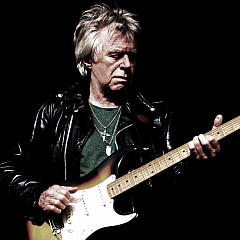
A renowned guitarist and rock revivalist, Dave took "I Hear You Knocking" to the top of the UK charts and was the first to record Elvis Costello's "Girls Talk."
History Of Rock

History Of RockSong Writing

An interview with Dr. John Covach, music professor at the University of Rochester whose free online courses have become wildly popular.
David Bowie Lyrics Quiz

David Bowie Lyrics QuizMusic Quiz

How well do you know your David Bowie lyrics? Take this quiz to find out.
Ed Roland of Collective Soul

Ed Roland of Collective SoulSongwriter Interviews

The stories behind "Shine," "December," "The World I Know" and other Collective Soul hits.
Adam Duritz of Counting Crows

Adam Duritz of Counting CrowsSongwriter Interviews

"Mr. Jones" took on new meaning when the song about a misguided view of fame made Adam famous.