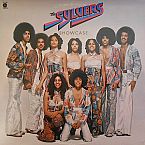
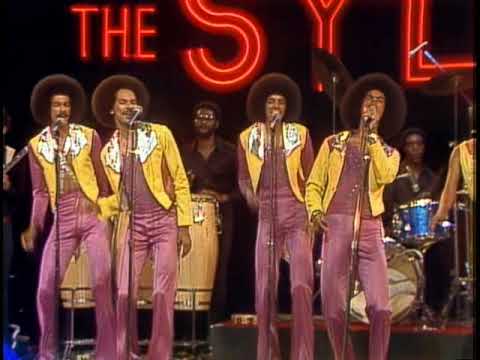
A family group with nine members (all with the last name "Sylver"), The Sylvers later charted with the songs "Hot Line" (#3) and "High School Dance" (#17). They also appeared in the 1979 film
The Fish That Saved Pittsburgh. For a better look at the disco goodness they were pushing out in 1976, check out the
Showcase album cover.
You could play an interesting game called "Which song title containing the word 'boogie' from the '70s could make us all blush now?" There's Kool & the Gang's "
Jungle Boogie," or perhaps "
Boogie Shoes" by KC & The Sunshine Band, and let's not forget Taste of Honey's "
Boogie Oogie Oogie." So "Boogie Fever" doesn't sound too bad by comparison, after all... right?
The Sylvers were well-suited to their time; but their time just happened to be an alternate dimension when we look back on it now. For all of that, they really put their all into the show - note the brass section and disco-style piano work on this piece. Hey, listen to it again, it's catchy. What else did club dancers demand? Come to that, what more do they demand now?
Interesting history in the lyrics: The first verse describes a scene at the drive-in movie. Drive-ins were a very big deal back then, but the speaker they're describing were these big, clunky metal things on a wire hung on a pole beside each space. You'd drive up, roll down (not button down) your window and hook the speaker over your window on both sides - instant stereo-car! Also great fun when people drove off without remembering to put the speaker back, resulting in a lot of uprooted speaker poles being dragged to the exit.
There is only one cure for Boogie Fever: a transfusion of disco music. In this song, the singer's girl is afflicted, so everywhere they go, that funky disco sound has to play. Even at the drive-in, they can't listen to the movie, which is actually a pretty trippy way to watch King Kong.
This was written by Freddie Perren with his partner Kenneth St. Lewis, and Perren produced the track. Perren is known for producing Gloria Gaynor's "
I Will Survive" and Peaches and Herb's "
Shake Your Groove Thing."
As disco took off in the '70s, so did the word "boogie." It used to refer to the boogie-woogie rhythm in blues music, but the songwriters behind the groovy dance hits of the era popularized it as slang for dancing. When lyricist St. Lewis showed up to one of the group's rehearsals, he suggested they come up with a song built around the buzzworthy word, which led to "Boogie Fever." With so many disco revelers being afflicted by the title disease, it's no wonder the single became a hit.
Perren noted in The Billboard Book Of Number One Hits: "You didn't need a PhD in music to understand what it was all about. People like to party, it had a recognizable and relatable lyric, the track was really pumping and it was released at the beginning of the disco thing."
St. Lewis knew he had to make the title stand out in a sea of other boogie tunes, so he brainstormed how to make the word effective. He landed on a couple stinkers before pairing boogie with fever. "At first I had 'Epidemic' but that didn't sing too well," he said. "As I thought about it, it came out 'Boogie Fever.'"
In order to decide which of the nine siblings would sing the lead vocal, Perren went around the room testing voices until he landed on 18-year-old Edmund Sylvers.
"Edmund was perfect at the time because he was beginning to mature, yet he still had a youthful flavor to his voice," Perren explained in The Billboard Book Of Number One Rhythm & Blues Hits. "It appealed to kids and to young adults as well."
This was Perren's first project since leaving Motown Records, where he spent six years writing hits for the Jackson 5 and The Miracles. While he was mulling over his decision to resign from the label, an old college buddy suggested he try working with The Sylvers. Considering his buddy was Larkin Arnold, the vice president of Capitol Records, Perren took him up on the offer.
This was changed to "Cargo Fever" for a 2003 Old Navy commercial advertising cargo pants. The ad starred future Criminal Minds actor Shemar Moore as the host of Cargo Train - a riff on Soul Train, which Moore hosted at the time.
It was also used in commercials for the Little Caesars pizza chain and Intel Pentium II.
This was used on the TV series Chuck in the 2011 episode "Chuck Versus The Bearded Bandit." It plays in a commercial Big Mike filmed for the Buy More back in the '70s.
It was also featured in these movies:
Despicable Me (2010)
Roll Bounce (2005)
Krippendorf's Tribe (1998)
The Stand (1994)
The Spirit Of '76 (1990)