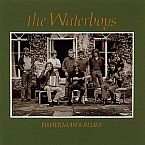
Fisherman's Blues

Album: Fisherman's Blues (1988)
Charted: 32
Play Video

Songfacts®:

  • This is the title track of The Waterboys fourth and best-selling album. It was recorded during the first day of sessions for the record at Windmill Lane Studio in Dublin in January 1986, one of a dozen songs that were laid down that day. It was the first time that the band had recorded at Windmill Lane and The Waterboys' founder and leader Mike Scott told us in a 2012 interview that he'll "never forget it." He said: "I had all my writing on pieces of paper. I was fixing the papers, and the song needed a third verse. I had had the first two verses for about six or eight weeks, so I wrote the third verse in the studio. The music got written that day in the studio as well. I had the chords, but the tone of the song came from Steve Wickham's fiddle accompaniment."

    Scott added that back then he worked in this semi-improvising fashion a great deal. "I was very lucky that I had a band that was sufficiently intuitive that we could make stuff up on the spot," he said, "and it would work. I've never had a band quite as intuitive as that since then: the combination of Steve Wickham on fiddle, Anthony Thistlethwaite on mandolin and sax, and the bass player, Trevor Hutchinson, who was an incredible improviser. When I had those guys, I could make up a song on the spot, and they would be arranging it as they played it for the first time. Some of the songs on that album are actually first takes."
  • Regarding the song's lyrical content, Scott told us: "The words might have been from a personal situation where I was under a lot of pressure with the breakup over a relationship."

    The lyrics were also partly inspired by W.H. Auden's poem The Night Mail, which he remembered from reading at school. He recalled to us: "It was about how the mail train would roll through the night and the poem itself replicated the feeling, the rhythm, the speed of the train. So when you read the poem either out loud or in your mind, it conjured the movement of the train. Certainly when I wrote the second verse of 'Fisherman's Blues,' I was trying to get that effect."

    Wystan Hugh Auden (1907-1973) was an American poet of English origin. Starting off as one of the committed poets of the 1930s, espousing left wing politics, by the late 1940s he had moved to a more conventional Christian viewpoint. The Night Mail was written for the closing few minutes of a documentary film about a London, Midland and Scottish Railway (LMS) mail train from London to Scotland, which was produced by the GPO Film Unit. Here are a couple more songs on our database inspired by Auden:

    "Soho (Needless To Say)" by Al Stewart
    "Vapor Trail" by Rush.
  • Fisherman's Blues marked a new direction in the Waterboys' sound as it saw them switching from their earlier grandiose 'big music' material to a more scaled down Celtic folk sound. It was whilst listening back their first days session on a cassette a couple of days later, that Scott realized that "wherever it had come from," this song "was kind of different for the Waterboys. It was a new sound," he recalled. "Our whole sound had changed at that point. We had gone from an electric guitar and having keyboards in the band and a big sound all of a sudden to this lean string sound, with mandolin and acoustic guitar."

    The Waterboys performed the song on UK music show The Tube a few months later, the first time the band demonstrated to the public their new musical direction.
  • Recording for Fisherman's Blues took another two years, but the album was finally released in October 1988 in both Europe and the States. It went on to become the Waterboys' best selling album, despite reaching only #13 in the UK charts and #76 on the Billboard 200. Sales in the States were helped by the band's Fisherman's Blues Tour during the fall of 1989. Scott told us it "was our third North American tour and it was really successful. We did 22 shows that were all sold out."

    The Waterboys frontman added that he booked different opening acts for each venue. "Before the days of email, I would be forming outlines from my hotel room of a few cities and their bands, trying to sort out somebody sympathetic to come and play with us," Scott recalled. "So in some cities we had folk or traditional acts. In the Northwest we had an American Indian group called Arrows to Freedom - I think that was in Vancouver and Seattle. I wanted to do something different, something interesting everywhere."
  • This is the most covered song amongst all of Mike Scott's compositions. He told us: "There are more than 50 recorded cover versions of it. It's been covered in French, Norwegian and Spanish. There are also jam band, country rock, torch song and hip-hop versions. My favorites are the ones where people make the song their own. My very favorite is a Japanese punk version that came out in the late '90s by a band called Pealout. It's really great, really crunching electric guitar and punky lead singer. I love it. There's also a great version by a Canadian band called Great Aunt Ida, which came out I think in 2005, a beautiful slow version, kind of like if Neil Young covered it."
  • The song has also been used several times during movies and TV shows. Amongst Scott's favorites is when it soundtracked a scene on the 1988 comedy film Waking Ned Divine. He told us: "I loved the way they used it, the old boat going across the sea like that. That's beautiful."

Comments

Be the first to comment...

Editor's Picks

Muhammad Ali: His Musical Legacy and the Songs he Inspired

Muhammad Ali: His Musical Legacy and the Songs he InspiredSong Writing

Before he was the champ, Ali released an album called I Am The Greatest!, but his musical influence is best heard in the songs he inspired.

Michael Sweet of Stryper

Michael Sweet of StryperSongwriter Interviews

Find out how God and glam metal go together from the Stryper frontman.

Devo

DevoSongwriter Interviews

Devo founders Mark Mothersbaugh and Jerry Casale take us into their world of subversive performance art. They may be right about the De-Evoloution thing.

Dennis DeYoung

Dennis DeYoungSongwriter Interviews

Dennis DeYoung explains why "Mr. Roboto" is the defining Styx song, and what the "gathering of angels" represents in "Come Sail Away."

Tom Bailey of Thompson Twins

Tom Bailey of Thompson TwinsSongwriter Interviews

Tom stopped performing Thompson Twins songs in 1987, in part because of their personal nature: "Hold Me Now" came after an argument with his bandmate/girlfriend Alannah Currie.

Evolution Of The Prince Symbol

Evolution Of The Prince SymbolSong Writing

The evolution of the symbol that was Prince's name from 1993-2000.