Listen To The Mocking Bird

Album: Sound Traditions (1855)
Play Video

Songfacts®:

  • This mournful American folk ballad is similar in content to "The Ash Grove," herein a mocking bird is singing over the dead sweetheart's grave. The song was equally popular as an instrumental, and was said to have been a personal favourite of President Abraham Lincoln.

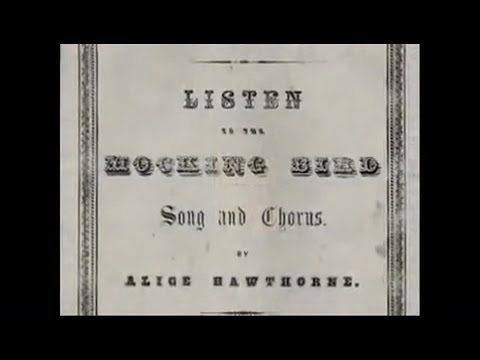
    When it was first published in 1855 by Winner & Shuster, it was described as an Ethiopian Ballad after Richard Milburn, a Negro alluded to by musicologist Eileen Southern as "a street whistler-guitarist." The song was said to have been written (i.e. lyrics by) and arranged by Alice Hawthorne.

    According to Southern in The Music Of Black Americans, Milburn received only 20 copies of the song as payment - which does seem extraordinarily mean in view of its subsequent popularity, but the publisher could hardly have anticipated this.

    Alice Hawthorne was actually the pseudonym of songwriter Septimus Winner who owned a music store, and gave Milburn a job on the strength of his whistling talent. (Hawthorne was Winner's mother's maiden name).

    "Listen To The Mocking Bird" became a massive hit throughout the USA and Europe, so much so that it has been estimated that by 1905, three years after Winner's death, it had sold twenty million copies, fifteen million in the States alone.

    After Winner sold the song, Richard Milburn's name was omitted from the credits, but if he was shortchanged, so was Winner. The song was not immediately popular, and he is said to have received only five dollars for the rights! >>>
    Suggestion credit:
    Alexander Baron - London, England

Comments: 3

  • ImslpThe song is treated on IMSLP as a collaboration between Richard Milburn and Septimus Winner. Winner was also a composer, violinist and (unusually for the time) a publisher. Milburn (who was known as 'Whistling Dick') seems to have been a guitarist along with being a whistler skilled at imitating different bird songs. They sold their song to rival Philadelphia publisher Lee and Walker in 1856. Five dollars in 1856 was a gold coin containing nearly an 1/4 troy-ounce of gold, so it was not quite the paltry sum that many writers seem to believe it is. Composers normally sold pieces to publishers for a flat sum in that era or even printed copies of the piece (John Philip Sousa sold some works to publishers for printed copies in the 1880s, for example). The price on the 1855 prints was 25 cents per copy - again not as cheap as we think today. Anyone can see and download the first edition at IMSLP.
  • A.j. from Medina, Ny"Listen to the Mockingbird" was one of the many theme songs of The Three Stooges.
  • Polly from Pittsburgh, PaPeople danced to this tune on the White House lawn after news of Lee's surrender came to DC.
see more comments

Editor's Picks

Bob Daisley

Bob DaisleySongwriter Interviews

Bob was the bass player and lyricist for the first two Ozzy Osbourne albums. Here's how he wrote songs like "Crazy Train" and "Mr. Crowley" with Ozzy and Randy Rhoads.

David Bowie Leads the Society for Prevention of Cruelty to Long-Haired Men

David Bowie Leads the Society for Prevention of Cruelty to Long-Haired MenSong Writing

Bowie's "activist" days of 1964 led to Ziggy Stardust.

Al Jourgensen of Ministry

Al Jourgensen of MinistrySongwriter Interviews

In the name of song explanation, Al talks about scoring heroin for William Burroughs, and that's not even the most shocking story in this one.

Linda Perry

Linda PerrySongwriter Interviews

Songwriting Hall of Famer Linda Perry talks about her songs "What's Up" and "Beautiful," her songwriting process, and her move into film music.

Danny Clinch: The Art of Rock Photography

Danny Clinch: The Art of Rock PhotographySong Writing

One of rock's top photographers talks about artistry in photography, raising funds for a documentary, and enjoying a County Fair with Tom Waits.

Boy Bands

Boy BandsFact or Fiction

From NKOTB to 1D, how well do you know your boy bands?