Fujiyama Mama

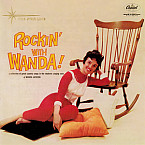
Album: Rockin' With Wanda (1958)
Play Video

Songfacts®:

  • "Fujiyama Mama" was written by Jack Hammer, the pen name for Earl Solomon Burroughs, in 1954. Burroughs also co-wrote the rock and roll hit "Great Balls of Fire."

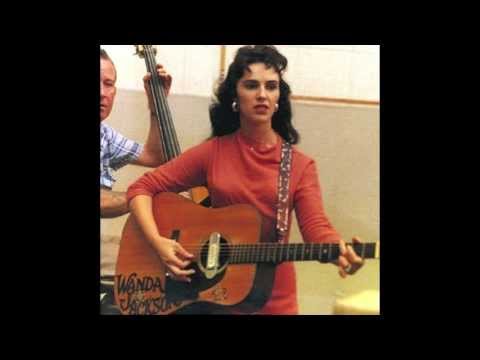
    "Fujiyama Mama" is sung from the perspective of a feisty Japanese woman. The lyrics use Mount Fuji, a powerful volcano, and atomic bombs, symbolizing immense energy, to describe her strong personality. The first recording was by rhythm and blues singer Annisteen Allen in 1955, but the version most people know is likely the one by American rockabilly singer Wanda Jackson, which became a surprise hit in Japan in 1958.
  • Jackson heard Allen's recording and loved the song's energy. When she pitched it to her producer, Ken Nelson, he was hesitant about the lyrics. Jackson, known for her fiery personality, had to convince him to let her record it.
  • The recording session itself was a turning point in Jackson's career. Struggling to find the right tempo and key, she grew frustrated. Her ever-supportive father, sensing her anxiety, stepped in during a break. Jackson recalled to Holly George-Warren: "He came into the studio and pulled me aside. Daddy never had to say much. He was a man of few words and spoke pretty quietly. But he said, 'Wanda, you rear back and sing that song however you want to sing it.'"

    Emboldened, Jackson let loose, and the iconic growl synonymous with her rockabilly sound emerged for the first time.
  • The raw energy and suggestive lyrics of "Fujiyama Mama" proved to be too much for American audiences, and it failed to chart. Jackson explained during a concert in 2009: "Nobody would play it. They barely had accepted Elvis and the other ones, and they weren't too sure about accepting a teenage girl singing this kind of music."

    Across the Pacific, however, a different story unfolded. Released in 1958, "Fujiyama Mama" skyrocketed to #1 in Japan, holding the top spot for a staggering six months. It was the nation's first rock and roll hit, a genre far removed from traditional Japanese music. Jackson herself became a sensation, touring the country in 1959 to packed theaters, clubs, and even military bases.

    The reasons for this unexpected success remain open to interpretation. Some suggest the song resonated with a desire for female empowerment in post-war Japan, while others point to the sheer energy of rock and roll as a novelty.
  • Decades after Jackson ignited Japan with her version of "Fujiyama Mama," a new champion emerged. Haruomi Hosono, the co-founder of the legendary Japanese electronic band Yellow Magic Orchestra, covered the song on his 1978 solo album, Paraiso.
  • In 1980, American rockabilly artist Pearl Harbour covered "Fujiyama Mama" on her debut solo album, Don't Follow Me, I'm Lost Too. The song became a live favorite, and after marrying The Clash bassist Paul Simonon, she even performed it with the band. Harbour recalled in an interview with Songfacts in 2024: "When I first heard Wanda Jackson's version of 'Fujiyama Mama' at a record store in the late 1970s, I flipped out and thought, 'This is exactly what I want to sound like!' It sounded tough, and I thought the lyrics were tongue-in-cheek. I was very surprised that it had been a hit with Japanese audiences in 1958.

    I must say the crowds went crazy when The Clash brought me out to perform the song with them on their one and only tour there in 1982. Like myself, The Clash was drawn to 'Fujiyama Mama' because it was fast and aggressive."
  • The White Stripes frontman, Jack White, a huge fan of Jackson, has performed "Fujiyama Mama" live with her on several occasions. White also produced Jackson's 30th album, The Party Ain't Over, in 2011 and released it on his independent label, Third Man Records.

    Speaking about his love for Jackson, White told The Sunday Times in 2011: "Songs such as 'Let's Have a Party' and 'Fujiyama Mama' were quite abrasive at the time. Wanda was singing about shootin' the lights out and knockin' the building down. And Elvis had convinced her to do that – she was a sort of nicer country singer before that. She got in there and started growling and belting it out. I think a lot of female artists today have her to thank for breaking the door down."

Comments

Be the first to comment...

Editor's Picks

Donnie Iris (Ah! Leah!, The Rapper)

Donnie Iris (Ah! Leah!, The Rapper)Songwriter Interviews

Before "Rap" was a form of music, it was something guys did to pick up girls in nightclubs. Donnie talks about "The Rapper" and reveals the identity of Leah.

Timothy B. Schmit

Timothy B. SchmitSongwriter Interviews

The longtime Eagle talks about soaring back to his solo career, and what he learned about songwriting in the group.

Boz Scaggs

Boz ScaggsSongwriter Interviews

The "Lowdown" and "Lido Shuffle" singer makes a habit of playing with the best in the business.

Best Band Logos

Best Band LogosSong Writing

Queen, Phish and The Stones are among our picks for the best band logos. Here are their histories and a design analysis from an expert.

Philip Cody

Philip CodySongwriter Interviews

A talented lyricist, Philip helped revive Neil Sedaka's career with the words to "Laughter In The Rain" and "Bad Blood."

Billy Steinberg - "Like A Virgin"

Billy Steinberg - "Like A Virgin"They're Playing My Song

The first of Billy's five #1 hits was the song that propelled Madonna to stardom. You'd think that would get you a backstage pass, wouldn't you?